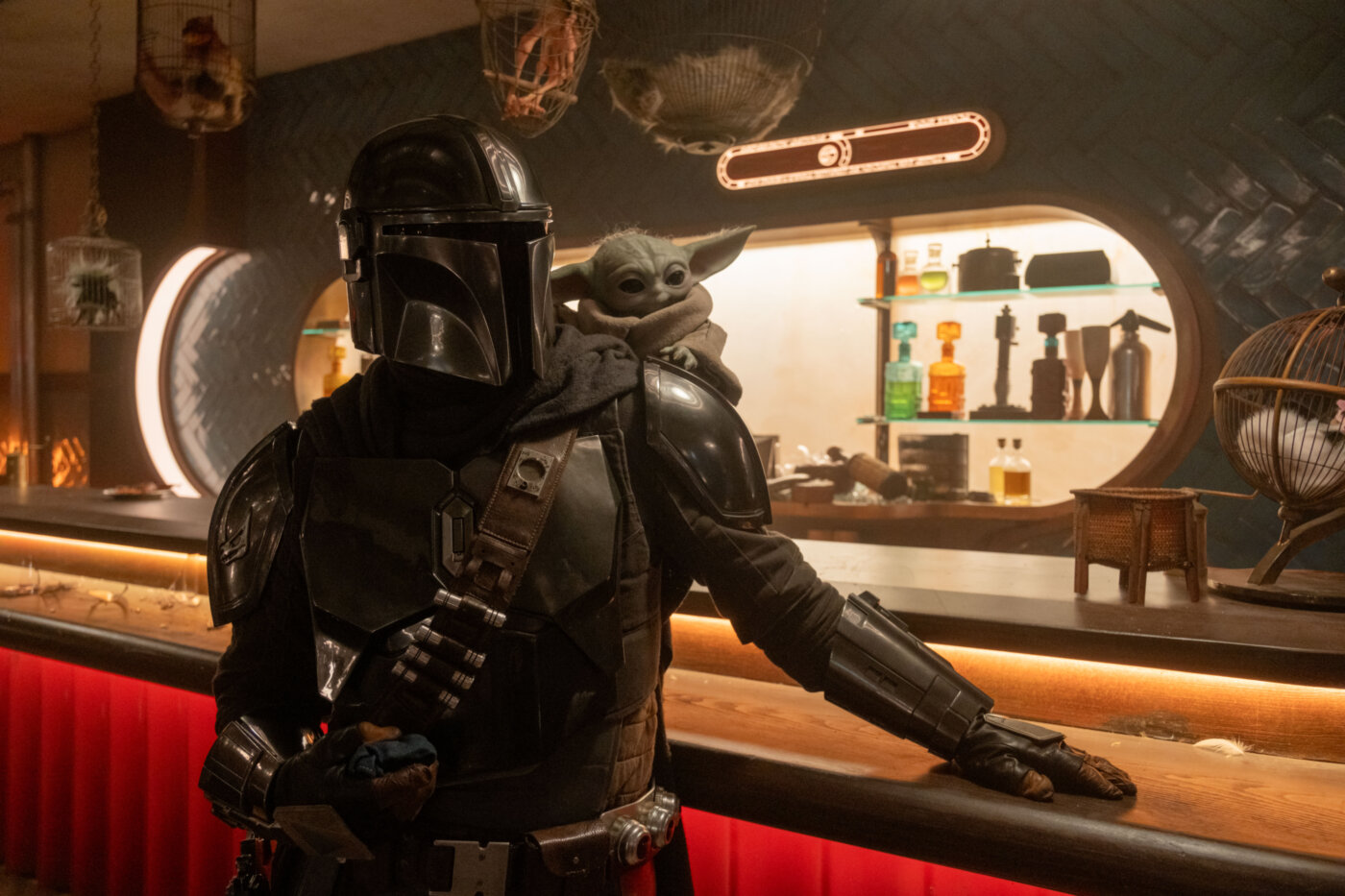

A grizzled bounty hunter and his adorable companion team up to save a grotesque space slug in The Mandalorian and Grogu, a feature-length spinoff of the Disney+ Star Wars series opening in Prague and cinemas worldwide this weekend. This one-off adventure riffs on Lone Wolf and Cub in the same way that George Lucas took inspiration from Kurosawa, and occasionally soars as it attempts to shed five decades of franchise baggage… but it can’t fully escape the cold grasp of corporate IP.
The Mandalorian and Grogu opens on a Hoth-like ice planet as the titular characters crash a meeting where an Imperial Warlord (Hemky Madera) is shaking down his subjects for extra protection money. They blast up the place while taking down stormtroopers, AT-STs, and AT-ATs in a breezy chase across a precarious mountain ridge that is particularly ill-suited for transport by bulky, slow-moving vehicles.
Oh no. The excessive nostalgia bait on display during this 10-minute opening sequence is a downer, but even more of a downer is what has become of our once-compelling hero. In the Disney+ series, Mando (Pedro Pascal, under a metal helmet for nearly all of the movie) was most interesting as a morally ambiguous bounty hunter who ultimately decides to do the right thing when it comes to caring for the strange space baby that has fallen into his lap. Here, he’s a full-fledged rebel fighting for the resistance, more Luke Skywalker than Boba Fett.
The Mandalorian, at least in its first season, worked best as a small-scale space western that ignored the larger Star Wars universe and focused on its core characters. But as The Mandalorian and Grogu opens, Mando is now rebel merc taking orders from Colonel Ward (Sigourney Weaver) and going on missions alongside Zeb Orrelios (Steve Blum) to take down Imperial targets. Only problem: there’s no Vader or Palpatine in this film to really sell the idea of an evil empire threat, and Mando, stripped of any tangible character arc, is a lot less interesting as a mere instrument of the resistance.
But The Mandalorian and Grogu gets a little more interesting as our characters tackle their second mission: rescue Rotta the Hutt (voiced by Jeremy Allen White), the kidnapped son of Jabba the Hutt, from a space gangster (Jonny Coyne) who runs underground gladiator-style battles. Mando and co. need to save Rotta so that his aunt and uncle will provide the resistance information on their next Imperial target, a mysterious commander that doesn’t even have a photograph.
It’s not the go-here, go-there plotting that picks the film up after the opening sequence, but the escape from franchise restraints. As our heroes investigate a neon cityscape set in permanent midnight, get intel from an alien food truck entrepreneur voiced by Martin Scorsese, and Ludwig Göransson’s synth score kicks in, The Mandalorian and Grogu morphs into something that feels less like Star Wars and more like Blade Runner, with action beats that riff on Gladiator (a delightful monster-filled battle) and, of all things, The French Connection (a chase under elevated train tracks).
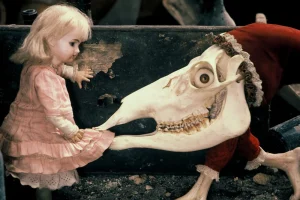
Writers Jon Favreau, Dave Filoni, and Noah Kloor find their footing in the second half of The Mandalorian and Grogu, avoiding the kind of memberberry exhaustion that plagues many franchise movies and most recently turned The Super Mario Galaxy Movie and Mortal Kombat II into the feature film equivalent of the DiCaprio pointing meme from Once Upon a Time in Hollywood. There are a lot of new and interesting characters here (to movie audiences, at least), including a rival bounty hunter and his snarling dog-creature companion, and a pair of Stan Winston-inspired stop-motion Golems that spring to life during the climax.
This iteration of Mando is still boring, but the writers seem to know that: the film reaches its pinnacle during a 20-minute segment when he’s taken out of commission and Grogu takes center stage. Here, the silent creature both cares for his fallen master and hones his own survival skills on a Dagobah-like swamp planet, giving this puppet more depth and humanity (Predator: Badlands style) than our purported hero. Maybe a standalone Grogu film is what we really need.
Favreau’s direction helps smooth over the rougher narrative patches, keeping the movie briskly paced and peppering the runtime with enough inventive action and creature work to maintain momentum even when the underlying story begins to wobble. But Göransson’s score winds up being the film’s secret weapon: rather than leaning on John Williams’ iconic themes, the composer pushes the sound of The Mandalorian and Grogu toward something wholly original. When those synth beats kick in during the climactic action scene, the film suddenly feels energized in a way the screenplay itself rarely achieves.
Visually, however, the film is less successful. Cinematographer David Klein shoots much of The Mandalorian and Grogu in a murky, muddy palette that often obscures the production design and creature effects, particularly in 3D, where the image is distractingly dim. Select sequences expand into a taller IMAX aspect ratio, but the format shift does little to improve the overall aesthetic; the movie may play better on the small screen, but it lacks the visual polish and grandeur fans expect from a Star Wars feature film.
The Mandalorian and Grogu never fully solves the fundamental problem at the center of modern Star Wars media: the neverending rebel-versus-Empire conflict now relies almost entirely on audience investment in decades of previous franchise storytelling rather than something earned in any particular film or series. Whenever the film leans too heavily into Imperial warlords, secret missions, and resistance plotting, it starts to feel dramatically weightless. But there are enough long stretches where Favreau and company largely ignore all of that baggage, allowing the movie to evolve into a weird, creature-filled space western with some genuine personality and an irresistible Lone Wolf and Cub relationship at its core.