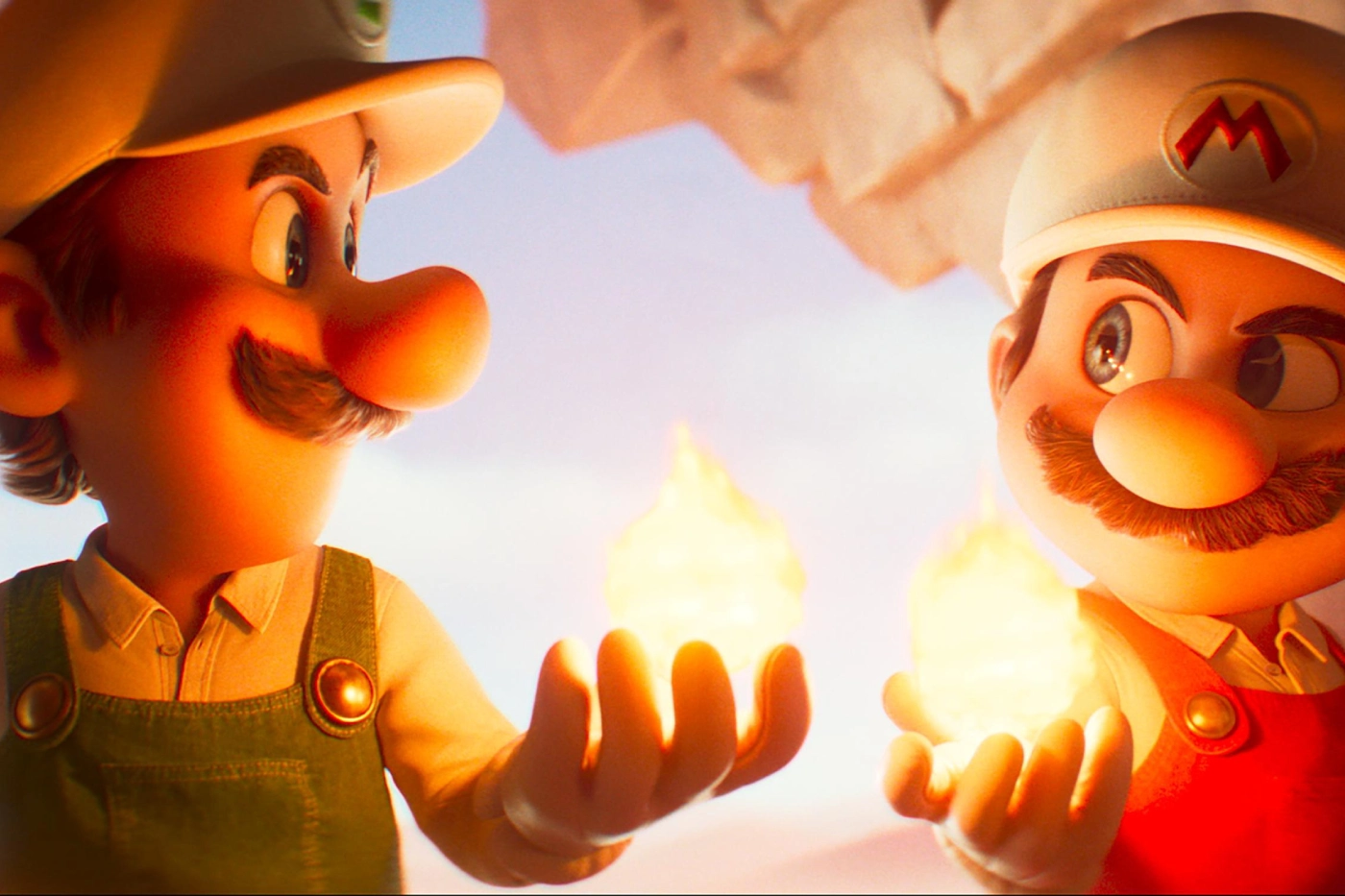

Mario and Luigi team up with a colorful array of characters from over four decades of Nintendo video games to save yet another princess in The Super Mario Galaxy Movie, now playing in Prague (in Czech-dubbed and original English-language versions at select engagements) and cinemas worldwide. This sequel to 2023’s smash hit The Super Mario Bros. Movie is packed to the gills with references that will delight longtime fans, but it’s a noticeable step down in storytelling terms, lacking the narrative drive and thematic depth to support its relentless spectacle.
Picking up after the events of the first film, the story sends Mario (Chris Pratt), Luigi (Charlie Day), Princess Peach (Anya Taylor-Joy), and Toad (Keegan-Michael Key) into outer space following the abduction of Rosalina (Brie Larson), here reimagined as Peach’s long-lost sister. The culprit is Bowser Jr. (Benny Safdie), whose attempt to outdo his father sets off a galaxy-spanning chase that brings the heroes into contact with a wide array of familiar faces, from Yoshi (Donald Glover) to Fox McCloud (Glen Powell) and a host of deep-cut villains from across the franchise.
The plot, such as it is, functions largely as a framework to string together these encounters. Mario and Luigi bounce from one brightly rendered environment to another—asteroid fields, honeycomb worlds, desert outposts—rarely staying in one place long enough to establish a sense of geography or stakes. The result is a film that feels constantly in motion but rarely grounded, more concerned with delivering the next visual or nostalgic beat than building momentum.
The biggest issue is that the film is so slavishly dedicated to recreating what fans recognize from the games that it forgets what makes a story compelling in a passive medium. There are no meaningful character arcs or sense of progression; Mario and Luigi discover what they need to defeat each obstacle without effort, often literally pulling solutions from Question Blocks. While this mirrors the mechanics of the games, it proves dramatically unsatisfying, reducing conflict to a series of preordained outcomes rather than earned victories.
What’s missing is the core appeal of the games themselves: the process of failure, learning, and eventual success. Whether playing firsthand or watching others, the satisfaction of overcoming repeated challenges is central to the video game experience, from the original Super Mario Bros. on the NES all the way to Super Mario Odyssey on the Switch.
Here, that element of learning and growth that had previously been central to the player experience is entirely absent. The characters succeed on their first attempts, rarely adapting or growing, which drains the film of tension and undermines its emotional payoff.
Ironically, the most compelling figure is Bowser (Jack Black), who spends much of the first half reluctantly aligned with the heroes. Black brings the same comic energy that made the character a standout previously, and the film briefly teases a more layered dynamic. But this is abandoned in favor of a return to the familiar villain role, with little narrative justification, flattening what could have been the sequel’s most interesting thread.
The film’s expansive cast is both a strength and a weakness. There’s undeniable pleasure in seeing so many characters brought to life with care, and longtime fans will find plenty to enjoy in the rapid-fire cameos and callbacks—particularly the inclusion of villains from the sometimes-forgotten Super Mario Bros. 2. But the sheer volume of characters means few are given room to register beyond their initial appearance, turning what could have been meaningful additions into fleeting moments of nostalgia.
Even the more prominent new arrivals are unevenly handled. Rosalina, despite her central role, is reduced to a familiar damsel-in-distress function, undercutting the more active role that Peach takes in the sequel. Meanwhile, Fox McCloud is an entertaining presence, with Powell leaning into a cocky, Han Solo-style persona, but the characterization feels at odds with the more earnest, hero-driven version fans may expect from those games, where Fox was a more genuine hero and Falco served as the cocksure sidekick.
That said, there is a clear affection for the source material that carries the film a long way. Visually, the animation is vibrant and detailed, faithfully translating the look and feel of the games—despite a wide-ranging array of presentations throughout the years—in ways that countless earlier video game adaptations struggled to achieve. While this film and its predecessor may not be the most sophisticated entries in the genre, they stand out as perhaps the most authentic, something fans will likely appreciate.
The Super Mario Galaxy Movie works best as a spectacle and a celebration of the franchise’s history, but falls short as a fully satisfying piece of storytelling. While its breakneck pace and dense layering of references will keep devoted fans engaged, those less invested in the games may find little to hold onto beneath the surface. It’s an entertaining but overstuffed sequel, one that captures the look of the Super Mario games wonderfully, but not the magic of playing them.