
The legendary British heavy metal band gets a straightforward big-screen portrait in Iron Maiden: Burning Ambition, now playing in Prague cinemas and select markets worldwide. Spanning five decades of music history in a tight 105-minute runtime, the documentary traces the group’s rise from London pub gigs to global stadium domination, and while its approach occasionally feels closer to an episode of VH1’s Behind the Music than a theatrical event, a strong emphasis on fan testimony and the band’s cultural reach keeps it consistently engaging.
Burning Ambition follows Iron Maiden’s evolution from their formation in the mid-1970s under bassist and founder Steve Harris through multiple lineup changes that eventually solidified the classic configuration featuring guitarists Dave Murray and Adrian Smith, vocalist Bruce Dickinson, and drummer Nicko McBrain.
From there, it moves briskly through their explosive 1980s breakthrough, the intense touring cycle that cemented their global status, and the turbulence of the 1990s when Dickinson departed and Blaze Bayley stepped in as frontman. It closes on the band’s resurgence in the 2000s following Dickinson’s return, a reunion that redefined their modern-era identity.
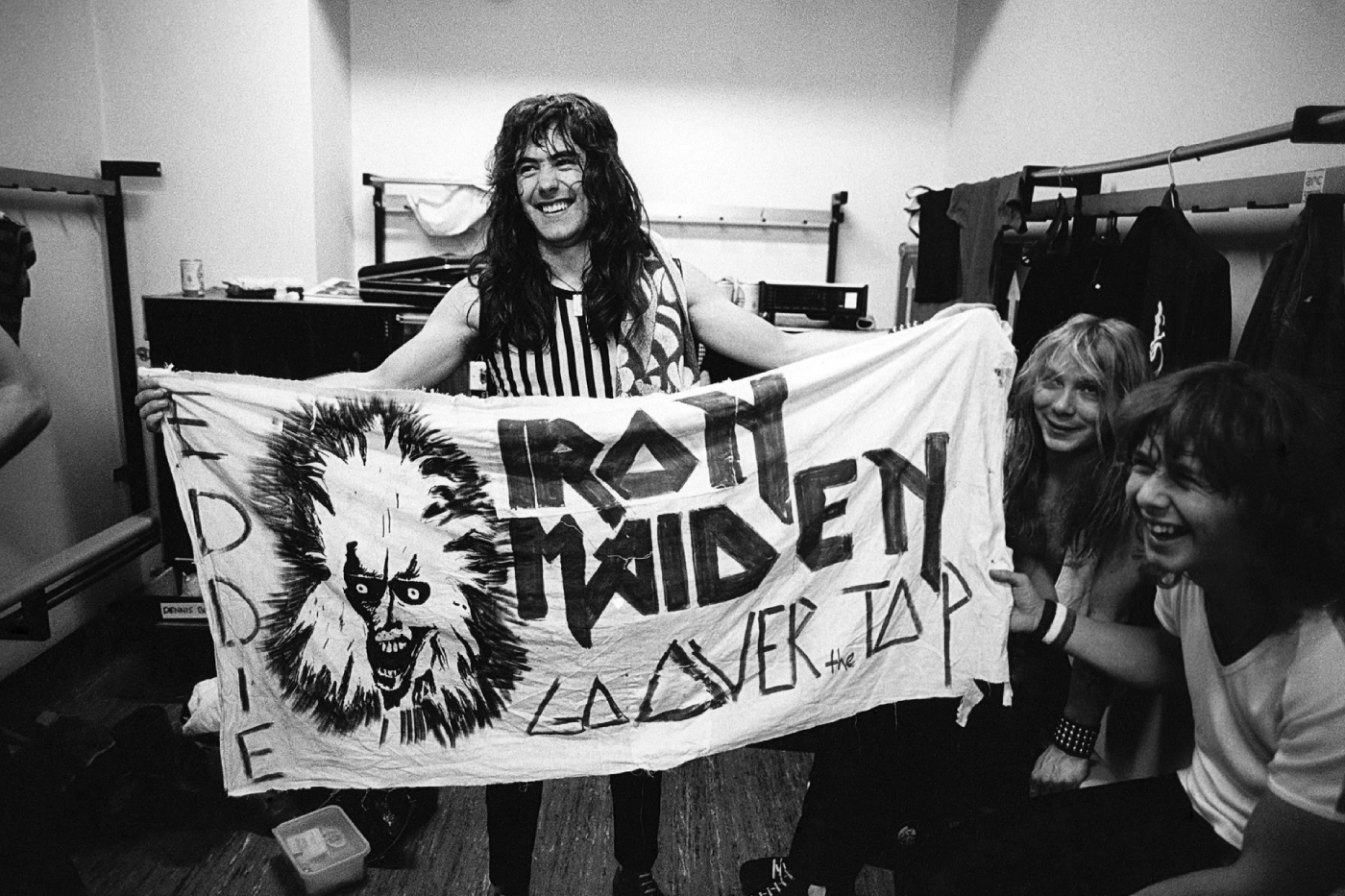
Rather than adopting a conventional talking-head structure, the documentary keeps its core subjects off-camera for most of its runtime. The band members narrate their story in voiceover while archival footage, concert recordings, photographs, and backstage material carry the visuals. This approach preserves the appearance and energy of Iron Maiden’s early decades, although it also introduces a sense of distance; when the film finally cuts to present-day images of the band late in the runtime, the contrast is striking—not only in age but in the sudden collapse of the temporal separation the film has carefully maintained.
That same sense of restraint extends to the storytelling itself. The narrative moves quickly, often skimming over emotional depth in favor of forward momentum and well-worn anecdotes. There are hints of tension—lineup changes, creative disagreements, the physical toll of relentless touring—but these moments are generally framed through nostalgia rather than conflict. Even significant ruptures, such as Dickinson’s departure and Bayley’s tenure, are treated with surprising gentleness, as though time has already softened their edges beyond recovery.
At its most effective, however, Iron Maiden: Burning Ambition captures the scale and strangeness of Iron Maiden’s global reach. Archival material from the band’s 1984 performances in Poland behind the Iron Curtain is especially compelling, including surreal images of military personnel engaging with the band and an impromptu performance at a local wedding.
Similarly, footage from the 1985 Rock in Rio festival underscores the sheer magnitude of their appeal, with Dickinson performing through a stream of blood in front of a sea of fans that seems almost unreal in scale. These sequences offer a reminder of how Iron Maiden’s music transcended language, politics, and geography at a moment when few Western rock acts could claim such reach.
Yet the film’s most distinctive strength lies in its fan perspective. Rather than centering the band as distant icons, it allows listeners from radically different backgrounds to frame the story. A doctor reflecting on discovering Iron Maiden after the Lebanese Civil War, and a New York firefighter describing the music as a form of emotional survival in the aftermath of 9/11, give the documentary a grounded human dimension that often proves more affecting than the band’s own reflections.
Brief appearances from figures like Lars Ulrich, Gene Simmons, Chuck D, and Tom Morello further broaden the cultural context, but it is Oscar-winner Javier Bardem’s enthusiastic, almost childlike admiration for the band that leaves the strongest impression—an unexpectedly joyful reminder of Iron Maiden’s enduring reach.
The film also dedicates space to Eddie, the band’s long-running mascot, charting his evolution through archival stage props, animatronics, and newly commissioned animation that traces his shifting visual identity across eras. These segments add texture and a sense of continuity to the band’s aesthetic universe, reinforcing how central Eddie has been to Iron Maiden’s brand and mythology without ever feeling like branding in a reductive sense.
Musically, however, the documentary is more conservative than it might have been. Iron Maiden’s hits like The Trooper and The Number of the Beast underscore nearly the entire film, but extended performance sequences are largely absent. We hear the hits frequently, yet rarely in full, and that decision feels like a missed opportunity given the cinematic potential of their live shows. Still, the archival sound design and editing are strong throughout, stitching together decades of material into a cohesive sonic and visual rhythm.
Iron Maiden: Burning Ambition works as both an accessible entry point for new listeners and a reflective overview for long-time fans; it’s a competent, carefully-assembled portrait of a band whose influence is difficult to overstate, and it succeeds in capturing their global footprint with clarity and affection. But in an era of increasingly ambitious concert films and music documentaries, including Baz Luhrmann‘s EPiC: Elvis Presly in Concert and James Cameron‘s Billie Eilish – Hit Me Hard and Soft: The Tour, one can’t help but imagine a more explosive big-screen Iron Maiden experience.