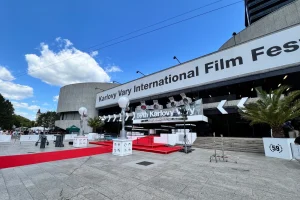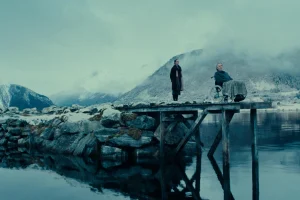
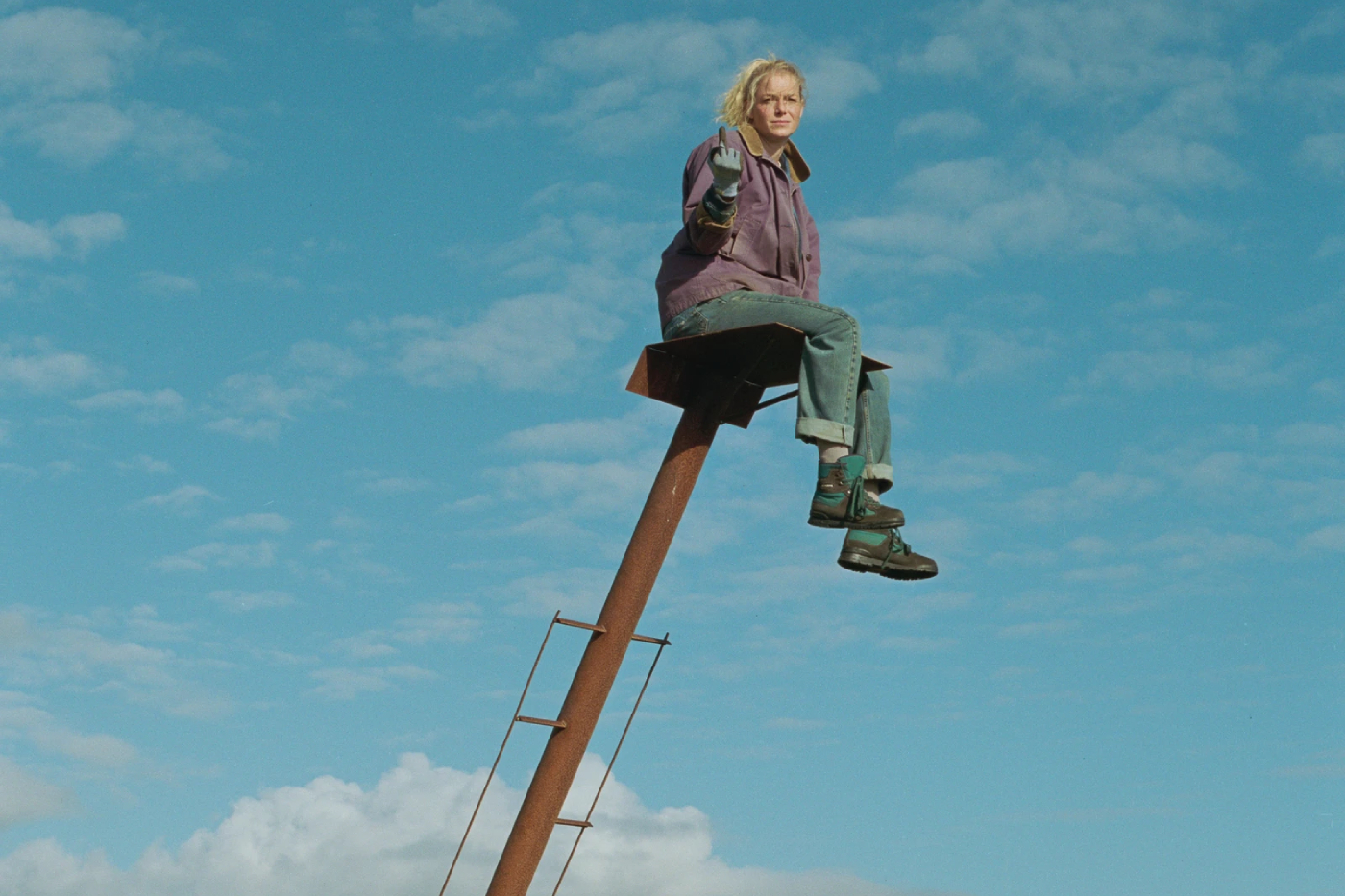

Scenes of a family drifting toward separation in rural Iceland are wistfully captured in The Love That Remains, which premiered at last year’s Cannes Film Festival, screened at the Karlovy Vary International Film Festival, and opens in Prague cinemas this weekend (and with English subtitles at select screenings). This latest feature from writer-director Hlynur Pálmason (Godland, A White, White Day) unfolds as a series of loosely connected vignettes rather than a conventional narrative, blending domestic realism with bursts of surreal imagery; the result is a film that is emotionally elusive but visually striking, lingering in memory even as its narrative resists easy resolution.
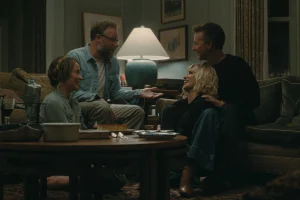
Set over the course of a year, The Love That Remains follows Anna (Saga Garðarsdóttir), an internationally recognized artist working in rural isolation, and Magnus (Sverrir Gudnason), a seafaring fisherman whose long absences have gradually eroded their marriage. Their kids—played by Pálmason’s own children—move through the household with an unforced naturalism that reinforces the film’s semi-observational tone. A brief appearance by Godland star Ingvar Sigurðsson as a grandfather adds continuity with the director’s earlier work, but the focus remains firmly on the emotional quietude and slow unraveling of a family still bound together by habit more than affection.
Rather than building toward traditional dramatic beats, The Love That Remains accumulates meaning through moments: a tense meeting between Anna and a dismissive gallery representative; Magnus adrift in a recurring dream of the sea; and a chaotic childhood game involving bows and arrows that ends in an emergency room visit. These fragments rarely resolve into overt narrative consequences, instead forming a mosaic of domestic instability. What emerges is less a story about separation than a study of emotional inertia, how people remain connected even as their relationship fractures beyond repair.
Pálmason continues to refine his distinctive blend of grounded realism and unexpected fantasy, but here the balance tilts further toward the surreal. A giant rooster that appears in Magnus’ dream life, an intrusive sword dropped inexplicably into a family scene, and a series of quietly uncanny visual interruptions all suggest a household in which psychological states leak into physical reality. Yet the film avoids explicit interpretation, allowing these images to hover between metaphor and intrusion. They feel less like symbolic explanations than emotional afterimages: expressions of grief, resentment, and dislocation that the characters themselves cannot fully articulate.
Despite its occasional surreal flourishes, the film’s most compelling quality lies in its restraint. Pálmason integrates his unusual touches into the fabric of everyday life, allowing the audience to piece together the emotional situation in the same way the characters themselves are living it: gradually, imperfectly, and without clarity. This approach gives the film a quiet narrative momentum, even in the absence of conventional plot escalation.
Garðarsdóttir delivers a standout performance as Anna, anchoring the film with a tightly coiled mix of exhaustion, irritation, and suppressed ambition. We get the impression that she Anna is forcing the issue of divorce, but she is portrayed neither as villain nor victim but as someone caught in the slow exhaustion of domestic compromise. Gudnason’s Magnus, meanwhile, is more openly vulnerable, drifting between awkward persistence and emotional withdrawal. The dynamic between them entirely avoids melodrama, instead settling into a more uncomfortable realism: two people who still share intimacy, history, and responsibility, but not direction.
The supporting cast adds texture without overwhelming the central relationship, as the children bring a spontaneous, unselfconscious energy that contrasts with the adults’ emotional stasis. Cinematography is handled by the director himself, and the Icelandic landscape is captured in muted tones and a boxy 4:3 frame that enhances the film’s sense of nostalgia and containment. The result is a visual style that feels both intimate and distanced, as if memory itself were shaping the image.
A score by Harry Hunt (h hunt) deepens this atmosphere further, blending soft, jazz-inflected motifs with an understated melancholy that never overstates emotion (there’s more than a hint of Vince Guaraldi here). The music, like the film itself, resists dramatic peaks in favor of lingering tones and unfinished thoughts. Together, image and sound create a world that feels suspended between present and faded recollection.
While The Love That Remains may lack the narrative drive of a more conventional domestic drama, its strength lies in its accumulation of mood and detail. It is less concerned with resolving the story of a marriage than with observing what it feels like to inhabit its slow dissolution. Like The Sound of Falling, also seen at the 2025 KVIFF, the result is a film that prioritizes texture over resolution, atmosphere over explanation, and emotional ambiguity over narrative closure.
Pálmason has crafted a work that is deliberately unhurried and often opaque, but also consistently absorbing in its own quiet register. For viewers willing to engage with its fragmented structure, The Love That Remains offers a richly textured portrait of love in decline—one that finds beauty not in endings, but in the uneasy, unfinished space between staying and leaving.