
An American author is drawn into a spiraling mix of supernatural folklore and real-world violence during a retreat to a remote Irish hotel in Hokum, now playing in Prague cinemas after its premiere at this year’s SXSW festival. The third feature from writer-director Damian McCarthy (Caveat, Oddity) continues his fusion of gothic horror and crime-thriller mechanics, but refines it into his most confident work yet—one that balances atmospheric dread, narrative misdirection, and carefully deployed shocks with striking precision.
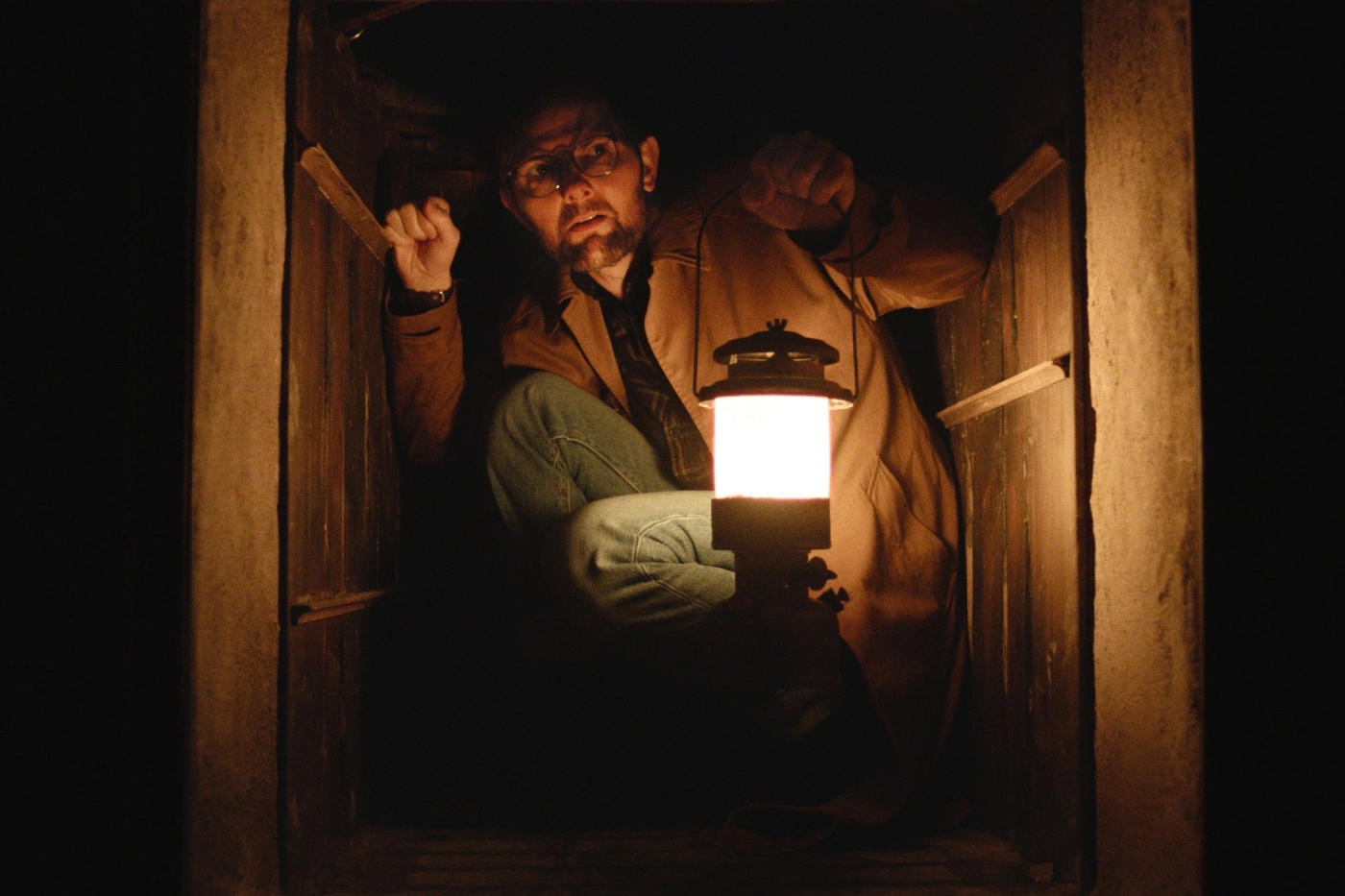
Hokum stars Adam Scott as Ohm Bauman, a successful novelist struggling to complete the final chapter of his Conquistador series while grappling with unsettling visions tied to his past. Seeking isolation, he travels to The Bilberry Woods Hotel in rural Ireland, a place linked to his family history and local legends about a witch said to trap souls beneath the building. The setup initially suggests a familiar descent into haunted-house horror along the lines of 1408 or Secret Window, with Scott’s character positioned as a skeptical outsider slowly unraveling under pressure.
McCarthy, however, refuses to remain in that register for long. Without underlining the shift, the film gradually pivots away from its apparent ghost story structure and into something closer to a fractured Patricia Cornwall-like thriller as Ohm confronts the hotel’s staff (played by Peter Coonan, Michael Patric, Florence Ordesh, and Will O’Connell), and a shifty outsider (David Wilmot) alongside the paranormal. What begins as a controlled exercise in isolation horror steadily opens into a more complex web of human wrongdoing, where the supernatural and the criminal coexist rather than compete.
Crucially, McCarthy introduces key revelations earlier than genre convention would dictate, trusting the audience to stay oriented even as the narrative reconfigures itself in real time. That structural confidence pays dividends in how Hokum manipulates tension. Rather than saving information for late twists, McCarthy threads exposition through conversation, overheard fragments, and brief, matter-of-fact disclosures that never halt momentum. Yet even as the film evolves into a more grounded mystery-thriller, the earlier supernatural framing never fully disappears: it lingers at the edges, shaping interpretation and keeping ambiguity alive.
The horror imagery itself is memorably varied, even when uneven in impact. The hotel’s folklore—especially the tales surrounding a witch said to lead children into the underworld—feeds into some of the film’s most unsettling visual ideas. Equally striking are recurring motifs such as a deranged children’s television mascot and a dead body that appears to shift with uncanny autonomy (shades of that unforgettably creepy doll from Oddity).
Much of the film’s success is anchored in its central location. The hotel is more than a backdrop; it becomes an active pressure system, with its dust-covered honeymoon suite and dim corridors reinforcing the sense of slow entrapment. Cinematographer Colm Hogan captures these spaces with careful, controlled composition, though the film occasionally pushes its low-light aesthetic too far, obscuring detail at moments where clarity would sharpen the tension rather than dilute it.
Known largely for his dry comedic timing, Scott leans into something far more brittle and self-destructive here. Ohm is not an easy figure to follow—abrasive, self-absorbed, and emotionally guarded—but Scott’s performance ensures he remains relatable even when he is most unlikable. That tension becomes essential to the film’s effectiveness: the audience is simultaneously alienated by him and compelled to remain inside his unraveling perspective, trapping us inside the hotel right alongside him.
Hokum is less interested in literal hauntings than in the deep-seated trauma that people carry with them wherever they go. The film repeatedly returns to ideas of guilt, authorship, and self-mythology—how narratives, whether personal or fictional, can distort accountability. Ohm’s arc is not simply about survival or discovery, but about confronting the ways he has shaped (and avoided shaping) his own story.
McCarthy, whose previous work already demonstrated a strong command of contained dread, uses this material to refine his approach rather than expand it outward. The influence of classic suspense filmmaking is present, but the tone remains distinctly his own: tightly controlled, morally unsettled, and willing to let ambiguity stand rather than resolve itself into explanation. The Irish filmmaker has quickly become one of the most distinctive voices in modern horror.
Like the filmmaker’s previous features, Hokum is a film that consistently resists easy categorization, even as it draws on familiar horror and thriller frameworks. For all its darkness, it ultimately leaves its protagonist in a more hopeful, less nihilistic place than where he began—suggesting that the real horror may not be what inhabits the hotel, but what the guests bring with them when they arrive.