
Michael Jackson escapes his father’s oppressive thumb to find international stardom—and nothing bad ever happens after that—in Michael, a glitzy new biopic on the King of Pop opening in Prague and cinemas worldwide this weekend. While most critics have dismissed this for completely ignoring all of Jacko’s later controversies, the professional sheen from director Antoine Fuqua, a strong central theme in John Logan’s screenplay, and two powerhouse performances from Colman Domingo and a dazzling Jaafar Jackson (Michael’s real-life nephew) elevate this to the upper echelon of musical biopics—at least for audiences willing to forget everything that the film leaves out.
Michael opens in Gary, Indiana, in 1966, where a young Michael (an impressive Juliano Valdi) trains relentlessly with his brothers as part of the Jackson 5 under the watchful—and often abusive—eye of his domineering father Joseph (Domingo). Joe demands absolute perfection, pushing his sons through exhausting rehearsals even after performing late-night gigs. When Michael dares to protest, insisting they’ve done well enough, Joe responds with a belt. These early sequences are blunt but effective, quickly establishing both the discipline that shaped Michael’s artistry and the emotional cost that would define his life.
Logan’s screenplay uses these formative moments as a thematic foundation rather than lingering on them. Michael’s trajectory toward stardom feels inevitable, but it comes at the expense of a childhood—and, more crucially, any semblance of a nurturing relationship with his father. A small but telling interaction with Motown founder Berry Gordy (Larenz Tate), who gently guides the young Michael in the recording studio, highlights exactly what Joe withholds: encouragement, patience, and genuine care. It’s a fleeting moment that resonates throughout the rest of the film.
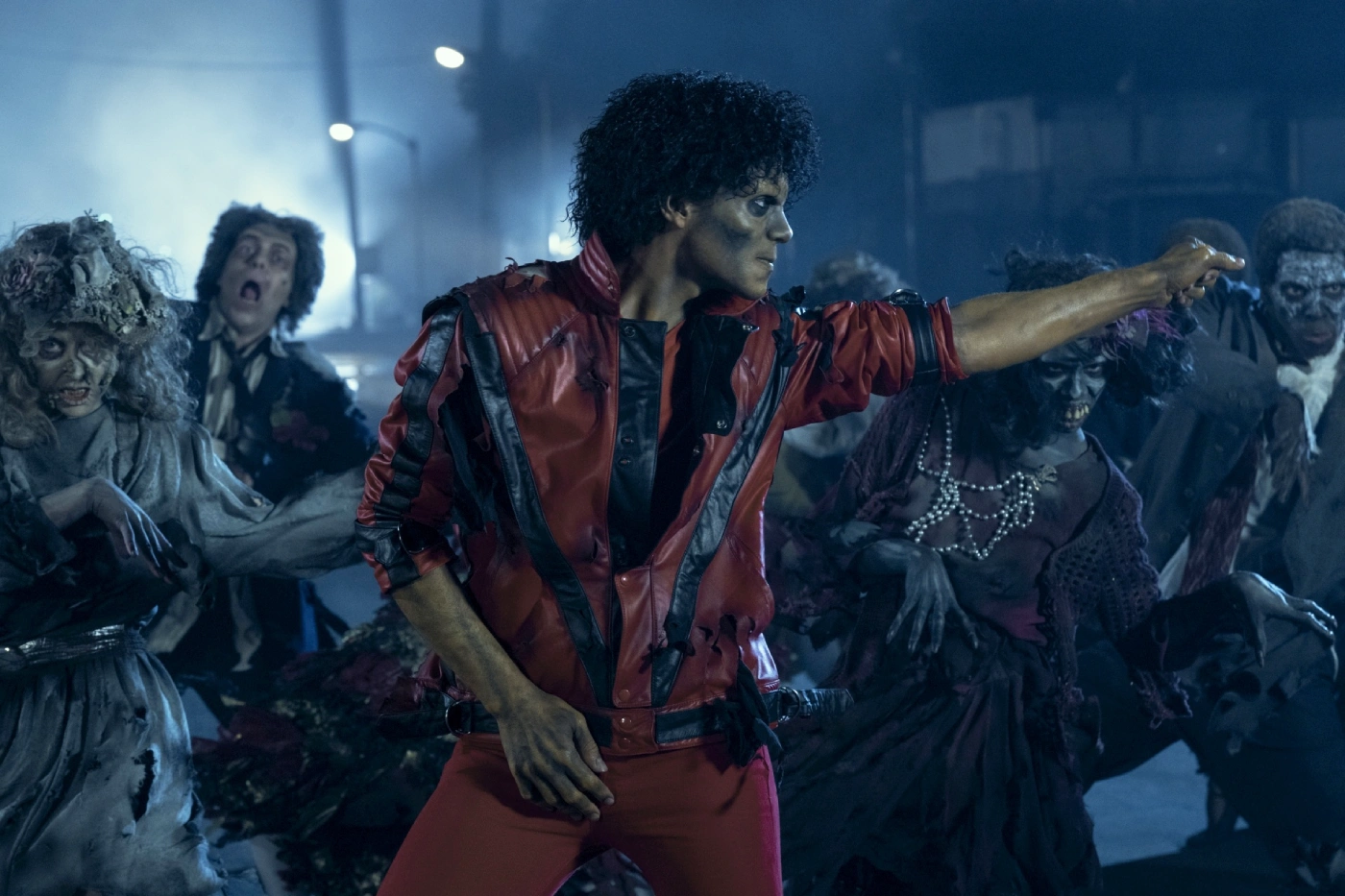
Valdi is so engaging in these early scenes—particularly when performing Jackson 5 hits like ABC and I’ll Be There—that it’s almost disappointing when the film transitions forward in time. But the film finds a new gear once Jaafar Jackson takes over the role. While not an exact physical match for MJ, he moves and most impressively sounds exactly like his uncle; he captures Michael’s physicality, vocal cadence, and stage presence with astonishing precision. Whether aided by subtle sound design or not, the illusion is complete—this is as close as a biopic has come to fully resurrecting a musical icon.
As the narrative moves into the late 1970s and early ’80s, Michael begins carving out a solo identity, recording Off the Wall with Quincy Jones (Kendrick Sampson) during late-night sessions while still operating under his father’s rigid control. Even as his fame grows, Michael remains emotionally tethered to his family, unable to directly confront Joe. When he finally breaks away, hiring attorney John Branca (Miles Teller) to dismiss his father as manager via a curt fax, the moment lands with quiet ambiguity rather than genuine catharsis—a practical reflection of their fractured relationship.
That dynamic remains the film’s strongest narrative thread. Michael resists reducing Joe to a one-note villain, instead presenting him as a deeply flawed product of his own circumstances: a man hardened by labor and deprivation, desperate to mold his sons into something greater, even at tremendous personal cost. Domingo brings a controlled intensity to the role, allowing glimpses of vulnerability beneath the harsh exterior. Jaafar Jackson, meanwhile, fully inhabits Michael’s internal conflict, portraying a man who can command a global stage but cannot bring himself to meet his father’s gaze.
The focus on this central relationship inevitably sidelines much of the supporting cast. Nia Long has a few tender moments as Katherine Jackson, but Michael’s siblings are largely pushed to the margins—most notably Janet, who has been excised from the movie entirely. KeiLyn Durrel Jones makes a strong impression as Bill Bray, Michael’s longtime bodyguard and perhaps the closest thing he has to a surrogate father figure, grounding his scenes with a quiet emotional presence.
If the film falters, it is in its reluctance to fully explore what drives its protagonist. Michael presents Jackson as a perpetually childlike figure, defined by innocence and arrested development, with repeated nods to Peter Pan and Neverland. While this aligns with the film’s central theme—that his upbringing robbed him of a normal life—it also limits the complexity of the portrait. The more challenging or contradictory aspects of his personality are smoothed over, though quietly hinted at by Fuqua in key moments, including a final performance of Bad.
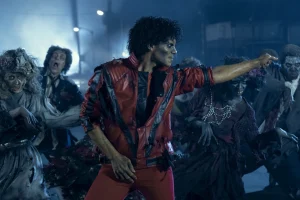
While Michael sanitizes and simplifies, it compensates with spectacle. The musical sequences are undeniably electric, with recreations of Don’t Stop ’Til You Get Enough, Beat It, Billie Jean, Thriller, Human Nature, and many more staged with precision and energy. Whether in rehearsal rooms, recording studios, or full-scale performances, these moments give the film a pulse that transcends its narrative limitations.
Technically, the film is polished across the board. Dion Beebe’s cinematography lends a sleek, modern gloss that still captures the texture of the era, while the production and costume design convincingly recreate the shifting aesthetics of Jackson’s career. Some reliance on digital effects is noticeable, particularly in broader establishing shots (Bubbles, too, is a real distraction), but it rarely detracts from the overall presentation.
Michael is a ultimately compromised but compelling biopic—one that chooses celebration over confrontation and narrative clarity over complexity. Still, it isn’t at odds with reality: it only requires the viewer bring the film full circle with their own knowledge of Jackson’s controversial legacy. That choice may divide critics, but within its self-imposed boundaries, the film undeniably succeeds as a high-powered biopic on the level of a A Complete Unknown or Rocketman, and more than a few notches above Bohemian Rhapsody. Powered by one of the most enduring catalogs in pop history, Michael may not tell the whole story, but it’s destined to become a giant hit among general audiences.