
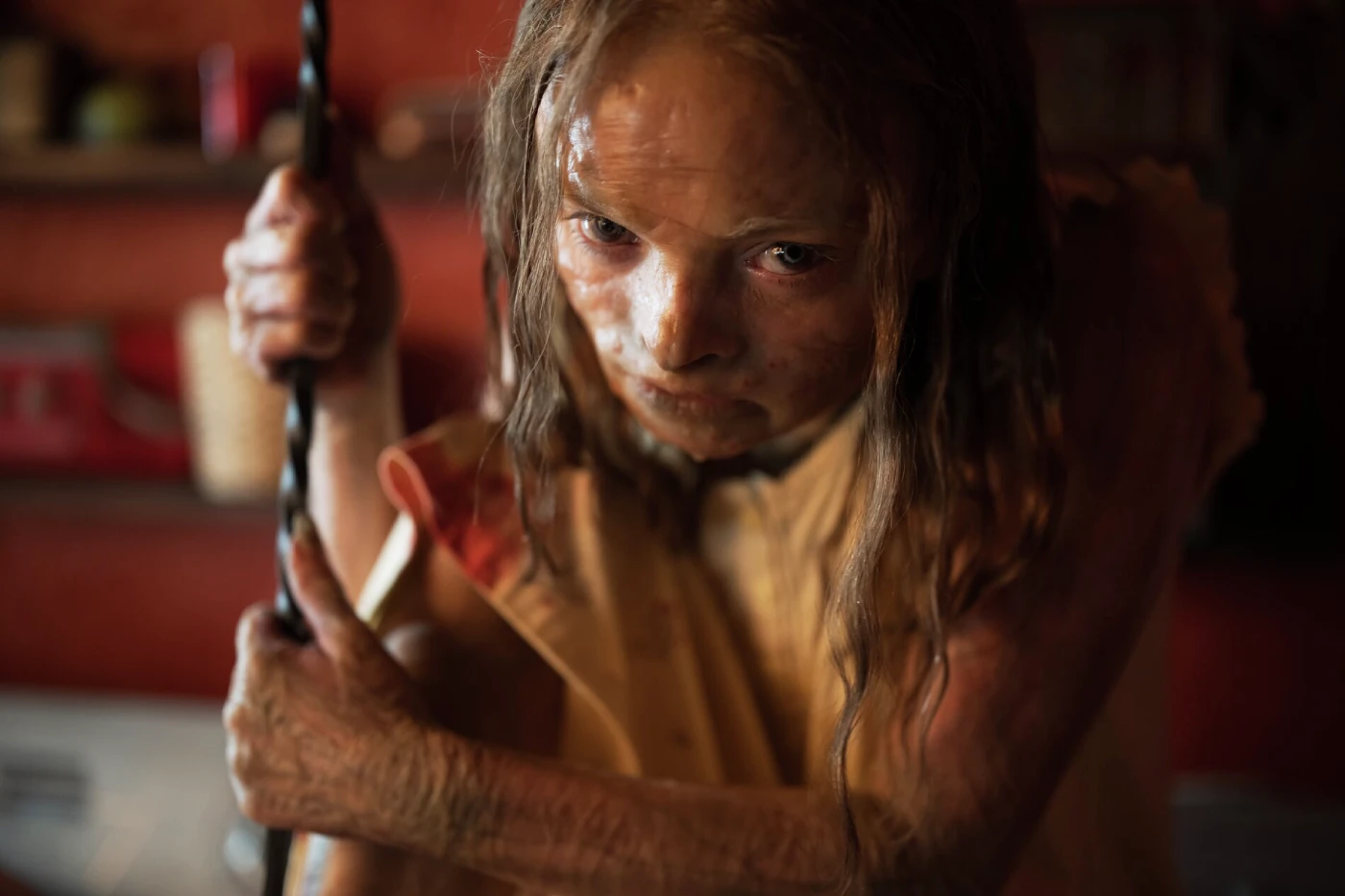

A kidnapped daughter is returned after eight years, but in a state of demonic possession, in Lee Cronin’s The Mummy, which opens in Prague and cinemas worldwide this weekend. There’s a neat mummy monster briefly glimpsed in the first five minutes of this movie, but the writer-director largely abandons this initial promise for some far more generic possession movie tropes in this overbearing 133-minute feature that includes about 15 seconds of on-screen mummy. Call it Lee Cronin‘s The Exorcist.
Poor Katie Cannon (Natalie Grace): kidnapped in Cairo as a young girl, she’s recovered from a sarcophagus amidst the wreckage of a plane in rural Egypt eight years later. She’s completely catatonic outside of sudden, violent spasms, but instead of seeking advice from health professionals of any distinction, parents Charlie (Jack Reynor) and Larissa (Laia Costa) bring her home to Albuquerque at the advice of the Egyptian doctor who probably just wants to be rid of her. She just needs some bedrest, he tells them.
Sure, Katie levitates off said bed, but it’s really a loving home, including younger siblings Sebastián (Shylo Molina) and Maud (Billie Roy) and grandmother Carmen (Veronica Falcón), that’s going to get her back in good spirits after eight years of abduction. Curiously, no one beyond Charlie seem to question what exactly happened to Katie during those eight years.
And yeah, Katie scrambles around the spaces beyond the Albuquerque home’s walls on all fours, munching on scorpions and vomiting pea soup, clawing at the walls and speaking in tongues and rasp-voiced vulgarities. But a doctor, mental health professional, government official, police officer, or even priest is never called. Everyone knows exactly what’s going on here, except everyone in the movie.
When Charlie lifts up the carpet in Katie’s bedroom and notices the floor is bleeding and festering with insects, he replaces the carpet and shrugs it off, never to mention it again. When Larissa accidentally peels off a foot-long chunk of skin off Katie while attempting a manicure, and Charlie examines the skin and discovers handwriting on it, he takes it to the local university to get it translated. Note to parents: if your child’s skin falls off and you notice some writing on it, it probably doesn’t matter what it says. The important thing is the skin falling off in the first place: if you want to help your child, get them a doctor, not a professor who specializes in dead languages.
But there is one curious character who does want to help Katie: Cairo-based Detective Dalia Zaki (May Calamawy), whose superior failed to solve her disappearance eight years ago, and suspected the family of involvement. Her scenes, while largely serving as rote backstory, are the most interesting the movie has to offer, if only because they represent reprieve from the endless barrage of possession movie clichés that make up the rest of the film.
There’s a lengthy sequence late in the movie in which Dalia tracks down the kidnapper (Hayat Kamille) and discovers the horrifying truth, and Lee Cronin’s The Mummy briefly lurches to life as an Egypt-set police procedural. But when we get back to Albuquerque and Katie is floating around and using telekinetic powers to toss characters out of windows and telepathic powers to possess other members of her family, we firmly settle back into tropeville.
Almost all of this demonic possession material can be traced back to The Exorcist, which has been ripped off and remade countless times in the 50+ years since it was released; Lee Cronin’s The Mummy includes the same possession tropes seen as recently as The Ritual, The Exorcist: Believer, The Pope’s Exorcist, and Cronin’s own Evil Dead Rise, which this film morphs into during a climax that includes some stomach-churning grossout effects but feels most icky for all the violence directed at children.
You know what hasn’t been endlessly remade and ripped off over the past five decades? The original Boris Karloff version of The Mummy, which even rights holder Universal transitioned from horror into action-adventure in recent iterations with Brendan Fraser and Tom Cruise. A widely-seen mummy movie that leans into horror may not exist since the days of Hammer, with apologies to Bubba Ho-Tep and The Awakening and a pair of Russell Mulcahy B-movies.
Audiences going into Lee Cronin’s The Mummy will expect two things from the name alone: a mummy movie, and an auteur-level experience that justifies the director’s name appearing in the film’s title. They will get neither. This movie is competently put together by Cronin, and boasts some striking widescreen cinematography from David Garbett, especially in the Egypt-set scenes, and excellent sound design, especially in IMAX.
But Lee Cronin’s The Mummy is never scary and rarely even creepy, and Cronin’s generic script has none of the thematic depth or even story twists to justify the extreme runtime; Evil Dead Rise had a lot more interesting stuff going on at the story level, and that one came in 45 minutes shorter. It’s not Cronin’s fault—rights issues would have prevented this one from being called The Mummy, similar to Guy Ritchie’s The Covenant or Lee Daniels’ The Butler—but the finished film does not benefit the Irish filmmaker as an advertisement for his craft.











One Response
Appreciate the review thanks