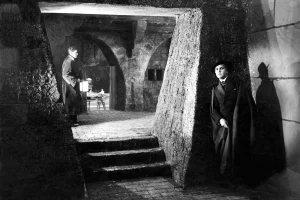

Slovak figure skater Ondrej Nepela struggles with pressure and repression on the eve of the 1973 World Championships in Bratislava in Last Routine (Šampión), now playing in Prague cinemas (and with English subtitles at Kino Lucerna and Kino Atlas). This intimate portrait of one of Czechoslovakia’s most renowned Olympic heroes from director Jakub Červenka sometimes struggles to connect on dramatic terms, but its technical credentials are largely first-rate and it soars on the ice, especially during the thrilling climactic routine.
This is the second portrait of the skater to release in local cinemas over the past six months, following last year’s Nepela, and the urge to compare them is irresistible; while both climax at the 1973 Championships, the earlier film charts roughly a year of his life leading up to the event, while Last Routine largely restricts itself to a 24-hour window. The two films can be said to complement each other to some degree, but in thematic terms, viewers watching them in close proximity will experience a heavy dose of déjà vu.
Last Routine opens with Nepela (played by Adam Kubala) and longtime coach Hilda Múdra (Jana Nagyová) returning to Prague following the 1972 Winter Olympics in Sapporo, where Nepela won the gold medal in figure skating over the Soviet Union’s Sergei Chetverukhin. Just 21 years old, Ondrej is one of the youngest figure skating champions in Olympic history, and plans to take his talents abroad to the musical revue Holiday on Ice.
But celebrations at home are short-lived: on the way back from the airport, he is informed of the death of friend and fellow skater Hana Mašková, who was killed in a tragic car accident in France. And he does not even make it out of her funeral before an StB secret police agent played by Miroslav Hanuš informs him that he will not be going abroad, but will instead remain in Czechoslovakia to represent the country at the 1973 Championships in Bratislava.
The film quickly transitions to the day before the championships, as Nepela struggles to complete a difficult triple Salchow during training. The stakes are clearly established: should he not win the World Championships, Nepela will likely not be allowed to travel abroad. As a gay man struggling with multiple forms of repression in communist Czechoslovakia, the pressure builds on the skater’s psyche to an almost unbearable degree.
Last Routine is at its weakest in the narrative shortcuts it takes to establish these stakes, which feel thinly sketched and a lot less nuanced than the reality of what Nepela was facing. Hanuš’s StB agent is almost cartoonishly over-the-top as a stereotypical thug who watches the skater’s every move, undercutting the pervasive nature of state surveillance.
Still, the film is not without more genuine representations of this threat. The film’s finest moment over its first two-thirds is a tender phone call between Nepela and singer and friend Eva Pilarová (Martina Jindrová), where he confesses his crushing fears ahead of the event and she consoles him with a tender Czech-language rendition of Where Do I Begin? from Love Story.
But their conversation is not private: it is also being monitored and recorded on tape by secret police agents, who listen in with state interest—and, crucially, their own personal feelings towards the skater. This sequence, which recalls the recent The Secret Agent and the Czech classic The Ear, is a far more effective representation of oppression than Hanuš’s one-note bully, and does a lot of work in countering the less realistic depiction throughout the rest of the film.
Last Routine also does a nice job of depicting a relationship between Ondrej and friend Matěj (Cyril Dobrý), who also yearns to break free from Soviet oppression but lacks Nepela’s resources; Karel Dobrý has a single scene as Matěj’s father, but he makes the most of it. Other characters, including family members of both Nepela and Múdra, feel more thinly sketched.
But Last Routine largely keeps focus on the two central characters, who are fully realized through a pair of committed performances. Kubala is restrained as Nepela—outwardly confident, but also insecure—capturing both elite discipline and the strain of state suppression, while Nagyová brings warmth and authority as Múdra. The emotional release for both comes in the climactic ice routine, staged with precision and escalating intensity. As Nepela performs under pressure, choreography becomes narrative expression, turning technique into catharsis.
Technically, the film is assured across most departments. Period-era sets and striking costumes from Katarína Štrbová Bieliková (Waves) creates an utterly authentic sense of early-1970s Czechoslovakia. Michal Novinski’s synth-heavy score builds momentum and peaks during the skating sequences, elevating the climax. The only drawback is the post-production color grading, which adds an artificial-feeling blue-grey Cold War sheen over Martin Štrba’s widescreen cinematography.
Last Routine works as a companion and comparison to last year’s Nepela, with both films circling the same terrain but offering different strengths. Nepela offers more narrative and psychological space; Last Routine is tighter and more intense, with a stronger final act payoff. Neither fully captures Nepela’s inner life, but both succeed in their own ways. Together they form a compelling diptych, and viewers interested in the skater’s story would be well served by seeing either one.