

An industrial researcher goes into hiding among political dissidents while being pursued by hired assassins in 1970s Brazil in The Secret Agent, which debuted at last year’s Cannes Film Festival before earning four Oscar nominations, including Best Picture and Best Actor, and opens in Prague cinemas this weekend (and with English subtitles at Kino Světozor, Kino Aero, and Bio Oko).
Directed by Kleber Mendonça Filho, The Secret Agent fuses historical political turmoil, local urban legends, and callbacks to classic 1970s cinema into a taut, visually arresting paranoia thriller. It confirms Mendonça as one of the most distinctive voices in contemporary filmmaking, following 2019’s Bacurau, and stands out as one of the very best films of 2025.
The opening scene, reminiscent of a Sergio Leone western, immediately establishes the The Secret Agent’s darkly satirical tone. Armando Solimões (Wagner Moura) pulls into a gas station littered with a dead body covered by cardboard, only to be confronted by corrupt local police. With no money to offer, he gives them a pack of cigarettes, which they happily accept. The officers’ indifference to the corpse serves as a bitter allegory for the corruption and moral decay at the heart of 1970s Brazil—a world where violence is ignored by authorities despite being a direct result of their actions.
Subsequent sequences introduce Armando’s family and associates: he reconnects with his young son Fernando (Enzo Nunes), now living with his father-in-law Sr. Alexandre (Carlos Francisco) following the death of Armando’s wife, and goes into hiding at a dissident commune run by Dona Sebastiana (Tânia Maria).
Meanwhile, corrupt authorities led by Chief Euclides (Robério Diógenes) investigate a human leg found in a shark, and a wealthy businessman, Henrique Castro Ghirotti (Luciano Chirolli), hires assassins Bobbi Borba (Gabriel Leone) and Augusto Borba (Roney Villela) to eliminate Armando.
Mendonça takes a bold narrative gamble by withholding Armando’s backstory until well into the film, leaving audiences unsure why the protagonist is hunted. Yet each scene is so compelling in its own regard that the story draws viewers along regardless.
Halfway through, a 15-minute sequence of exposition finally illuminates Armando’s past, seamlessly transitioning the film into a taut paranoia thriller reminiscent of The Conversation or The Parallax View. At this point, a contemporary storyline also unfolds involving Flavia (Laura Lufési), a researcher transcribing Armando’s tapes, allowing audiences to uncover his story in real time alongside her.
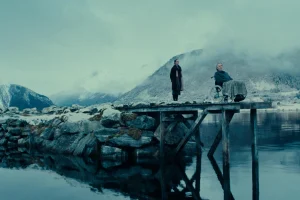
Cinematographer Evgenia Alexandrova captures period-era Recife with breathtaking precision, faithfully recreating the 1970s through production design, costumes, and careful framing. Contemporary shots in the same locations highlight the care taken to evoke a specific historical moment. Tomaz Alves Souza and Mateus Alves provide a tense, immersive score, which mixes original compositions with period Brazilian hits and international tracks like Donna Summer’s Love to Love You Baby, reinforcing the era’s cultural atmosphere.
The film’s local folklore elements, especially the “hairy leg” urban legend—a severed limb that attacks residents—blend political allegory with darkly surreal imagery, creating a narrative both historically grounded and cinematically inventive. The allegory is unmistakable: corruption left unchecked comes back to haunt the public, yet the story remains rooted in documented events: the hairy leg was a genuine urban legend in 1970s Recife, printed in local newspapers in place of stories that were censored by authorities.
Mendonça’s cinematic references are also deliberate, with nods to classic paranoia thrillers, John Boorman’s Point Blank, and Elio Petri’s Investigation of a Citizen Above Suspicion, as well as in-world screenings of The Omen and Jaws, which also ties into real-life shark attacks in the area at the time, connecting Recife’s local history to international cinema. The director also cited Czech director Karel Kachyňa‘s classic surveillance thriller The Ear as a direct influence on The Secret Agent.
Moura delivers an especially appealing performance, effortlessly embodying both the tense, hunted Armando of the 1970s and his adult son Fernando in the present day; the range earned him a well-deserved Best Actor nomination. The supporting cast is equally impressive, with an array of memorable, almost Fellini-esque faces that elevate even minor characters. It was unusual to see an international film selected as one of the nominees for the inaugural Academy Award for Best Casting, but it was entirely appropriate here.
Despite its lengthy runtime and occasional narrative detours, The Secret Agent maintains suspense, visual flair, and thematic resonance throughout. Its climactic choices may frustrate some viewers (and recall a similar move made in No Country for Old Men), but here they feel earned, underscoring the theme of intangible ghosts from the past that continue to haunt our present day, even if we fail to fully comprehend them.
The Secret Agent‘s meticulous recreation of 1970s Brazil, combined with a thrilling yet morally complex narrative and outstanding performances, makes it one of the year’s most memorable cinematic achievements. Blending historical reflection, folklore, and classic cinematic homage into a wholly unforgettable experience, this one rates right alongside Oscar winner One Battle After Another as one of the best films of 2025—and might even top it.