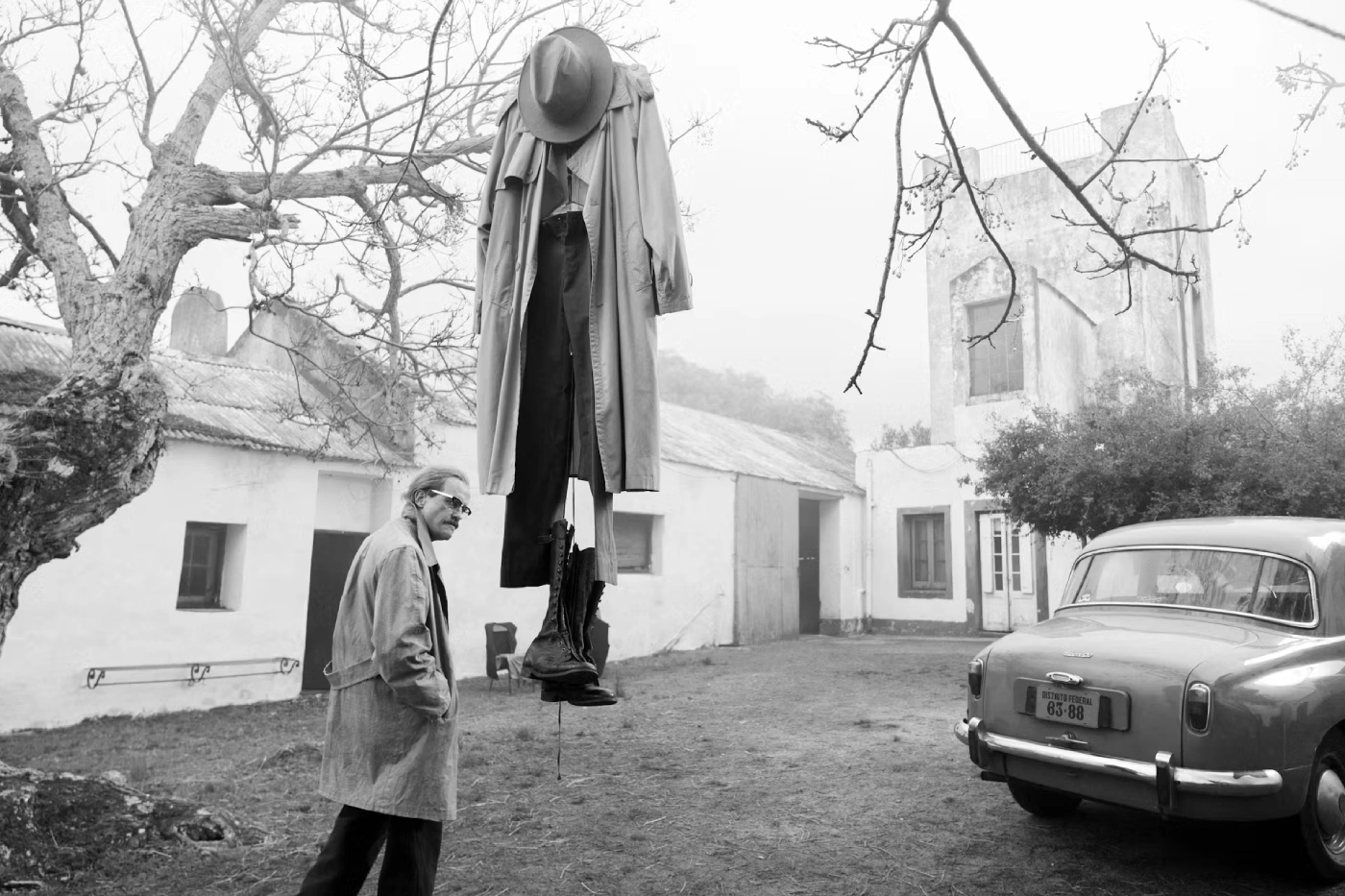
The infamous Nazi doctor and Angel of Death slips through Argentina, Paraguay, and Brazil in The Disappearance of Josef Mengele, which premiered at last year’s Cannes Film Festival and opens in Prague cinemas from May 7 (including English-subtitled screenings at Edison Filmhub and Kino Atlas). This striking, noir-inflected thriller from writer-director Kirill Serebrennikov partially plays like a postwar echo of The Zone of Interest, tracing Josef Mengele’s banal life after Auschwitz while ultimately never letting the weight of his crimes recede from view.
The Disappearance of Josef Mengele stars a perfectly-cast August Diehl (Inglourious Basterds, The Master and Margarita) in the titular role, opening in Buenos Aires in 1955 as the fugitive doctor pulls on a trench coat and dark sunglasses and steps into the street. Over the radio comes news of the overthrow of Nazi-sympathizing Argentine President Juan Perón, a political shift that will put several prominent Nazi fugitives at risk, including Adolf Eichmann. In what becomes the film’s defining rhythm, Mengele moves through everyday routines with the constant paranoia that Israeli agents may be waiting just around the corner.
Mengele would spend more than three decades in South America, successfully evading capture until his death by accidental drowning in 1979. The film only rarely touches on the logistics of his escape and the financial protection provided by his wealthy family’s business empire, but Serebrennikov is less interested in mechanics than in routine: the unnerving ordinariness of how a man responsible for industrialized horror continued to eat, work, socialize, and live the kind of routine life he robbed from countless others.
That structure can be deliberately disorienting. The film jumps back and forth across decades, sometimes abruptly, intercutting episodes years apart with little warning. In 1956, Mengele returns to Germany to visit his father Karl (Burghart Klaußner) in Günzburg, where he is urged to stay. “You were just doing your duty,” his father tells him with chilling casualness, indifferent to or unaware of his son’s appalling crimes.
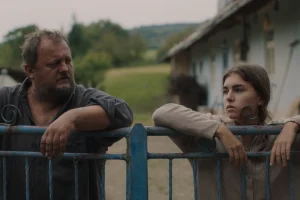
In 1958, he marries his late brother’s widow Martha (Friederike Becht) in Argentina, only for that domestic arrangement to collapse as legal scrutiny and scandal force him back into hiding. By 1963, he is living on a São Paulo cattle farm with Hungarian expatriates Géza (Tilo Werner) and Gitta Stammer (Annamária Láng), whose tolerance curdles once they understand exactly who they have taken in. In 1977, his estranged son Rolf (Maximilian Meyer-Bretschneider) visits him in Brazil, hoping for some acknowledgment of guilt. Mengele tells him to get a haircut.
Shot in lustrous widescreen black-and-white by cinematographer Vladislav Opelyants, The Disappearance of Josef Mengele is often cool to the point of detachment. Serebrennikov presents these fragments of exile in a dry, procedural register, reducing one of history’s most monstrous figures to the humiliations and routines of a hunted old man.
The point is not to humanize him, but to expose the terrifying normalcy with which evil can persist once history has moved on. The film’s clinical structure evokes the banality of evil, watching Mengele drift through polite society, family dinners, and provincial routines with the same bureaucratic self-justification that once enabled atrocity.
That strategy is violently interrupted midway through by the film’s most shocking sequence: a sudden shift into color, staged like home-movie footage, that finally confronts Mengele’s crimes at Auschwitz directly. Here, Serebrennikov abandons distance and forces the horror onscreen, depicting Mengele’s experiments and murders with sickening immediacy.
It is an intentionally jarring rupture, and the film’s most divisive choice, but also its most clarifying. The point is not simply to remind viewers what Mengele did, but to shatter any temptation to view his postwar life as merely the story of a fugitive on the run. Whatever noir pleasures the film flirts with are poisoned from within.
Diehl is exceptional in a role that demands absolute control. He never asks for sympathy, nor does the film. His Mengele is vain, brittle, self-pitying, and monstrous, clinging to the conviction that he was a serious man in service of serious ideas. Diehl plays him not as a snarling caricature, but as something more unnerving: a man who remains convinced of his own rationality long after history has rendered its verdict. His performance gives the film its center of gravity, charting the slow collapse of a man whose greatest punishment is not justice, but the gradual erosion of his own certainty.
For all its deliberate coldness, The Disappearance of Josef Mengele is a deeply unsettling film, and not always an easy one to sit with. Its fragmented structure can feel distancing, and its most graphic choices will divide viewers. But Serebrennikov’s film is too formally rigorous and too morally clear to mistake for provocation alone. This is not a portrait of a monster designed to explain him, only to show how monsters endure: through money, ideology, complicity, and the terrifying willingness of ordinary people to let them disappear.