

A banned writer dedicates himself to composing a book no one can read in The Master and Margarita, director and co-writer Michael Lockshin‘s gung-ho adaptation of Mikhail A. Bulgakov‘s literary classic now playing in select Prague cinemas (and with English subtitles at Kino Světozor). Long considered unfilmable—though that didn’t stop a number of little-seen previous attempts—this latest version is an unexpected delight, bringing Bulgakov’s work to vivid life through playful narrative devices and elaborate visual effects. It’s only fitting, considering the film’s themes, that political machinations continue to prevent it from reaching audiences outside Russia.
Principal photography on The Master and Margarita was completed in late 2021, but the film suffered a blowback during the Russian invasion of Ukraine months later, and distributor Universal Pictures backed out during post-production. If there’s one caveat to the finished film, it’s that the extensive CGI work isn’t quite up to the current Hollywood standard; one can’t help but wonder if things might have been different had it been made a year earlier.
Despite the post-production troubles, The Master and Margarita was released in Russian cinemas in early 2024, and despite being a bitter critique of censorship and oppression in 1930s Moscow—and, naturally, under Putin’s current regime—the film was a massive box office and critical hit, winning the top prize at Russia’s version of the Oscars. But despite its themes and pedigree—and despite the director’s outspoken criticism of the Russian invasion—wider international distribution for any Russian-made film remains elusive; kudos to Aerofilms for bringing it to Prague cinemas.
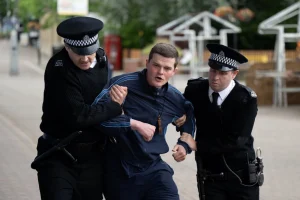
The whirlwind narrative of The Master and Margarita centers on the Master (Evgeniy Tsyganov), a writer whose latest play about Pontius Pilate has been cancelled by Soviet authorities for its parallels to the communist regime. “Write what you know,” representatives of the Union of Soviet Writers tell him before kicking him out of the union. A dangerous proposition.
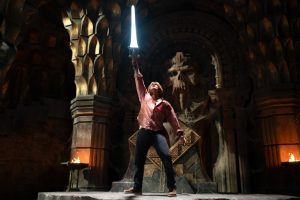
Wandering around Moscow defeated, the Master is entranced by Margarita (Yulia Snigir), who becomes his devoted lover and muse. She inspires him to continue writing despite the impossibility of his circumstances; his new work-in-progress, about the devilish Woland (August Diehl) who wreaks havoc in a society that doesn’t believe in him, is simultaneously enacted on the screen.
Lockshin employs a series of playful narrative devices that keep viewers constantly engaged. The story unfolds largely through the lens of an unreliable narrator in a sanatorium, blurring the lines between reality and imagination. At one standout point, two characters take turns recounting separate—yet converging—backstories simultaneously. But neither really exists, in a sense, as both are figments of the Master’s imagination.
This inventive structure captures the surreal spirit of Bulgakov’s novel and allows the audience to experience Moscow as a place where reality and fantasy are inseparably intertwined. As the narrative unfolds, the lines are blurred not only for the audience but also for the protagonist, whose personal memories and the story he is trying to remember become impossibly entangled.
Tsyganov is excellent as the Master; we feel the weight of oppression in his weary eyes, and his performance conveys a profound bitterness tempered by enduring humanity. Snigir is equally compelling as Margarita, bringing elegance, seduction, and raw emotional power to the role. The chemistry between Tsyganov and Snigir grounds the film, breaking through the fantastical and satirical elements to generate genuine compassion for these characters and investment in their relationship.
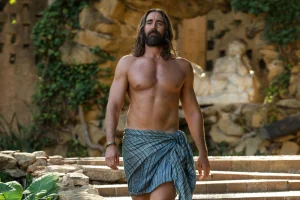
Diehl is a wonderfully menacing presence to Woland, the Devil visiting Moscow with his entourage, even if the Russian dubbing can sometimes distract (in scenes with Tsyganov’s Master, he speaks his native German). The Pontius Pilate storyline, featuring Claes Bang as the Roman official, is more condensed than in Bulgakov’s book but underscores the novel’s parallel exploration of morality and cowardice, adding depth to the Master’s own narrative struggles.
The film’s overt satire is among its strongest elements. Soviet bureaucracy, censorship, and the shallow materialism of Moscow’s elite are depicted with bitter humor, highlighting the timelessness of Bulgakov’s social critique. The parallels to Russia today are unmistakable, and the success of the film in Russia demonstrates that audiences still appreciate films that combine spectacle with pointed political commentary.
Production design, sets, and costumes are meticulously crafted, convincingly recreating 1930s Moscow while subtly illustrating the city’s transformation into a modern metropolis. Simple shots of the Master and Margarita walking through muddied period streets are mesmerizing. The CGI, meanwhile—particularly for Behemoth the talking cat (voiced by Anora‘s Yura Borisov)—is a notch below contemporary blockbuster standards; the compositing on some establishing shots also feels a little off.
Intertwining three narrative threads and jumping back and forth through timelines, The Master and Margarita moves with surprising energy. Lockshin balances these layers with care, allowing viewers to follow the story without feeling overwhelmed. The magical realism is visually inventive without being overbearing, and the emotional core of the Master and Margarita’s relationship provides a grounding human element.
The Master and Margarita honors Bulgakov’s novel through inventive narrative techniques and a commitment to the book’s dark humor, political critique, and fantastical spirit. This new adaptation is now the definitive vision of one of the 20th century’s most acclaimed novels—a bold, intelligent, and visually sumptuous work, and a rare blockbuster with a genuine literary heart. If only wider audiences had the chance to appreciate it.