
Earth’s greatest champions, and a washed-up action movie star, are thrown into a deadly interdimensional tournament in Mortal Kombat II, now playing in Prague and cinemas worldwide. This direct follow-up to the 2021 reboot makes a clear effort to course-correct for franchise devotees, leaning harder into game lore, character fan service, and elaborate fight sequences. The result is a film that will satisfy viewers here for blood-spurting combat and recognizable fighters, but will likely leave anyone expecting coherent storytelling or logical world-building increasingly exasperated.
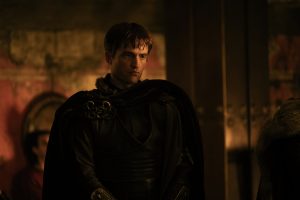
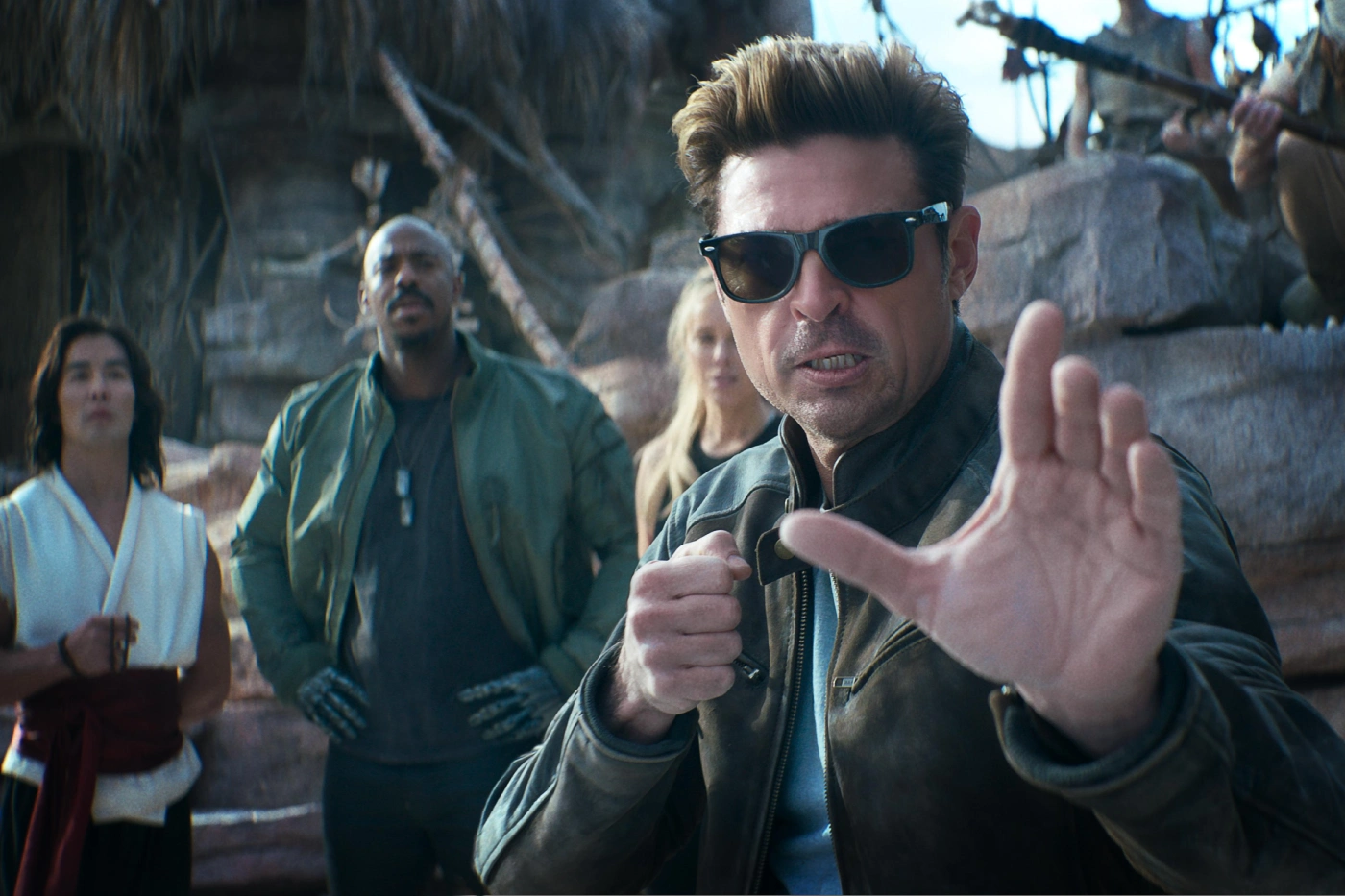
The story again revolves around Earthrealm’s champions being selected to compete in Mortal Kombat, a tournament that will decide the fate of the realms. Returning warriors Sonya Blade (Jessica McNamee), Liu Kang (Ludi Lin), Jax (Mehcad Brooks), and Cole Young (Lewis Tan) are joined by newly recruited Hollywood action star Johnny Cage (Karl Urban), whose presence immediately shifts the film’s tone into something more playfully irreverent and self-aware.
But even this premise struggles under its own internal logic. Screenwriter Jeremy Slater is working with a famously thin narrative foundation of the 1990s fighting games created by Ed Boon and John Tobias, yet the film still piles on mythology without resolving its basic contradictions.
Why is the fate of entire realms decided by an organized fighting tournament rather than outright war? If villains Shao Kahn (Martyn Ford), Shang Tsung (Chin Han), and Quan Chi (Damon Herriman) are willing to cheat, invade, and manipulate necromancy at will, what purpose does the tournament actually serve? And if divine “rules” exist, why do they appear so inconsistently enforced?
The result is a plot that constantly undermines its own stakes. Characters are summoned into fights by arbitrary divine intervention, stripping them of agency at key moments. Johnny Cage, who should anchor the emotional arc as a reluctant hero choosing to do the right thing, is instead repeatedly teleported from one set-piece to another. The film gestures toward themes of destiny, sacrifice, and heroism, but rarely allows those ideas to develop through character choice rather than plot mechanics.
Exposition, meanwhile, is relentless and often arrives at the exact moment scenes require momentum rather than explanation. Characters die, return, are resurrected, or reconfigured into alternate versions of themselves with minimal narrative consequence. Almost every major death from the previous film is undone in some form, often through Netherrealm detours or necromantic reversals, which steadily erodes any sense of permanence or emotional weight. Characters like Scorpion (Hiroyuki Sanada) and Sub-Zero (Joe Taslim) will appear in this sequel, even if our heroes have to literally go into Hell to find them.
And yet, for all its structural chaos, Mortal Kombat II succeeds most where it matters for its core audience: the fights. The action choreography is consistently strong, with clear physical staging and a welcome emphasis on practical stunt work blended with stylized CGI environments that often come right from the games: fans will be delighted to see stages like The Pit and The Dead Pool faithfully recreated here.
Matches are fast, brutal, and inventive, often recreating the feel of the games’ signature fatalities without fully descending into incoherence. The colorful arenas give each encounter a distinct visual identity, even when narrative context is distressingly thin: almost every fight is between combatants who have never met each other before.
Urban is the film’s clear standout as Johnny Cage, injecting the proceedings with charisma and comic timing that the script rarely earns. Josh Lawson’s Kano once again provides an effective anarchic Aussie energy, while CJ Bloomfield, under mounds of prosthetic makeup as Baraka, steals his scenes and becomes a surprisingly memorable physical presence in the ensemble.
Around them, Adeline Rudolph’s Kitana and Martyn Ford’s Shao Kahn supply the central mythological tension, even if the writing rarely allows that conflict to deepen beyond functional plotting. Tan, returning as Cole Young, is particularly underserved—a notable downgrade in screen time after leading the previous instalment—though his abrupt exit does at least carry a rare sense of finality in a film otherwise allergic to consequences.
The ensemble approach works best when the film leans into its game-like structure rather than resisting it. Every fighter is essentially a playable character given a brief showcase before being shuffled into the next match, and the film is most effective when it embraces that arcade rhythm without overexplaining it.
Ultimately, Mortal Kombat II is a significant improvement over its predecessor in spectacle and fan service, but (like the recent The Super Mario Galaxy Movie) a real downgrade in basic storytelling terms. It never fully solves the problem of adapting a video game into a coherent cinematic story, but it does deliver enough energy, personality, and well-executed combat to satisfy audiences who understand what they’re signing up for.