
“It’s like describing a dog to someone who has never seen a dog, and then asking them to draw it.”
A furniture warehouse manager whose life is spiraling out of control discovers a maze of bizarre rooms and hallways when he noclips through a wall in his store’s basement in Backrooms, opening in Prague and cinemas worldwide this weekend. There are some nits to pick with this liminal horror film in terms of narrative and character development, but the final result is undeniable: backed by striking visuals and an omnipresent sense of existential dread, this is a visionary work that signals a bold new voice in contemporary horror.
All the more impressive when that voice is coming from 20-year-old filmmaker Kane Parsons, who began a YouTube series based on the Backrooms creepypasta when he was barely old enough to drive. Four years later, he has reimagined the minimalistic nature of those earlier videos into something more palatable for a mainstream audience while keeping the core concept intact and deepening the lore for existing fans. The result is poised to become distributor A24’s most successful project to date, and should usher in a new series of feature films.
Written by Will Soodik (Ash vs Evil Dead) from Parsons’ earlier series, Backrooms opens with a standalone sequence that feels like it could have been its own short. Through grainy VHS found footage, we take the perspective of an unnamed protagonist who ventures too far into the titular Backrooms—a series of dull, windowless corridors made up of architectural elements that feel like they were designed by M.C. Escher—before meeting his fate at the hands of an unseen presence.
But Backrooms quickly pivots away from that format by introducing crisp digital cinematography and two tangible central characters: Clark (Chiwetel Ejiofor), owner of Cap’n Clark’s Ottoman Empire, and Mary (Renate Reinsve), a therapist trying to help him work through a mounting personal crisis. Set sometime around 1989-1990, the film leans heavily into the period through details like retro VHS commercials and Mary’s self-help psychology books on tape, which help ground the film in a tactile pre-digital reality that parallels the artificial emptiness of the Backrooms themselves.
Clark’s life is already unraveling before anything supernatural enters the picture. Following an argument with his wife, he has been sleeping inside his store, and strange electrical issues plague the warehouse after hours: lights flicker on and off without explanation, and even an electrician cannot make sense of what is happening inside the building. One night, while investigating the breaker box in the basement, Clark notices a thin seam of light emerging from behind a wall. When he touches it, he blends straight through the surface and enters the Backrooms.
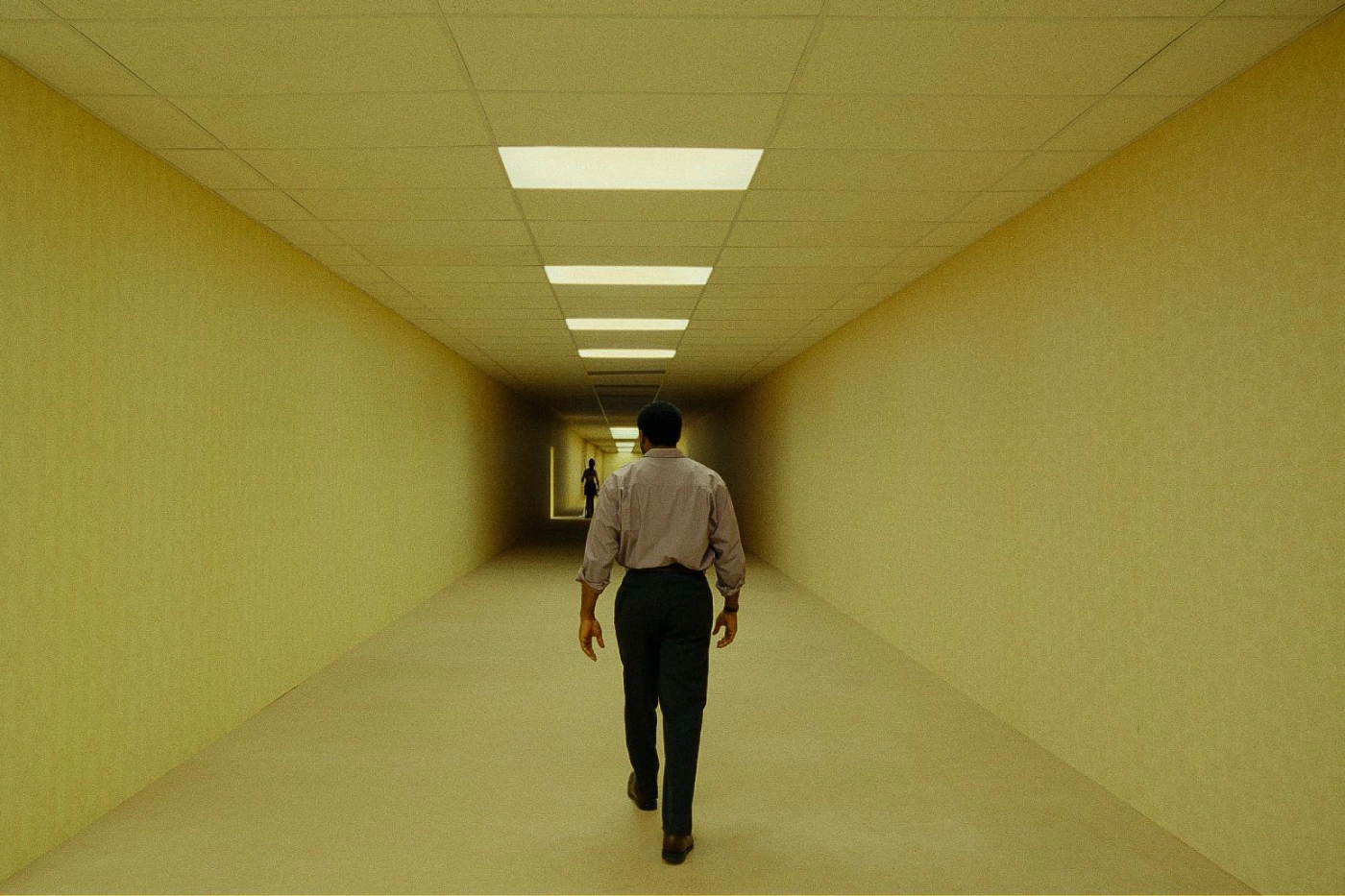
Here, Parsons creates a suffocatingly specific kind of dread without relying on jump scares or traditional horror iconography. The spaces themselves become terrifying: endless yellow hallways, humming fluorescent lights, strange architectural dead ends, and impossible room layouts that feel assembled by something attempting—and failing—to imitate human design. As Clark desperately calls out for another living soul and hears something enormous moving in the distance, Parsons turns the simple act of navigating empty office corridors into one of the most unsettling horror sequences in recent memory.
What makes these scenes especially striking is how visually distinct they feel from most contemporary studio films; if Wes Anderson ever directed a horror movie, it might look something like this. Breaking from his earlier series, Parsons and cinematographer Jeremy Cox bring an unusual crispness and visual clarity to these sterile environments, emphasizing symmetrical compositions and muted geometric design in ways that make the Backrooms strangely beautiful even as they become increasingly threatening.
Later sequences involving Clark, assistant manager Kat (Lukita Maxwell), and her videographer boyfriend Bobby (Finn Bennett) returning to document the Backrooms on VHS cameras more directly evoke the analog aesthetic of the original YouTube shorts, though one misses the clean visual precision of Clark’s first descent into the maze; thankfully, that returns as Mary begins investigating Clark’s disappearance and eventually enters the Backrooms herself.
Parsons understands that the horror of the Backrooms lies not in exposition, but in atmosphere and implication: these spaces are terrifying precisely because they feel familiar in ways that are impossible to fully articulate. Kudos to the production designers, working with a minimal budget (a reported $10 million) to create a distinctive, evocative environment that is more than just a setting but the thematic basis for the whole movie. The Backrooms feel like a corrupted reconstruction of reality assembled by something that understands the broad strokes of human existence but cannot grasp its emotional logic.
That thematic ambiguity is one of the film’s greatest strengths. The Backrooms can be interpreted as hazy memory, existential limbo, psychological collapse, or even a kind of AI hallucination—an imitation of human spaces generated without any understanding of what makes those spaces comforting or alive. Parsons smartly resists overexplaining the phenomenon, allowing the audience to sit with the uncanny fascination of these mangled environments.
The underlying themes remain compelling because the imagery itself communicates so much of the horror, even when the screenplay occasionally becomes too explicit in spelling out its ideas through lengthy dialogue exchanges. That’s really the only misstep here: two climatic sequences evoke memories of Neo meeting The Architect in The Matrix Reloaded as the film stops dead in its tracks to directly address its underlying themes, instead of weaving the subtext into the narrative in a more streamlined manner, as Parker Finn did in Smile and (especially) Smile 2.
Backrooms is greatly elevated by two exceptional lead performances from Ejiofor and Reinsve, who bring an emotional grounding that most high-concept horror films lack, crafting believable, deeply human characters even when the screenplay leaves certain aspects underdeveloped. Ejiofor gives Clark a mounting sense of desperation and instability, while Reinsve—fresh off her Oscar-nominated turn in Sentimental Value—finds depth in Mary’s quiet empathy and lingering childhood trauma.
The two actors carry the film through its more abstract stretches and make the emotional stakes feel tangible inside an intentionally artificial world. It’s only a shame that the screenplay resolves one of their storylines in somewhat abrupt and unsatisfying manner.
Still, for its minor flaws, Backrooms feels like the arrival of something genuinely new in mainstream horror: a studio-backed feature that still retains the unsettling weirdness and experimental spirit of internet-born horror storytelling. Parsons translates the uncanny dread of the original creepypasta into cinematic form with startling confidence, creating images and spaces that linger in the mind long after the credits roll. Like the Backrooms themselves, this is a film that’s difficult to fully explain—but impossible to forget.