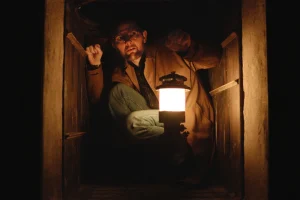
America’s rural roadways, campsites, and abandoned superstore parking lots make for a canny setting for traveler horror in Passenger, a new horror film from director André Øvredal (The Last Voyage of the Demeter, Scary Stories to Tell in the Dark) opening in Prague and cinemas worldwide this weekend.
This throwback to highway horror films like The Hitcher, Joy Ride, and Jeepers Creepers boasts some outstanding scenes of terror and a pair of engaging lead performances from Lou Llobell (Foundation) and Jacob Scipio (Bad Boys: Ride or Die), but that’s not quite enough to carry the undercooked and largely underwhelming narrative at its heart. Still, there’s more than enough here to raise your pulse, and genre audiences may be sated.
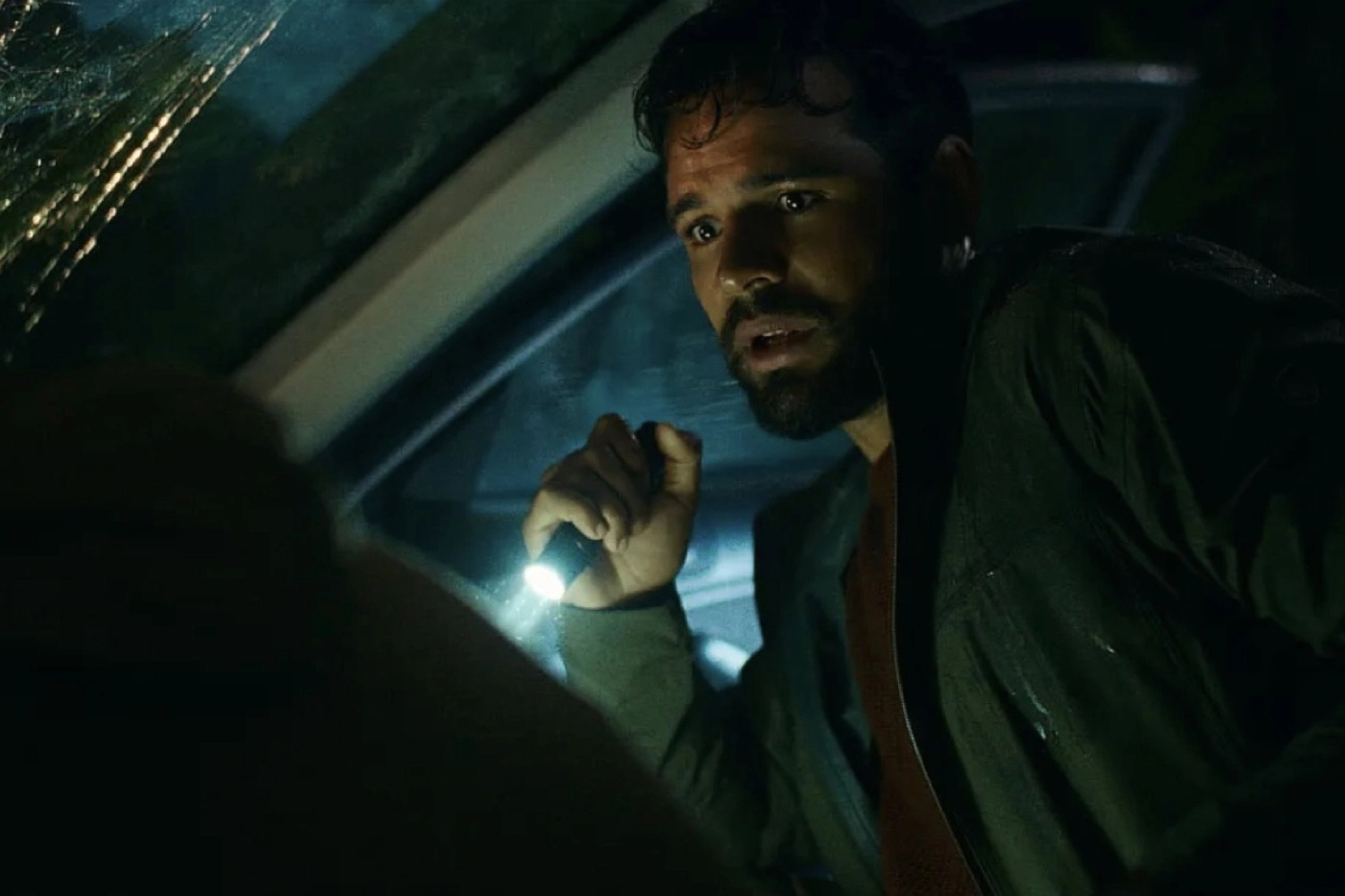
Llobell and Scipio are Tyler and Maddie, a young couple who depart from the Big Apple grind to embark on a life on the road, driving across the country in a pimped-up van and sleeping in parking lots outside 24-hour gyms. But their traveling idyll is upset after they stop to offer assistance at a crash on an isolated country road; they cannot save the unfortunate driver (Miles Fowler), but they can receive the roadway curse that led to his demise, as the supernatural Passenger now tags along for their journey.
Who is the Passenger? Played by Joseph Lopez and looking like a mummified Ozzy Osbourne, he comes to haunt our heroes in the usual Bughuul fashion: sometimes he’s there, sometimes he’s not, sometimes only one of our protagonists can see him, and sometimes they both can. He may be real, he may be imagined, and the screenplay is frustratingly skittish when it comes to establishing the rules of his existence: all we know is that a pendant depicting Saint Christopher, patron saint of travelers, can help ward him off. Or maybe it can’t.
These films usually go overboard on the exposition, but Passenger could have used just a little more in terms of backstory; Maddie’s deep dive into hobo symbology is one of the more interesting aspects of T.W. Burgess and Zachary Donohue‘s screenplay. Melissa Leo shows up as a fellow traveler the couple meet at Burning Van (heh) to fill us in on the limited details.
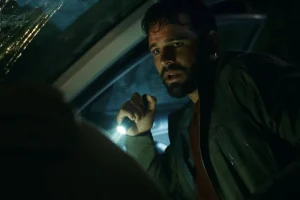
Passenger has plenty of the usual jump scares, but it’s also got three standout horror set pieces. A sequence featuring Maddie stalked by the Passenger in an abandoned Big Lots parking lot is anxiety-inducing, and another featuring Tyler crawling underneath the van to retrieve some bolts will leave you shouting at your screen. But the real showstopper is a campground scene where the ghoul haunts from behind a screen playing Roman Holiday; as Maddie uses the running projector as a makeshift flashlight, he morphs into the image of Gregory Peck.
These scenes are inventively designed and masterfully realized by director Øvredal, who weaves some real nail-biting tension into the narrative and keeps us on the edge of our seats. But they also represent only 15 minutes of Passenger‘s expedient 94-minute running time, and aren’t quite enough to overcome the general deficiencies in the rest of the script, which takes a sharp turn into silliness during a climax in the Arizona desert.
With scarcely any supporting characters beyond Leo’s brief appearances, Scipio and Llobell remain front and center for nearly the entire runtime, and both actors bring a friendly and engaging naturalism that helps sell the increasingly bizarre supernatural developments. We invest in both their relationship and the survival of these characters, which is more than can be said for most modern studio horror films.
Much of Passenger unfolds in the dead of night, lit only by headlights, parking lot lamps, and the flickering projector beam, but Federico Verardi’s cinematography never falls into the muddy, underlit digital aesthetic that plagues so many contemporary films. Øvredal and Verardi make expressive use of darkness while always allowing the audience to clearly track the geography of a scare scene—something that feels refreshing after often struggling to see what The Mandalorian and Grogu was presenting on-screen.
Øvredal leans on silence, ambient road noise, and carefully timed sound design to generate tension, supported by Christopher Young’s restrained soundtrack. The quietness of many of the scare sequences makes them significantly more unnerving, though the tension is occasionally sapped by sudden radio blasts. Of course, the film cannot resist ending with Iggy Pop’s The Passenger playing over the closing credits, matching Zack Snyder‘s use of The Cranberries in Army of the Dead.
Passenger ultimately feels like a frustrating near-miss: a horror film with terrific atmosphere, inventive set pieces, and two compelling lead performances trapped inside a screenplay that never fully figures out its mythology or thematic destination. Still, Øvredal remains an undeniably gifted horror craftsman, and there is enough genuine tension here to satisfy audiences looking for a solid late-night fright flick. Even if the story eventually runs out of gas, the ride itself might be worth taking.