
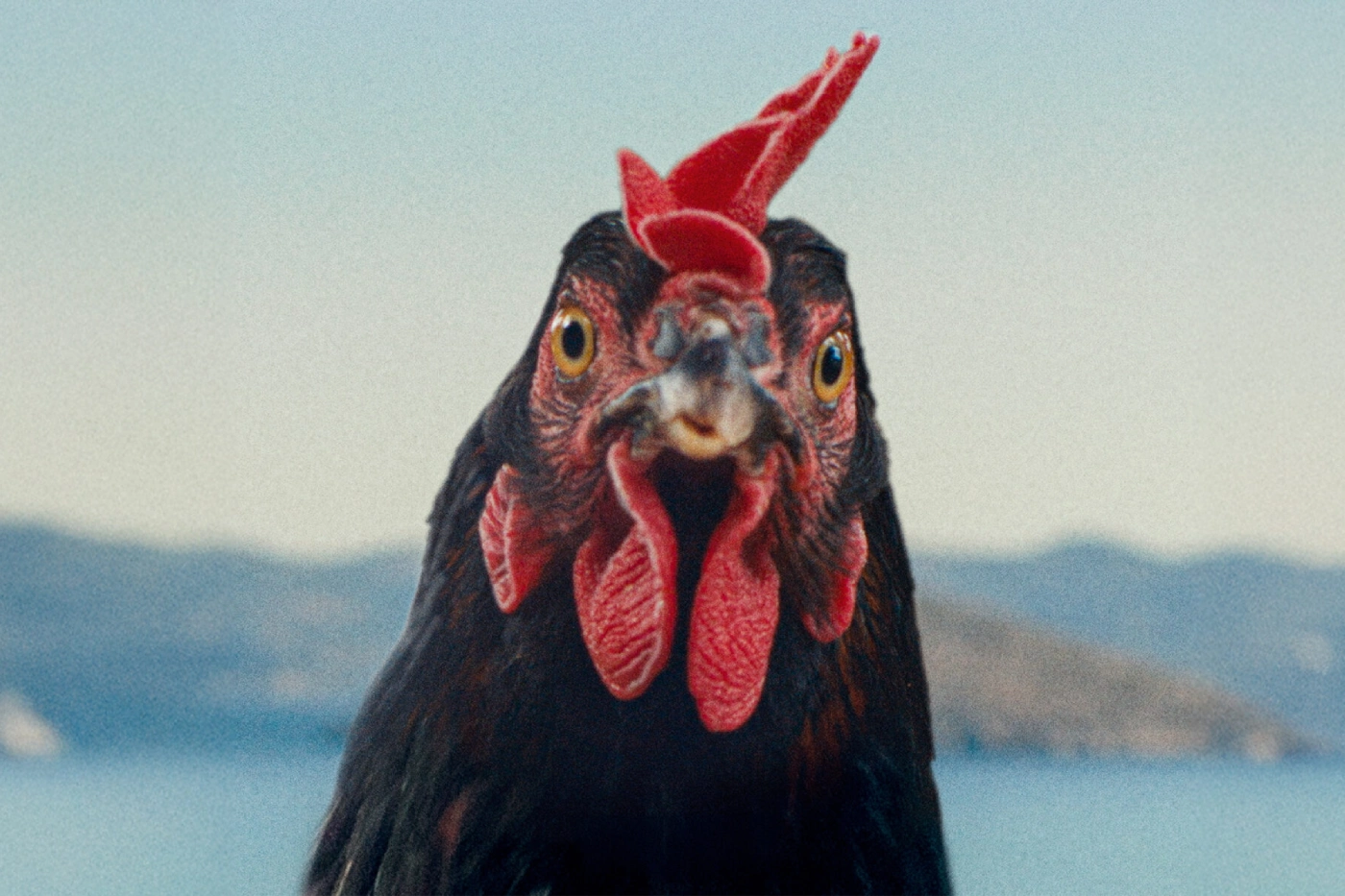
A rogue chicken observes the world around it—and particularly the plight of immigrants in Greece—in Hen, which premiered at last year’s Toronto International Film Festival and is now playing in Prague cinemas (and with English subtitles at Kino Světozor and Edison Filmhub). This story of man through the eyes of an animal immediately recalls Robert Bresson’s Au Hasard Balthazar (and Jerzy Skolimowski’s more recent EO), but director and co-writer György Pálfi (Taxidermia) maintains a bitter, unsentimental approach that lands with unexpected force.
Hen opens with striking scenes inside an industrial poultry facility, where eggs are laid, processed, and shuttled along assembly lines of machinery and human hands in an almost mechanized rhythm of production. From this system emerges our protagonist: a black chick that immediately stands apart from the others, its entry into the world defined not by nature, but by an uncaring food industry.
The titular hen matures quickly within this environment before being loaded onto a truck with the others, presumably destined for slaughter. Because of her black plumage, she is singled out by the driver and rejected from the shipment, only to be told she will instead end up as soup in his wife’s kitchen. During a stop at a gas station, however, she escapes.
What follows is a journey through rural Greece by the sea, including an encounter with a fox, before she eventually finds refuge at a decaying roadside restaurant run by an older man (Yannis Kokiasmenos), his daughter (Maria Diakopanayotou), and her child. Discovered by the family’s dog Titan, she is placed in a coop alongside other chickens.
After finding a mate in the local rooster, she lays eggs that are regularly collected by the man; in one quietly unsettling scene, she watches him crack them open and cook them into an omelet. The hen repeatedly attempts to escape, as we slowly observe the true function of the property: it is being used as a transit point for migrants arriving in Greece by boat, facilitated by local criminal figures.
Like Au Hasard Balthazar and EO, Hen largely resists anthropomorphizing its animal protagonist. The hen behaves as a hen, and the humans treat her accordingly, creating a work that feels unusually grounded and almost documentary in texture. At the same time, Pálfi allows space for the audience to project meaning onto her journey, never fully closing the gap between instinct and interpretation.
There are moments, however, where the film deliberately leans into stylization. A playful montage set to Ravel’s Boléro captures her repeated escape attempts from the coop, while a romantic musical cue underscores her brief pairing with the rooster. These sequences do not break the realism so much as refract it, gently encouraging us to read emotion into behavior that remains, on the surface, purely animal.
One of the film’s central narrative threads is the hen’s search for a safe space to lay her eggs without them being taken away by the restaurant owner. This deceptively simple instinct becomes a powerful thematic mirror for the film’s human subplot involving migrant trafficking. Pálfi draws a stark, often uncomfortable parallel between the treatment of animals as commodities and the treatment of displaced people as disposable bodies moving through a similar system of exploitation.
The film takes an increasingly bleak turn toward its climax as the migrant storyline comes fully into focus, sharpening its allegorical intent. The juxtaposition of animal and human vulnerability becomes more explicit, reinforcing the film’s central critique of systemic indifference and violence. While effective, this escalation feels unusually dark, and our protagonist’s unknowing role feels particularly cruel.
The use of animal actors in Hen is remarkable throughout. The hen—played by eight trained chickens—is seamlessly integrated into the film’s world, with seamless editing (by Réka Lemhényi) and staging so precise that at times it feels almost impossible without digital augmentation. While subtle effects work must assist at certain moments, the result is convincing throughout, including standout sequences involving a fox and a dog.
Zoltán Dévényi and Giorgos Karvelas’ cinematography is also impressive, capturing both the intimacy of the hen’s low vantage point and the broader Greek landscape with striking clarity. The camera’s proximity to the animal world gives the film a distinct visual grammar, grounding its allegory in tactile observation rather than abstraction.
Hen is a challenging but often deeply affecting allegory that extends the tradition of animal-centered cinema while pushing it into harsher political territory. Pálfi’s approach—unsentimental, patient, and often confrontational—ensures the film lingers long after its final images. It is not an easy watch, nor a comfortable one, but it is a strikingly original piece of filmmaking that uses its unusual perspective to cast familiar human horrors in a stark, unsettling new light.