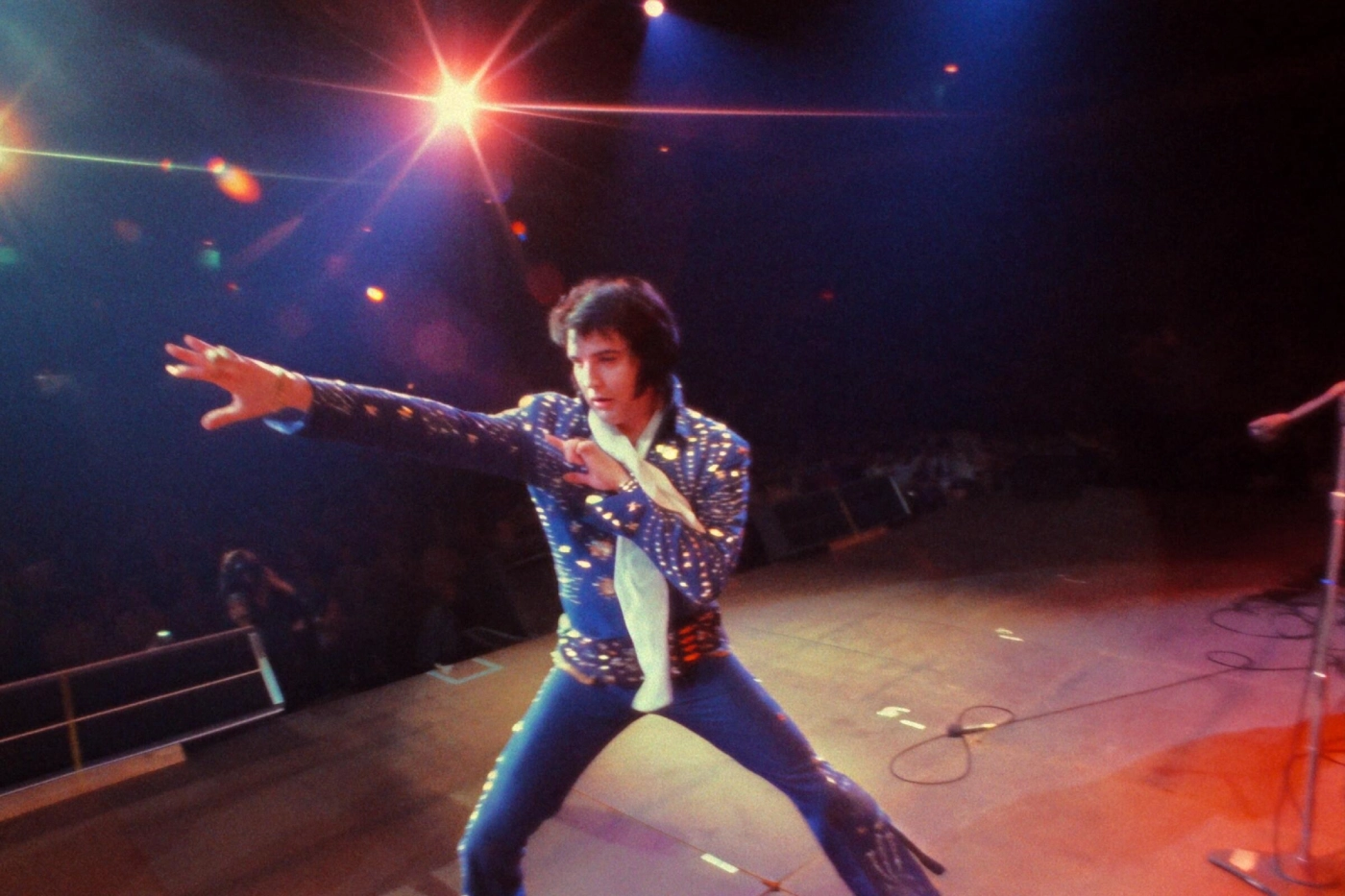

The King begins his Vegas residency inEPiC: Elvis Presley in Concert, a new concert documentary largely comprised of previously-unseen footage opening in Prague and cinemas worldwide this weekend. Built almost entirely from previously unseen archival footage, the new documentary captures Elvis Presley in rehearsal and on stage, combining dizzying energy with intimate glimpses of the artist’s personality.
While director Baz Luhrmann’s attempts to contextualize the material—including scenes dedicated to Colonel Tom Parker and brief reflections on Elvis’s views on the Vietnam War—sometimes feel distracting, the film’s core remains a thrilling celebration of Presley as a performer. While the director’s 2022 film was flawed, it remains a better venue for the bigger Elvis picture: see this one purely for the performance, and in IMAX if you can.
The first 15 minutes of EPiC deliver a whirlwind montage of Elvis’s career up to the late 1960s, tracking his meteoric rise to fame, military service, and Hollywood exploits. This dizzying opening sequence settles into the main narrative: the early days of Elvis’s Vegas residency, where rehearsal footage reveals a playful but also professional side rarely seen on screen.
Among the highlights are his riffs on Beatles classics such as Yesterday and Something, during which Presley’s characteristic humor emerges—he comments that George Harrison’s lyrics are “pretty suggestive.” Behind-the-scenes moments, including jam sessions with the TCB Band, capture a natural, laid-back camaraderie that contrasts with the high-stakes intensity of live performance.
Once the film moves to the stage, Luhrmann’s editing delivers a string of electrifying concert moments. Early performances of That’s All Right and Hound Dog demonstrate Presley’s velocity and charisma, while Polk Salad Annie showcases a raw, gritty energy that we don’t always associate with The King.
The climax brings a sequence of some of Elvis’s most iconic hits—Burning Love, Can’t Help Falling in Love, In the Ghetto, and Suspicious Minds—delivered with a force that feels both immediate and timeless. These numbers reaffirm why Presley’s Vegas period remains a pivotal moment in his artistic reinvention.
The technical craftsmanship in EPiC is equally impressive. Cinematographer Bob Scott (original archival footage) and Luhrmann’s restoration team, including Peter Jackson’s Park Road Post Production, worked meticulously to bring over 59 hours of 35mm and 8mm material to stunning 4K resolution. This is easily the best The King has ever looked on the big screen.
The film captures the shimmer of Vegas stage lights, the plush interiors of rehearsal spaces, and the expansive hotel stages, all while preserving the kinetic energy of Presley’s performances. Audio restoration, blending original recordings with newly produced tracks, highlights the tremolo and vibrato that made Elvis’s voice legendary.
The performances themselves are magnetic: Presley’s playful interactions with his band and fans reveal a performer both charming and professional, while the TCB Band punctuates every moment with precise virtuosity. EPiC also explores the duality of Presley’s public and private personas. Rehearsals and afterparty scenes show him relaxed, approachable, and capable of levity, while stage footage underscores his disciplined showmanship and flair for spectacle.
The film’s fleeting contextual moments—brief nods to Parker, commentary on the Vietnam era—suggest the tensions of a performer navigating fame, politics, and personal expression, though these asides never overshadow the heart of the film: Elvis in concert. Luhrmann wisely saves the most iconic hits for the finale, ensuring the audience leaves the cinema on the highest possible note.
At its core, EPiC reasserts Elvis Presley’s enduring cultural and musical significance. By blending intimate behind-the-scenes glimpses with high-energy performances, the film illuminates how Presley’s Vegas years were both a reinvention and a continuation of the raw charisma that first made him a global icon. For fans and newcomers alike, the documentary provides a rare opportunity to see The King in his element—swinging, smiling, and singing with a presence that feels both monumental and immediate.
Ultimately, EPiC: Elvis Presley in Concert is a triumph of archival resurrection, restoration, and modernization. Luhrmann’s vision allows Presley’s talent to shine in a way no prior concert film has achieved, making it arguably the most exhilarating and intimate portrait of Elvis ever captured on screen. For anyone seeking the full sensory thrill of Elvis live, this film delivers a dazzling, unforgettable experience, succeeding 1970’s Elvis: That’s the Way It Is as the definitive vision of The King in concert.