
A lonely survivor of an apocalyptic pandemic seeks a better life that may or may not be out there in The Dog Stars, which opens in Prague and cinemas worldwide this weekend. This initially striking Ridley Scott sci-fi flick turns frustratingly dull thanks to leaden pacing and an underdeveloped script lacking in narrative momentum, but comes to vibrant life during a wild third act that feels like it was cribbed from an episode of Fallout. While a mixed bag overall, there’s enough interesting stuff going on here to warrant a mild recommendation.
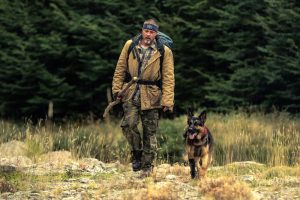
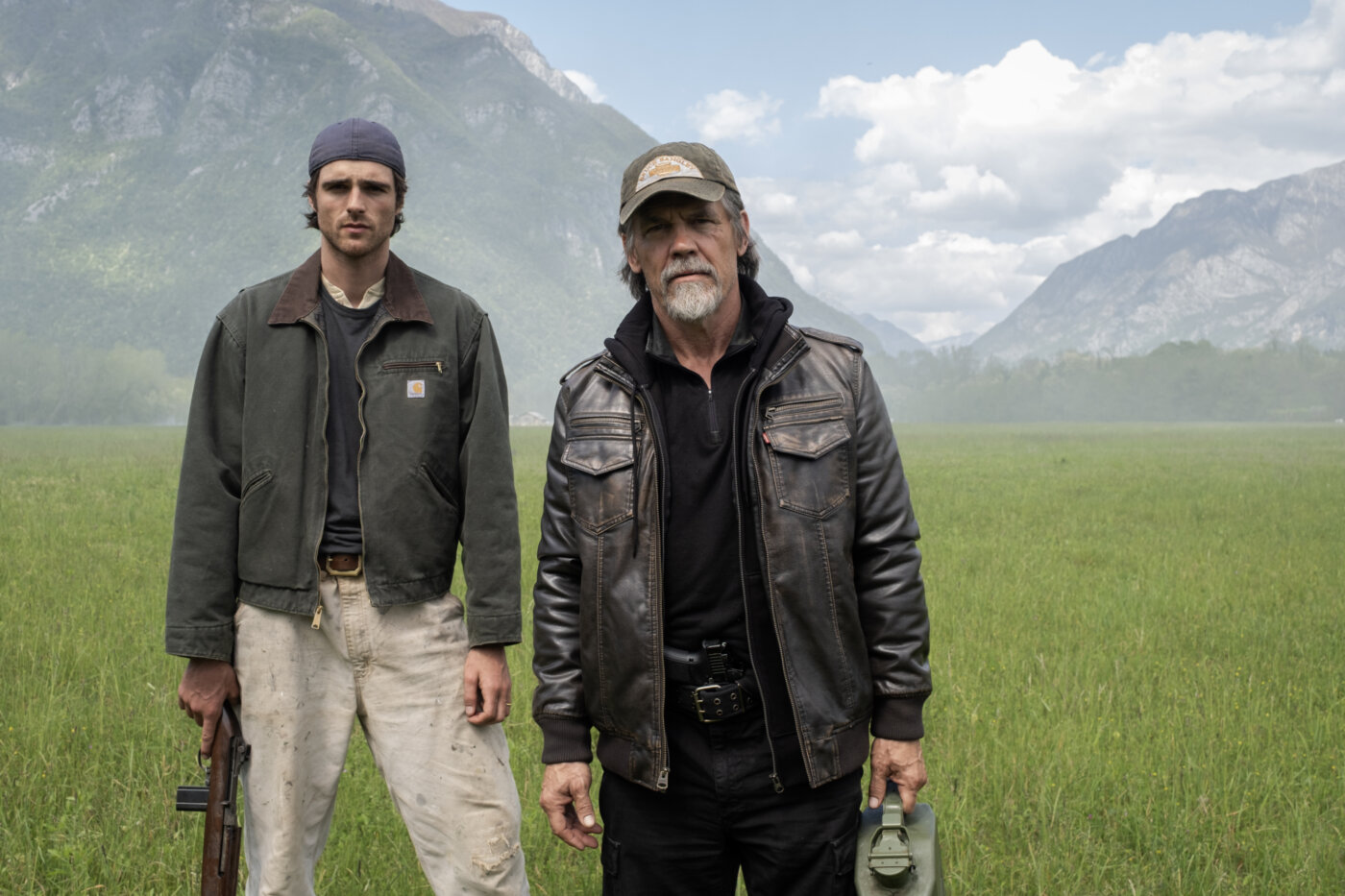
The Dog Stars features Jacob Elordi as Hig, a widower living with his German Shepherd Jasper at an abandoned military airfield in Colorado a decade after an influenza pandemic has decimated the human population. His only human companion is Bangley (Josh Brolin), a heavily armed military veteran who takes a considerably less charitable view of the remaining survivors than Hig does. Hig periodically flies his small Cessna into the ruins of Denver to scavenge for supplies, but when he picks up a faint radio signal from Grand Junction, he begins to wonder if there might be a better life waiting somewhere beyond the horizon.
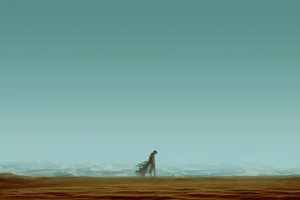
The opening scenes of The Dog Stars are arresting as Hig and Jasper quietly scavenge through a futuristic Denver devoid of people and overgrown with vegetation, immediately recalling sci-fi classics like I Am Legend or A Boy and His Dog. There’s almost no dialogue as Scott immerses us in this strange new world: abandoned buildings, wild plants reclaiming the city, and the eerie traces of whatever civilization was left behind. The production design is striking, and when Hig encounters another scavenger and learns about a new gang known as the Reapers, who leave burned corpses and mysterious symbols in their wake, it’s easy to imagine an exciting feature movie built around this setup.
But Hig is only in Denver to collect supplies. Soon he’s back at the airfield, where he and Bangley bicker over the latter’s policy of shooting first and asking questions later. Hig also delivers medical supplies to a secluded Mennonite community overseen by Aaron (Benedict Wong), whose children suffer from a potentially deadly blood disorder. It’s a bleak existence, and Hig is increasingly burned out by it. When that faint radio signal suggests that someone might still be alive in Grand Junction, he decides to find out for himself.
Thematically, there’s plenty to work with here. The screenplay by Mark L. Smith, adapted from Peter Heller’s novel, taps into both recent fears of global pandemics and much older anxieties about what remains when society collapses. Hig is searching for something better, but the film gradually reveals that what he really needs is a reason to appreciate the gift of life he already has in the wake of so much death.
The problem is that The Dog Stars makes this underlying theme the primary narrative thrust, and there simply isn’t enough happening around it to sustain the journey. Survival itself is mostly an afterthought; the Reapers are introduced as a potentially terrifying new threat but barely factor into the story, and Hig’s search for Grand Junction is less an urgent quest than a long road trip toward a predetermined emotional conclusion.
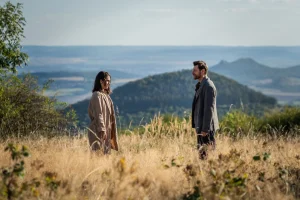
Engine trouble strands Hig at an isolated ranch inhabited by Pops (Guy Pearce) and his daughter Cima (Margaret Qualley), where he begins repairing his plane and gradually earns their trust. Qualley is particularly good at conveying Cima’s guarded grief without overplaying it, while Pearce initially bristles with hostility before slowly warming to his unexpected visitor. But these central relationships remain frustratingly underdeveloped, just as Hig’s relationship with Bangley never quite reaches the dramatic weight the story seems to be aiming for.
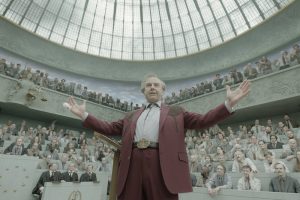
When Hig finally reaches Grand Junction, however, The Dog Stars suddenly becomes a different movie. For about 10 minutes, the film surges to strange life with a bizarre community led by Darlene, played by Allison Janney in a retro flight-attendant uniform and a performance that hijacks the entire movie.
There’s something unsettlingly surreal about the sequence, which recalls The Shining as much as Fallout, and the eccentric inhabitants seem to belong to a completely different, and considerably more interesting, post-apocalyptic story. Janney is having a blast with the material, and the sudden tonal shift is so striking that it almost feels like we’ve stumbled into another movie.
The Dog Stars keeps teasing more interesting possibilities—the Reapers, the mysterious radio transmissions, the ruins of Denver, the communities that have developed after the apocalypse—but repeatedly retreats into Hig’s emotional journey. We understand where the character needs to end up long before he gets there; what’s missing is something to hang the story on while he does it.
Scott, now 88, remains one of cinema’s great world-builders, and he and cinematographer Erik Messerschmidt makes the most of the film’s rural and urban landscapes. The brief glimpses of Denver, with skyscrapers disappearing beneath layers of vegetation, recall The Last of Us, while the aerial photography of the mountains and valleys gives the film an appropriately expansive sense of isolation. Scott also stages the occasional burst of violence with veteran precision, even if the action often feels disconnected from the more reflective drama surrounding it.
Harry Gregson-Williams’ score is another highlight, shifting between atmospheric suspense and warmer melodic passages that reinforce the film’s underlying message about human connection. Songs including Van Morrison’s Tupelo Honey and Hozier’s Like Real People Do add to the film’s melancholy, the latter effectively functioning as its emotional anthem.
There’s a great movie buried somewhere inside The Dog Stars, but the film ultimately settles for a familiar story about grief, survival, and learning to value human connection, handsomely mounted by a filmmaker who can still stage some visually arresting sequences. Elordi and the supporting cast keep it watchable, but without another narrative engine to drive Hig forward, we spend too much time waiting for The Dog Stars to arrive somewhere more interesting.