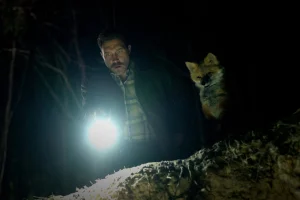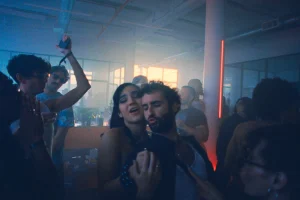

A struggling novelist moves into the home of an incapacitated bestselling author to complete her popular book series, and becomes entangled with the woman’s handsome husband, in Verity, now playing in Prague and cinemas worldwide. Michael Showalter‘s adaptation of Colleen Hoover‘s bestseller promises a throwback to the glossy erotic thrillers of the 1990s, but spends most of its nearly two-hour runtime as a dull Rebecca retread before finally exploding into something far more entertaining: an objectionably contrived series of revelations that border on accidental comedy.
Dakota Johnson stars as Lowen Ashleigh, a critically respected but commercially unsuccessful writer who is hired to finish the books of Verity Crawford (Anne Hathaway), a literary superstar left apparently catatonic after a car accident. The assignment comes through Verity’s husband Jeremy (Josh Hartnett), whom Lowen has already met under grisly circumstances on a Manhattan street before discovering his connection to her prospective employer.
For reasons that make considerably more sense to the screenplay than they do to anyone watching it, Lowen must move into the Crawfords’ lavish home to sift through Verity’s notes and research. Apparently none of these mountains of paper could be scanned, photographed, boxed up or otherwise transported in the digital age; Lowen needs to live alongside Verity, Jeremy and their young son Crew (Liam Fitch) for as long as the movie requires.
The arrangement immediately suggests Rebecca, with Lowen entering the home of another woman and gradually becoming attracted to her husband while the absent-yet-inescapable wife seems to occupy every room. Except Verity isn’t actually absent. She’s sitting there in a wheelchair, silently staring at Lowen in a manner that should probably convince our protagonist to find a hotel.
Lowen soon discovers something much more interesting than the notes for Verity’s unfinished novels: an unpublished autobiographical manuscript in which the author describes her obsessive relationship with Jeremy and increasingly disturbing feelings about motherhood. Hathaway narrates these passages while Showalter dramatizes them in flashback, and Lowen slowly begins to wonder what really happened inside the Crawford family. Very, very slowly.
The manuscript becomes the engine of Verity, but it’s a strangely inefficient one. Lowen appears to spend weeks reading something that could presumably be finished over a couple glasses of wine, discovering each crucial passage at exactly the moment the screenplay needs her to. Meanwhile, her relationship with Jeremy predictably intensifies, ensuring that by the time she reaches the manuscript’s most alarming revelations, she has become personally invested in what they might mean.
We spend much of the movie waiting for the obvious trap to spring. Is Lowen being manipulated? Did Jeremy deliberately leave the manuscript where she would find it? Are we watching another variation on Rebecca, with a vulnerable young woman seduced by a grieving husband whose version of his marriage shouldn’t be trusted for a second?
To Verity‘s credit, the answer isn’t quite what you expect. To its considerable discredit, what actually happens is so convoluted that the final stretch becomes hilarious.
It’s difficult to discuss the climax without spoilers, but suffice it to say that characters begin making decisions that bear little relationship to the people we’ve been watching for the previous 100 minutes. Jeremy’s reactions to certain discoveries are almost impossible to reconcile with either common sense or the information available to him, while Lowen eventually makes a pivotal choice that feels less like the culmination of her character arc than something demanded by a screenplay desperate to reach its final twist.
And then there’s Anna (Ismael Cruz Córdova), Verity’s nurse, who spends much of the film lurking around with precisely the kind of ominous presence that announces “red herring” in flashing neon letters. Like several elements of Verity, the character seems designed primarily to keep us guessing rather than to withstand any scrutiny afterward.
The sheer audacity of the ending is nevertheless entertaining. Once Verity finally stops being boring and starts assaulting our intelligence, it develops a kind of trashy momentum that the rest of the movie desperately needed. There’s pleasure in watching talented actors attempt to sell material this ludicrous with straight faces, even as each new revelation makes the previous one seem almost reasonable.
Perhaps Hoover’s novel makes these developments more convincing by allowing readers access to the characters’ thoughts, or simply by letting its ambiguities linger on the page. Onscreen, the mechanics are brutally exposed. People must behave irrationally because otherwise the next revelation can’t happen, and the entire construction threatens to collapse if you stop for even a moment to ask why anyone is doing what they’re doing.
That’s especially disappointing because Verity arrives with all the ingredients for a satisfyingly lurid erotic thriller. Johnson, Hathaway and Hartnett make for an absurdly photogenic triangle, the isolated luxury home provides an appropriately chilly setting, and Amy Williams’ handsome production design gives the movie the glossy surfaces associated with Basic Instinct, Fatal Attraction and their many imitators.
There are moments when you wonder whether director Showalter, who has a long and successful background in comedy, knows exactly how ridiculous this all is. If Verity were being played as a straight-faced parody in the vein of A Deadly Adoption, the wonderfully bizarre Lifetime movie starring Will Ferrell and Kristen Wiig, some of its choices might make more sense. But if there’s an inside joke here, nobody has let the audience in on it.
The movie’s most interesting ideas concern writing itself: whether something committed to the page represents confession, fantasy or manipulation, and how readily readers impose truth upon fiction when given the right context. There’s potentially a nasty little thriller buried in that ambiguity, especially when the person interpreting the text has already developed reasons to believe it.
But Verity ultimately cheats its own questions by piling contrivance upon contrivance. Instead of making us reconsider what we’ve watched, its twists encourage us to reconsider whether any of it made sense in the first place.
That’s a shame after last year’s The Housemaid demonstrated how much fun this kind of glossy pulp can still be when filmmakers embrace its absurdities and keep the machinery moving. The strong box office for both movies suggests audiences remain hungry for the erotic thrillers that largely disappeared from multiplexes after the 1990s. Hopefully Hollywood takes the right lesson from that appetite. But for a movie built around sex, murder, and obsession, Verity commits the one sin a trashy thriller should never permit: for most of its runtime, it’s simply dull.