An out-of-his-depth courier comes face-to-face with a zombie pandemic in Resident Evil, opening in Prague and cinemas worldwide this weekend. Filmed in the Czech capital and other locations in Bohemia last fall, this pulse-pounding, nerve-wracking thriller kicks into high gear after a breezy 15-minute setup and doesn’t let up until the closing credits. And while Zach Cregger‘s reboot may not have the colorful characters or elaborate backstory of the Capcom video games, it nails the survival-horror feeling of playing them, and that should translate well for both series fans and general audiences this Halloween season.
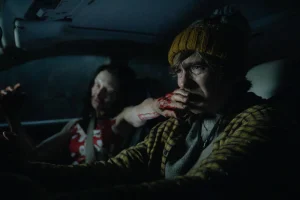
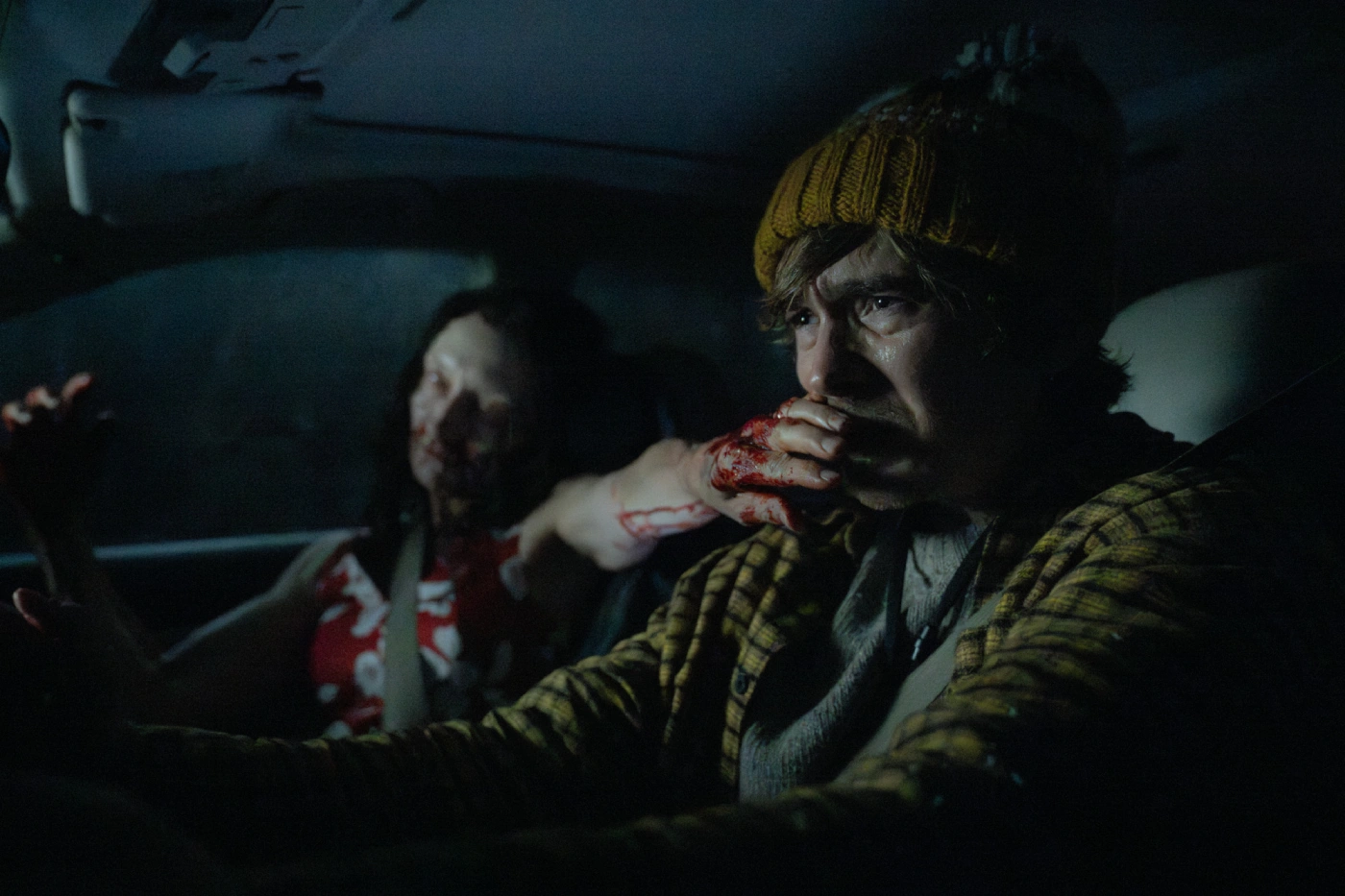
Resident Evil stars Austin Abrams as Bryan, a medical courier we first meet hopelessly wandering around a busy hospital trying to locate the recipient of the organ he’s carrying. He’s finished for the night when a doctor offers him one final delivery: drive a package to Raccoon City and he’ll get paid double. There’s just one caveat: heavy snow is falling, and Bryan doesn’t have winter tires.
On the road, he speaks to his pregnant girlfriend, who wants to know how he feels about the decisions ahead of them. Bryan tells her that he’ll support whatever she chooses, a superficially reasonable answer that clearly isn’t what she wants to hear. He’s still pondering that conversation when he hits a woman standing in the middle of the road.
From there, Resident Evil almost never stops moving, and a series of successively tense scenes includes an encounter with a local sheriff (Johnno Wilson), an isolated farmhouse and a snarling guard dog that recalls the creature in John Carpenter’s The Thing, and Umbrella soldier Maxine (Kali Reis) and scientist Carl (Paul Walter Hauser), who reveal the importance of the package he’s carrying and give his increasingly desperate journey through Raccoon City a destination.
That’s about all the plot Resident Evil needs. Director Cregger, coming off Barbarian and last year’s Weapons, isn’t interested in spending much time explaining viruses, corporations or the elaborate mythology accumulated across three decades of video games. He drops Bryan into the nightmare and concentrates almost exclusively on getting him, and us, through it from point A to point B.
The result is an unusually pure piece of survival horror. Cregger and cinematographer Dariusz Wolski frequently frame the action as if we’re navigating one of the games ourselves: a flashlight beam cuts through an otherwise black corridor, the camera inches toward a blind corner, and empty space becomes threatening simply because something might suddenly occupy it. Bryan enters unfamiliar locations, searches for weapons and ammunition and tries to determine which direction offers the least horrible way forward.
Cregger’s previous films were more controlled. Weapons, in particular, patiently constructed its mysteries and knew precisely when to break the tension with a sudden scare. Resident Evil has little interest in such patience. It’s louder, faster and considerably messier, essentially transforming into a feature-length splatter movie that keeps inventing increasingly revolting obstacles to throw in Bryan’s path.
And those obstacles are terrific. Instead of relying exclusively on familiar shambling corpses (the term ‘zombie’ is never mentioned here), Cregger unleashes mutations that seem capable of combining and transforming in unpredictable ways. A rolling mass of human body parts, an enormously bloated naked man with an especially disgusting surprise inside him, and an acid-spewing creature that makes an elevator ride considerably more complicated are among the highlights.
The effects are gruesome, imaginative and frequently very funny. Cregger approaches them with the same perverse curiosity as his protagonist. When Bryan witnesses two infected bodies doing something anatomically unprecedented in front of him, his response is less screaming terror than fascinated disbelief. Abrams’ delivery of a simple observation (“oh, that’s interesting”) neatly summarizes the movie’s attitude toward its own carnage.
That gallows humor is important because Resident Evil gets extraordinarily nasty. Bodies rupture, mutate, melt and recombine, but Cregger rarely asks us to recoil solemnly from what we’re seeing. He wants us leaning forward to get a better look. The gore becomes part of the fun without completely defusing the threat behind it, an especially difficult balance that the director maintains through most of the film.
Abrams, who was a standout in Weapons, is an ideal guide through the mayhem. Bryan isn’t an action hero and never magically turns into one. He panics, wastes ammunition magnificently (padlocks are his biggest foil), makes terrible decisions and survives encounters through some combination of instinct and luck. Abrams gives him enough personality to carry a movie entirely by himself while retaining the sense that he’d very much prefer to be anywhere else.
The supporting cast, including Reis, Hauser and Zach Cherry as another Umbrella scientist who shows up late, provide entertaining company when they appear, but they’re deliberately fleeting presences. This is Bryan’s nightmare, and Cregger isn’t building an ensemble in the manner of the Paul W.S. Anderson Resident Evil films.
There’s more going on beneath all the bloodshed than initially meets the eye, too. Bryan’s early conversation with his pregnant girlfriend hangs quietly over a movie that repeatedly confronts him with corrupted versions of childhood and new life. Among the infected he encounters are children, including some who retain just enough humanity to make his necessary acts of self-preservation particularly disturbing.
Cregger doesn’t belabor the connection, but it’s difficult to miss as these encounters accumulate. Bryan begins the night unable to articulate what responsibility he wants to take for bringing a child into the world; he then spends the rest of it confronting a world in which creation has gone grotesquely wrong. Birth, infection and mutation become variations on the same biological process as bodies create new forms of life that their hosts ultimately cannot control.
Wolski’s cinematography keeps much of the movie appropriately dark, sometimes sacrificing visual clarity for atmosphere but making those flashlight-lit interiors particularly effective. The real technical standout, however, is the propulsive score from Hays Holladay and Ryan Holladay. Their music pounds away beneath Bryan’s journey and helps maintain an almost exhausting level of momentum once the film gets moving.
Prague audiences will also have an additional layer of fun spotting familiar locations beneath Cregger’s Raccoon City makeover. One of the movie’s biggest monster set pieces unfolds around the Negrelli Viaduct, while Přístavní Street in Holešovice becomes the site of another spectacular sequence as Bryan approaches the hospital through a snow-covered urban nightmare.
As an adaptation, Resident Evil maintains a surprisingly loose relationship with the Capcom games. Raccoon City and the Umbrella Corporation are present, while a farmhouse typewriter, familiar weapons and other visual details function more as Easter eggs than pieces of substantial world-building. Viewers looking for established characters, monsters or a faithful reconstruction of the games’ mythology may understandably wonder why the movie carries the Resident Evil name.
But Cregger has captured something more fundamental. Resident Evil doesn’t reproduce the games’ stories so much as translate the experience of playing them: entering a dark room with too little ammunition, hearing something you can’t see, wondering whether you should investigate, and discovering that whatever is waiting around the corner is considerably worse than you imagined.
For a breathless 90 minutes, that’s enough. Resident Evil is less interested in expanding a franchise than trapping an ordinary guy inside a survival-horror game and watching him desperately try to make it to the next checkpoint. With Abrams’ wonderfully frazzled performance, gleefully disgusting creature designs and Cregger’s almost relentless command of tension, it’s a hell of a ride, and one of the rare video game adaptations that understands capturing how a game feels can matter more than recreating what happens in it.