A man inherits a dilapidated country estate and becomes entangled in its deep-seated mysteries in Wirbel, the feature debut of writer-director Tomáš Hubáček now playing in Prague cinemas (and with English subtitles at Kino Pilotů). This ethereal drama with tinges of horror benefits from gorgeous compositions that take full advantage of its Central Bohemian Uplands locations, though audiences expecting a coherent or even tangible story may be left cold.
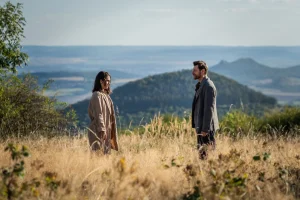
Wirbel stars David Švehlík as Martin, a weary, seemingly directionless man who arrives at an isolated farmhouse inherited from his estranged father. Dressed in a suit and carrying a suitcase, he looks conspicuously out of place in the rolling countryside, where the neglected house stands amid fields and hills that appear almost untouched by modern civilization.
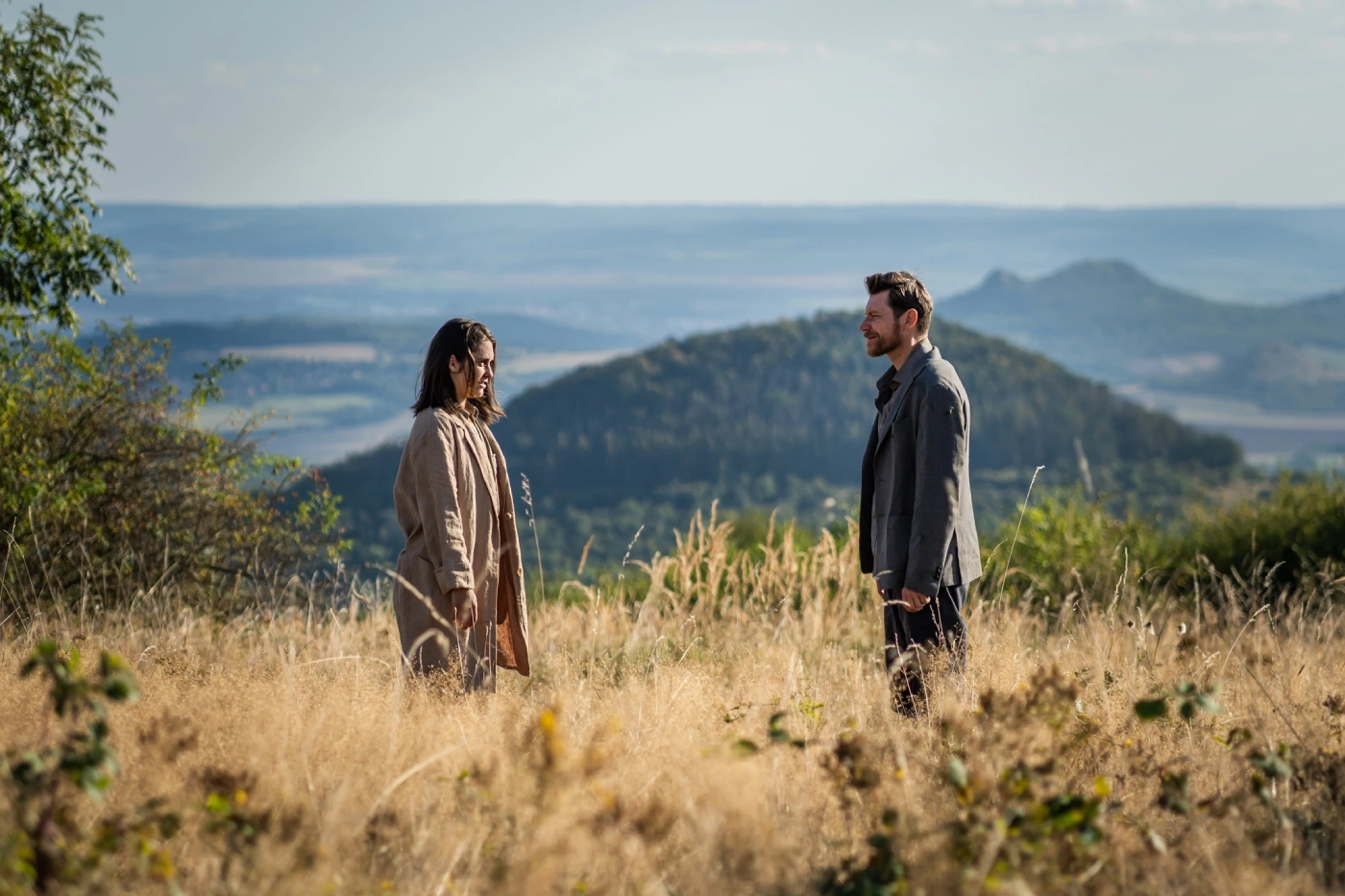
Martin settles into the property with little apparent purpose, gradually exploring the surrounding landscape and encountering its few inhabitants. Among them is Agnes (Judit Pecháček), an enigmatic young woman who seems to possess a deeper connection to the land and its troubled history. As Martin becomes increasingly drawn to her, he begins to uncover traces of the region’s former German inhabitants, along with suggestions that something ancient and potentially dangerous has awakened.
The village is experiencing unusual tremors and drought, and local stories hint at a supernatural force that has been disturbed by the abandonment of old traditions. Martin’s uncle (Milan Mikulčík), secluded away in a manor next to the local slaughterhouse, provides some clues, but Hubáček is in no hurry to explain what any of it means.
The director establishes a remarkably convincing folkloric atmosphere, allowing fragments of history, religious symbolism and supernatural suggestion to accumulate without explicitly connecting them. We’re drawn into the landscape alongside Martin, searching for meaning in abandoned buildings, damaged monuments and the strange behavior of people who seem to know considerably more than they’re willing to say.
The film opens with the legend of St. George and the Dragon, a story traditionally understood as the triumph of Christian virtue over an evil creature demanding sacrifices from the local population. But Hubáček’s interpretation appears considerably more complicated, particularly when the legend is placed alongside the history of the Sudetenland and the expulsion of its ethnic German population following World War II.
The Germans who once inhabited this landscape maintained traditions and rituals that connected them to the land, including, perhaps, ways of appeasing the mythical “dragon” beneath it. With those communities forcibly removed, their customs disappeared as well. The people who subsequently occupied the region inherited its houses and fields but not necessarily the knowledge or cultural relationships that had sustained them.
The resulting tremors and drought suggest a landscape thrown out of balance, its ancient guardian or adversary awakened because nobody remembers how to live alongside it. Whether the dragon is an actual supernatural presence or a metaphor for the consequences of historical displacement and environmental neglect is left deliberately unresolved.
There’s an especially intriguing inversion of the St. George legend here. What if the dragon isn’t simply an evil that must be destroyed? What if it represents something essential to the land, and the true catastrophe comes from a civilization that has forgotten its obligations to the natural world?
Key to that reading is Agnes, and Pecháček gives an enchanting, elusive performance as a woman who might represent the landscape’s surviving memory, its wounded spirit or even the dragon itself. Her relationship with Martin carries echoes of František Vláčil‘s Adelheid, another Czech film in which the intimate connection between a Czech man and a German woman becomes inseparable from the unresolved trauma of the postwar borderlands.
Like Adelheid, Wirbel explores the uneasy relationship between personal desire and historical inheritance. Martin has been given a home, but does he have any real claim to belonging there? Agnes seems to understand the landscape in ways he cannot, and their tentative connection suggests the possibility of reconciliation with a past that the contemporary region has never fully confronted.
Švehlík is a moderately engaging presence as Martin, conveying exhaustion and alienation through his reserved physicality, but the screenplay gives us almost nothing with which to understand him. We learn that he hasn’t seen his father since early childhood, while a conversation with a former girlfriend suggests he’s somehow given up on life. Beyond those fleeting details, however, Martin remains a blank slate.
Some indication of what he’s running from, what he wants or why he becomes invested in the estate’s mysteries would give the story a much-needed emotional foundation. Instead, Martin often seems less like a character than a figure placed within Hubáček’s carefully constructed compositions. He wanders through fields, explores old buildings and follows mysterious clues, but we rarely understand what any of these discoveries might mean to him.
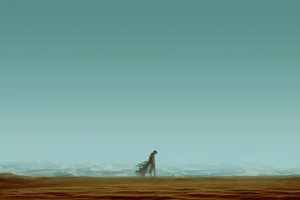
Cinematographer Alan Soural captures the Central Bohemian Uplands in images of remarkable beauty, frequently placing tiny human figures against enormous expanses of rolling fields, isolated trees and ancient volcanic hills. The compositions emphasize both the majesty of the landscape and the insignificance of the people who briefly inhabit it, suggesting a place that existed long before its current residents and will endure long after they’re gone.
These aren’t merely attractive establishing shots. The landscape becomes the film’s dominant presence, its contours and silences communicating more than much of the dialogue. Hubáček’s camera lingers long enough for ordinary fields and hillsides to acquire an almost supernatural weight, as though something ancient might be watching from just beyond the frame.
Equally impressive is Hubáček’s own haunting soundtrack, which combines swirling musical passages with the natural sounds of the countryside. The score builds to powerful crescendos at key moments, giving the film momentum even when the narrative appears to have stalled. Together, the cinematography and music create a hypnotic audiovisual experience that lingers considerably longer than the particulars of the plot.
There’s an intangible feel to watching Wirbel that recalls the climactic passages of Italian supernatural giallo films from the 1970s and 1980s. In those movies (The Spider Labyrinth, for one), the protagonist has finally assembled the pieces of some ancient mystery and begins searching through forgotten artifacts, underground passages and abandoned buildings in preparation for a confrontation with an unknowable evil.
Wirbel feels like that sequence stretched across an entire feature. We’re perpetually on the verge of revelation, surrounded by ominous landscapes and fragments of forgotten mythology, but the anticipated confrontation remains elusive. Despite its supernatural elements, there’s little conventional horror here; Hubáček is far more interested in sustaining the sensation of an ancient secret waiting to be uncovered.
For some viewers, that will prove frustrating, particularly as the film’s deliberate pacing and thin characterization make its mysteries increasingly abstract. But those receptive to its unusual wavelength will find an evocative, beautifully realized work that operates more like a cinematic folk tale than a traditional narrative.
This is an impressive debut, even if its ambitions occasionally exceed its dramatic grasp. Hubáček has a striking command of image and sound, and his juxtaposition of Christian mythology, Sudeten history and environmental anxiety offers considerable food for thought. Wirbel may never fully reveal its secrets, but the atmosphere it conjures is powerful enough to make the journey worthwhile.