
A groom-to-be struggles to reconcile his feelings for his future wife after a shocking revelation in The Drama, opening in Prague and cinemas worldwide this weekend. This diverting, divisive new film from A24 and director Kristoffer Borgli (Sick of Myself, Dream Scenario) combines caustic dark humor with a hefty thematic punch; while the screenplay (written by the director) makes its point early on and lags in storytelling momentum during the second half, compelling lead performances from Robert Pattinson and Zendaya keep it engaging throughout.
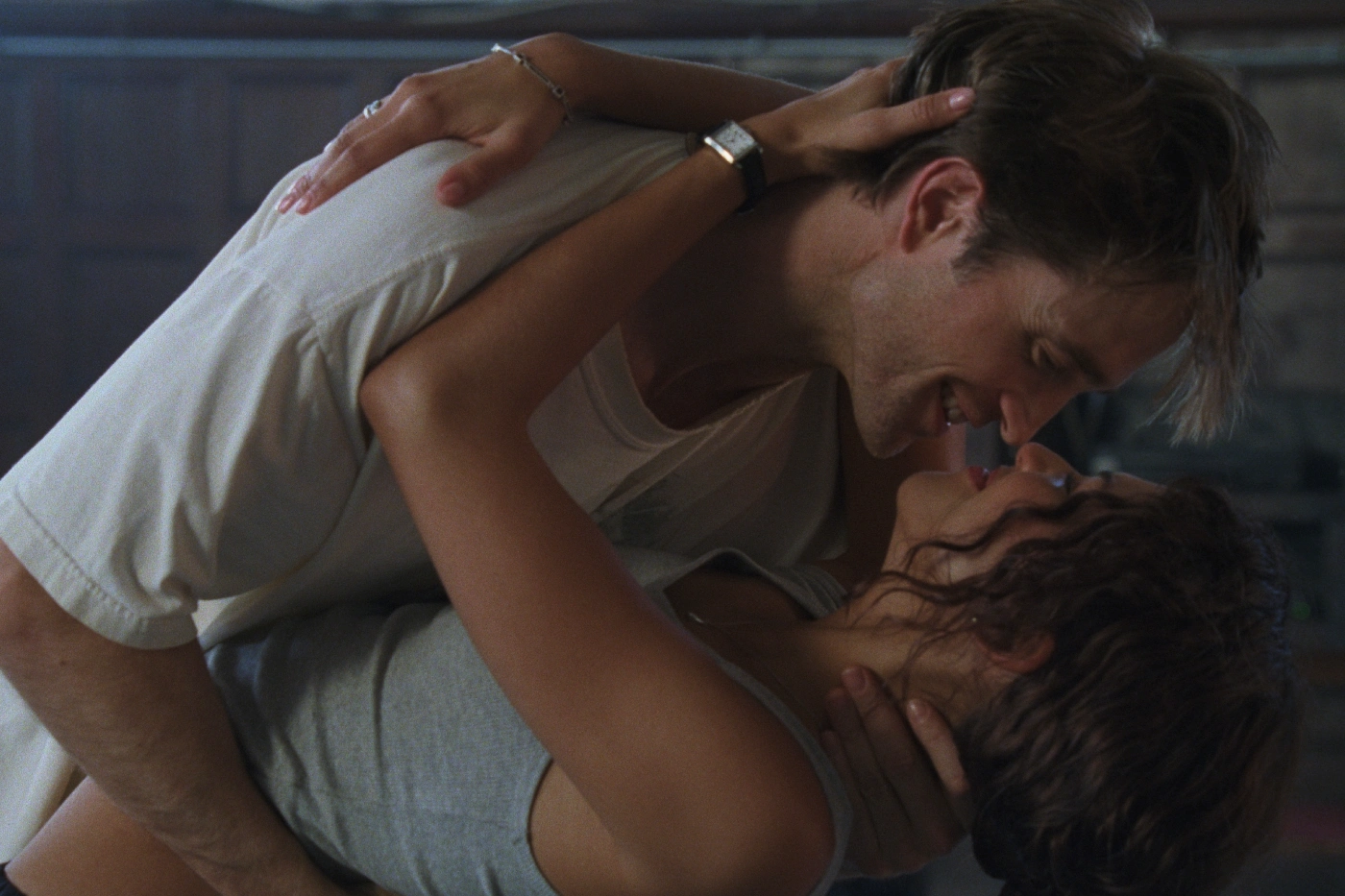
The Drama stars Pattinson as Charlie, a timid British expat in Boston who stumbles over himself while attempting to chat up Emma (Zendaya) at a neighborhood café. She’s deaf in one ear and initially misses his awkward opening attempt, only to notice him mid-delivery and generously offer him a chance to start over. It’s a small but telling gesture, already establishing Emma’s underlying warmth. Two years after the meet cute, the pair are on the eve of their wedding and deep into preparations.
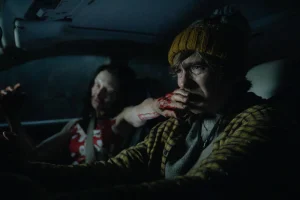
The titular drama arrives during a wedding dinner tasting with friends Rachel (Alana Haim) and Mike (Mamoudou Athie), when the group begins discussing the worst things they’ve ever done. What begins as uncomfortable dinner-party honesty escalates into a moral unravelling: Mike admits to using a girlfriend as a human shield during a dog attack, Rachel reveals she once locked a young boy in a closet overnight, and Charlie confesses to bullying a classmate so severely the boy’s family had to move away.
These are concrete, harm-causing actions, each with a clear victim and lingering consequence. But when Emma reveals something more abstract—that as a teenager she once planned a mass shooting, going as far as to bring her father’s rifle to school—the group’s reaction shifts dramatically. Despite the fact that she never acted on it, Emma becomes instantly recast as something far more monstrous in their eyes.
What follows is less a conventional relationship drama than a slow psychological erosion of certainty. Charlie, in particular, becomes unmoored, still deeply in love with Emma but unable to reconcile the gap between who she is and the violent impulses she once entertained. His struggle reflects a broader societal discomfort: an instinct to label, condemn, and simplify, rather than engage with the complexity of intent versus action. Borgli repeatedly circles the idea that empathy itself is unevenly distributed—those most quick to judge are often least capable of it, while those being judged are the ones trying, imperfectly, to understand themselves.
Emma’s backstory gradually reframes her revelation. Bullied at school, she once idolized mass shooters as distorted figures of revenge against a world she felt excluded from. But when another shooting at the local mall preempts her own plans (a sly comment on the prevalence of this kind of violence in America), she begins to confront the real human cost of the fantasies she had been entertaining, ultimately redirecting her ambitions toward anti-gun activism. The film is at its strongest in these moments, where Emma is not reduced to her revelation but expanded by it.
Much of the film’s thematic charge comes from its portrayal of how different characters process moral ambiguity. Rachel and Mike default to binary thinking—casting Emma as a psychopath—while Charlie’s inability to fully understand her pushes him into an anxious loop of reinterpretation. His desire to empathize is constrained by the limits of his own worldview; he wants Emma’s story to resolve neatly within a framework he already understands, rather than accepting that it might require him to expand that framework entirely.
Borgli uses this dynamic to probe a more unsettling idea: that the demand for moral clarity can eliminate the possibility of genuine understanding. That’s heavy thematic material for this kind of mainstream film, and while the response should be divisive, the attempt to bring these kinds of arguments to the forefront is an admirable one.
Zendaya is particularly impressive here, balancing restraint and emotional opacity with moments of striking vulnerability; Jordyn Curet, as the younger version of her character, also does some heavy lifting here. Emma is neither excused nor condemned, and both performances carefully invite our empathy. Pattinson matches his co-star with a tightly coiled, physically expressive turn as Charlie, capturing a man slowly losing his ability to trust his own judgment.
While the two stars drive the movie, supporting performances are solid across the board, even if limited to a single scene. Hailey Gates stands out in a dynamite sequence as Charlie’s colleague Misha, offering a more blunt, reductive lens through which to view Emma, while Sydney Lemmon’s DJ Pauline similarly embodies the film’s interest in how quickly people reduce others to narrative shortcuts. But the film could have been sharper, if perhaps less morally complex, if it hadn’t been Emma confronting Pauline in a way that mirrors the lack of empathy central to the movie.
If there is a limitation here, it lies in the relative thinness of the surface-level narrative. Beyond the wedding preparations and interpersonal fallout, the plot largely functions as a delivery system for thematic material. This is never fatal—Borgli is clearly more interested in ideas than incident—but it does mean The Drama‘s second half occasionally loses story propulsion.
But the filmmaker’s signature dark humor helps sustain momentum throughout. There is a consistent strain of uncomfortable irony running through the film; a scene of photographer Frances (Zoë Winters) matter-of-factly discussing how she will “shoot” everyone on the wedding day draws uncomfortable laughs. These tonal collisions recall the director’s earlier work, and also echoes the recent Good Night, Have Fun, Don’t Die, which also dealt with themes of school shootings in similarly acidic fashion.
Visually, the film is understated but controlled. Arseni Khachaturan’s cinematography favors clean, observational framing that allows performances to dominate, while production design quietly introduces unsettling details—such as a Krang-like painting in the couple’s living room—that hint at the film’s interest in distorted inner states. One only wishes the film took more advantage of its Boston setting, though The Drama was primarily shot in the UK.
The Drama succeeds as a thoughtful, uneasy exploration of empathy, perception, and moral judgment, elevated significantly by its two central performances. While its narrative structure occasionally sags under the weight of its ideas, the film’s thematic ambition and emotional intelligence remain compelling throughout. Anchored by Zendaya and Pattinson at full strength, it stands as another distinctive, conversation-starting entry in A24’s ongoing catalog of morally unsettled dramas.