

A visitor from the future leads a motley crew of diner patrons on a mission to prevent the unregulated rise of AI in Good Luck, Have Fun, Don’t Die, which debuted in the U.S. last month and opens in Prague cinemas this weekend. This trenchant satire from director Gore Verbinski with an ingratiating central performance from Sam Rockwell manages to be incredibly timely, laugh-out-loud funny, and impressively staged and designed on a tight budget. Despite some lengthy climactic exposition, this one is a real winner and one of the best films of early 2026.
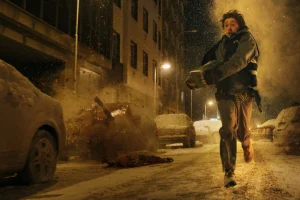
Is this reality, or are we stuck in an AI hallucination? Good Luck, Have Fun, Don’t Die stars Rockwell as the mysterious traveler, who introduces himself to a diner full of confounded patrons dressed in a clear poncho and covered in wires. He looks like a homeless man, but he insists it’s the height of fashion where he comes from: namely, the future, which has turned into a desolate hellscape through the rise of AI.
His mission: to lead a selection of these patrons on a mission to save the world, by stopping a 10-year-old boy from creating the AI algorithm that will take over the world. Only problem: he doesn’t know which selection of patrons is the right one, and this is his 117th attempt. This sounds crazy, but schoolteachers Mark (Michael Pena) and Janet (Zazie Beetz), grieving mother Susan (Juno Temple), ‘princess’ Ingrid (Haley Lu Richardson), and others have little choice but to go with it: he’s also strapped with a bomb.
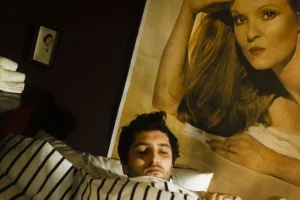
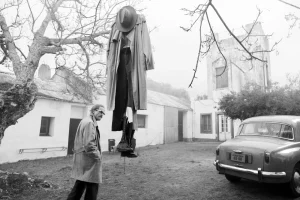
Rockwell’s appearance (and performance) immediately recalls Robin Williams in The Fisher King, while the general themes bring back memories of Twelve Monkeys and the social satire evokes Brazil to make it three-for-three in the Terry Gilliam reference department. Throw in a dash of Groundhog Day, some Edge of Tomorrow, and even The Matrix, and Good Luck, Have Fun, Don’t Die seems to riff on sci-fi classics in every other scene—but in an age of sequels and remakes and spinoffs, it never feels derivative.
Good Luck, Have Fun, Don’t Die is at its very best as a satire, and despite losing Rockwell’s caustic performance, two early flashbacks hit especially hard. In the first, Mark and Janet confront a wave of students unusually addicted to their phones when not hiding in a bunker during a school shooting. The second details Susan’s reaction to losing her own son in a school shooting—and having him replaced by a clone. That explains the unusual phone addiction—and the frequent product placement.
These scenes feel ripped from an episode of Black Mirror, and include the kind of laugh-out-loud moments of banal reactions to school shootings that few mainstream projects would touch outside of South Park. A tighter film might have stuck with the Stepford Wives teen clones angle, but Good Luck, Have Fun, Don’t Die wants to go big. In efforts to tie everything together, a third flashback tells the story of Ingrid, who is mysteriously allergic to technology, and the boyfriend (Tom Taylor) she loses to addiction to a new VR game.
What makes the film resonate beyond its sci-fi trappings is how precisely it mirrors the current moment. Matthew Robinson‘s script understands that the real danger of artificial intelligence isn’t a distant robot uprising but the quiet, incremental ways algorithms reshape human behavior long before anyone notices the consequences. Students numbed by screens, corporations monetizing grief, communities outsourcing decision-making to machines—Verbinski’s film exaggerates these tendencies just enough to expose how disturbingly close they already are to reality. The time traveler’s frantic attempts to stop the algorithm from being created feel less like science fiction than a desperate plea to slow down a technological arms race that already seems impossible to control.
Only quibble: a climactic sequence pauses the action for an extended conversation that unpacks the story’s philosophy in explicit detail, recalling the famously dense exposition dumps of The Matrix sequels. While the scene adds some welcome character insight, it also explains more than it needs to. By that point, the satire has already made its point with impressive clarity, and the film might have landed even harder had it allowed the audience to connect the final dots themselves.
Coming in at a reported $20 million budget—a fraction of the cost of the usual Hollywood project of this type—Good Luck, Have Fun, Don’t Die looks terrific, with the director’s usual keen eye for staging and blocking and creative uses of colors and shading from cinematographer James Whitaker. The extensive use of practical and digital effects is first-rate, with some climactic robotic creations that rival anything in Netflix’s The Electric State, which came in at a price tag of more than ten times that of this one.
Despite helming the massively successful first three Pirates of the Caribbean movies, Verbinski has been in director jail since 2013’s The Lone Ranger tanked at the box office. Good Luck, Have Fun, Don’t Die is his first feature in a decade since 2016’s A Cure for Wellness, and despite this one’s light theatrical performance, the director should be poised to make a comeback: it’s his best film yet, and destined to become a cult classic.