Filmmaker Ester Geislerová reconstructs the life of her father in A Pint of Ink (Dvě deci tuše), which premiered at this year’s Karlovy Vary International Film Festival and is now playing in Prague cinemas (and with English subtitles at Bio Oko, Kino Aero and Kino Atlas). This somber film is not a hagiographic portrait of one of the country’s leading experts in Japanese studies but a quietly devastating warts-and-all look at a life slowly decimated by alcoholism. Alongside Jana Hojdová‘s Robert Richardson: The White Devil, it’s one of two first-rate Czech documentaries to come out of this year’s KVIFF, both charting the tumultuous personal struggles of a leading figure in their respective fields.
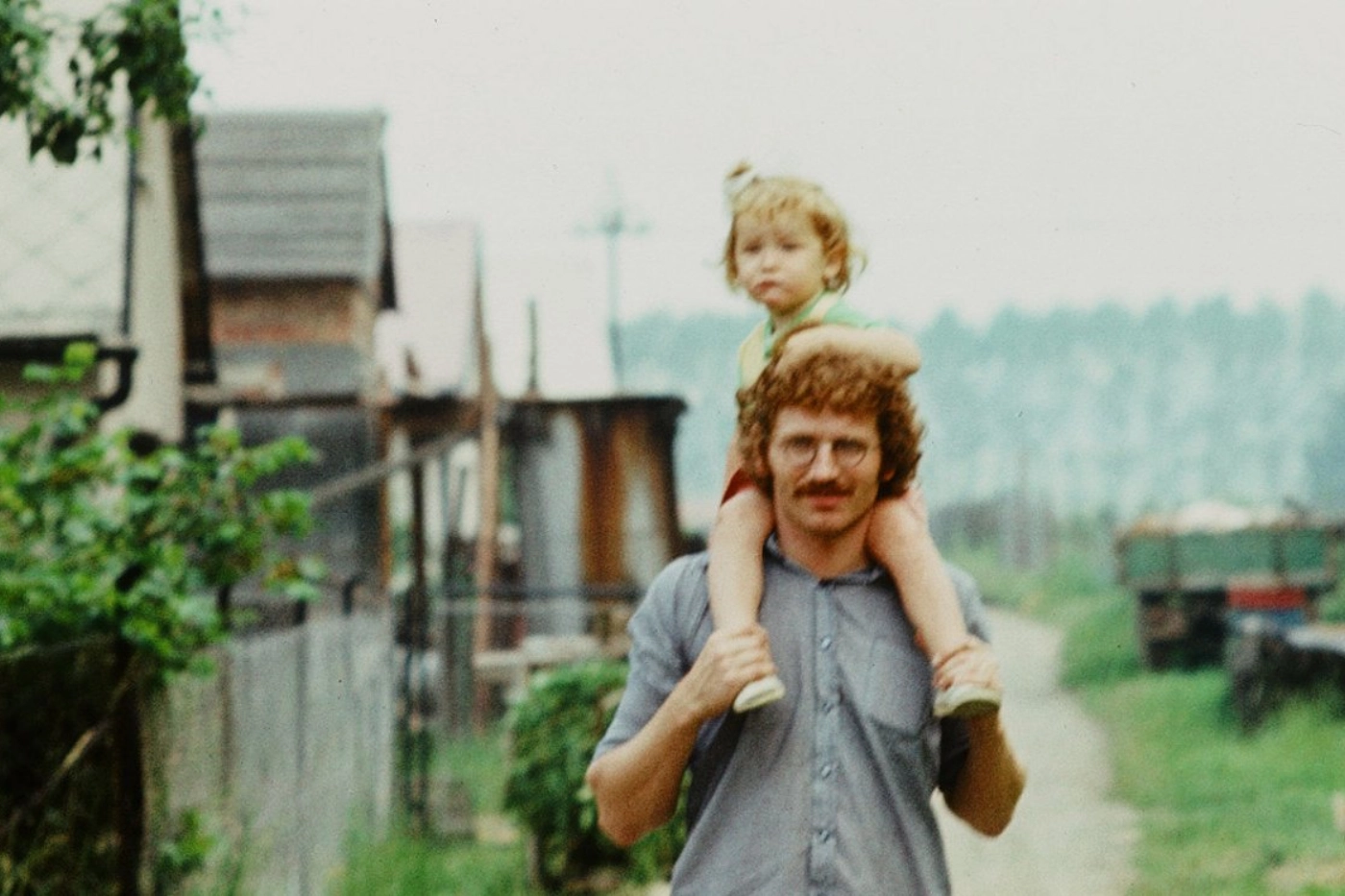
Geislerová opens by recalling the press reports surrounding her father Petr Geisler‘s death at just 59 in 2009 from cirrhosis of the liver. Rather than celebrating his accomplishments, the headlines reduced him to the father of one of the country’s most famous actresses (Ester’s sister Anna Geislerová, who appears throughout) and a noted alcoholic. But he was more than that: a translator, journalist, photographer, teacher and self-taught calligrapher, Geisler spent more than three decades working as a foreign correspondent for Japan’s Yomiuri Shimbun, writing in Japanese so fluent that his articles were often published without language editing.
Much of A Pint of Ink grows out of the GA-I-SU-RA exhibition that Geislerová and her sister Anna organized at Prague’s DOX earlier this year. The exhibition’s title comes from the phonetic Japanese characters Geisler used for his surname, and the film similarly immerses us in his world through his calligraphy, photography, newspaper articles, letters, family photographs and home movies. His expressive brushwork is everywhere, ranging from traditional ink on paper to liquid enamel and even fax thermal paper, reflecting an artist who treated calligraphy as a daily means of expression.
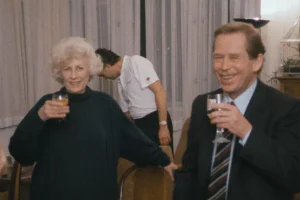
We see Geisler photographed alongside Václav Havel during official visits, while colleagues and Japanese associates recall his unusual command of the language and distinctive artistic talent. His career took him between the Czechoslovak reality of the 1970s and ’80s and a Japan that, behind the Iron Curtain, could seem almost impossibly distant.
Yet the more we learn about Geisler, the more difficult it becomes to separate his accomplishments from the addiction that ultimately consumed him. His relationships with his daughters, wives, friends and colleagues were all affected by his drinking, and the film doesn’t attempt to smooth over those consequences.
One of its most memorable moments comes when Geisler recounts a visit to a doctor who was shocked by the condition of his liver and other organs. Asked how much he drank, Geisler replied that it was two bottles. When the doctor clarified whether he meant wine or spirits, Geisler realized he was apparently a lightweight. The joke gets a laugh, but it also lands with a grim aftershock: this is not a colorful anecdote but a glimpse into just how thoroughly alcohol had consumed his life.
Geisler could be a gifted artist and a brilliant linguist while also being an absent father. Anna speaks about his addiction with particular bluntness, while Ester approaches him with a more forgiving curiosity, and their different perspectives reinforce one of the documentary’s central ideas: there is no single version of a person, even within the same family.
Preparing for the DOX exhibit, the filmmaker and her mother Věra lay out a long sheet of paper serving as a timeline of his life, moving through its milestones together. There are no elaborate tricks here; instead, editor Vladimír Barák has the more difficult task of organizing an enormous amount of archival material into a coherent portrait. The result is impressively fluid, moving between family memories, professional accomplishments and historical footage without losing sight of the person at its center.
The film also travels beyond the family archive, including a journey to Japan and locations such as Tokyo and Mount Fuji that help reconnect Geisler’s life with the country that became central to his professional identity. His story is particularly fascinating in the context of Czechoslovakia, where studying Japan in the pre-internet era meant building a relationship with a distant culture through limited books, language resources, and personal connections.
There are moments when A Pint of Ink feels more like a family time capsule than a conventional documentary portrait, and its intensely personal approach leaves some questions unanswered. But that intimacy is also its greatest strength. This isn’t an attempt to definitively explain who Petr Geisler was; it’s an attempt by a daughter to understand the father she lost, while preserving the pieces of his life that might otherwise have disappeared.
Roman Holý’s evocative original score complements that approach beautifully, giving the film a melancholy emotional texture without forcing the sentiment. More importantly, the extensive archive allows Geisler to emerge in all his contradictions: accomplished and troubled, charismatic and fragile, deeply connected to Japan yet complicated within his own family.
A Pint of Ink ultimately becomes a touching portrait of a life that ended far too soon. It successfully restores Geisler’s accomplishments to the story of his death, but perhaps just as importantly, it doesn’t allow those accomplishments to obscure the damage that resulted from his alcoholism. The result is neither an apology nor a condemnation, but something more valuable: an honest attempt to remember a complicated man.