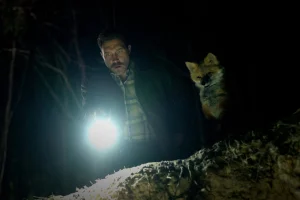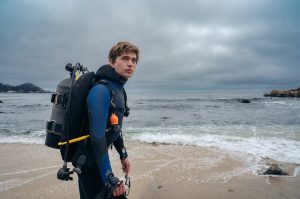
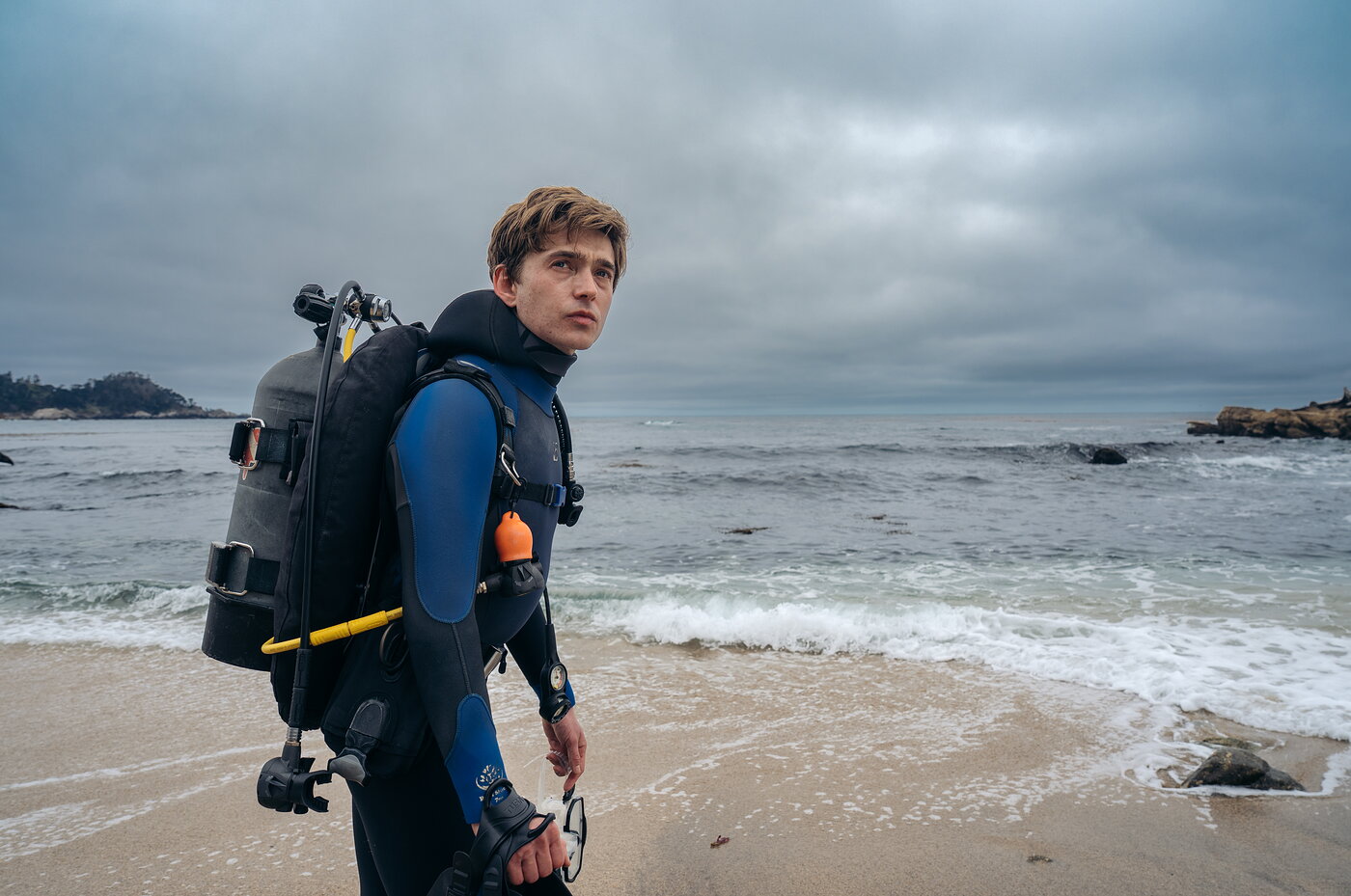
A young man searching for his father’s remains is swallowed by a sperm whale in Whalefall, opening in Prague and cinemas worldwide this weekend. This wonderfully inventive survival thriller from writer-director Brian Duffield (No One Will Save You) turns an outlandish premise into a gripping, meticulously detailed adventure, bolstered by an excellent Austin Abrams performance and some of the year’s most impressive creature effects—even if it lays on the central father-son stuff a little thick.
Abrams stars as Jay Gardiner, a young man who returns to his hometown on California’s central coast following the death of his estranged father, Mitt (Josh Brolin). A domineering figure who spent his life pushing Jay to meet his exacting standards, Mitt died by suicide by sinking himself into the ocean before mesothelioma could claim him, leaving behind a complicated legacy and unfinished business between father and son.
Inspired by his sister’s mourning that they don’t even have a piece of dad to put in the casket, Jay sets out on a solo dive to recover his father’s remains from the ocean. But his expedition takes an extraordinary turn when he encounters a sperm whale hunting a giant squid; as the whale swallows its prey, the squid catches Jay’s leg with a tentacle, dragging him into the enormous creature’s mouth and down its throat. Trapped inside a living animal with roughly an hour of oxygen remaining, Jay must somehow find his way back to the surface before he’s crushed, dissolved or suffocated.
The premise sounds like something out of a particularly gruesome fairy tale, but what makes Whalefall so effective is the attention paid to the mechanics of Jay’s predicament. Duffield, adapting Daniel Kraus’ novel with the author, constructs a remarkably convincing chain of events that allows us to follow every stage of the protagonist’s ordeal.
Jay isn’t simply swallowed by a whale and left to improvise an escape from some vaguely defined monster’s belly. Every new obstacle emerges logically from his environment, and every potential solution requires him to understand and exploit the anatomy of the creature surrounding him.
The whale’s muscular esophagus crushes his body, breaking a rib, until he discovers how to create enough space to breathe by utilizing a flipper. Its stomach acids threaten to dissolve him, eliminating any possibility of escaping through the digestive system. With his oxygen dwindling and his equipment rapidly deteriorating, Jay must continually reassess his situation and make increasingly desperate use of whatever resources remain available.
Among those resources are the severed beak of the giant squid, which Jay affectionately names Beaky, and a tiny jellyfish whose radiant glow provides some desperately needed illumination. These details give the film an unexpectedly playful quality without undermining the danger, transforming the whale’s interior into a strange ecosystem that Jay gradually learns to navigate.
It’s this procedural approach that makes Whalefall such a compelling survival story. Like 127 Hours, which confined James Franco’s protagonist to a narrow canyon, the film creates suspense not through constant changes of scenery but through the ingenuity required to overcome an apparently impossible physical predicament. There’s also something of Robert Redford’s extraordinary All Is Lost in its commitment to the practical details of survival, though Whalefall operates on a considerably more fantastical wavelength.
Abrams is excellent as Jay, delivering a far more reserved performance than his turns in Zach Cregger‘s Weapons and Resident Evil. There’s still a trace of the dry humor that made him so appealing in those films, but here he’s required to communicate largely through physical action, pain and determination. He makes Jay’s escalating desperation palpable without losing the character’s intelligence or resourcefulness.
Brolin is equally effective as Mitt, appearing in flashbacks that gradually reveal the difficult relationship between father and son. Even as he coughs his way through many of these scenes, visibly deteriorating from his illness, Mitt remains an imposing presence whose influence over Jay extends well beyond his death. Elisabeth Shue appears as Jay’s mother, while John Ortiz has a couple of affecting scenes as a friend of Mitt’s.
The film’s greatest achievement is its extraordinary realization of the underwater world. Cinematographer Aaron Morton establishes a beautiful, immersive atmosphere during the initial diving sequences, capturing the eerie tranquility of the ocean before the arrival of the enormous squid and sperm whale transforms it into something almost otherworldly.
Once Jay is swallowed, production designer Ramsey Avery and the visual effects team create an astonishingly convincing interior environment. The whale’s organs are gooey, sticky and grotesquely claustrophobic, but they’re also constantly moving, contracting and reacting to Jay’s presence. This doesn’t feel like an elaborate set dressed up to resemble a living creature; it feels like an actual organism that happens to contain our protagonist.
The giant squid and jellyfish are similarly realized with extraordinary attention to detail, and their implementation by Jay lends familiar real-world animals the fantastical quality of creatures from another planet. Duffield accomplishes something unusual here: he makes the natural world seem more alien and wondrous than most science fiction. Only a climactic sequence involving orcas feels comparatively conventional, lacking the imagination and strange beauty that distinguish the rest of the film’s creature encounters.
Interspersed with Jay’s ordeal are flashbacks to his relationship with Mitt, which provide the movie’s emotional foundation. The connection is immediately apparent: Jay has spent his life feeling suffocated by his father’s expectations, and now finds himself literally suffocating inside an enormous creature. Escaping the whale means confronting the lessons Mitt taught him, accepting the complicated love behind them and finally finding the freedom to live on his own terms.
It’s meaningful material, and the performances give it considerable weight. But Duffield doesn’t entirely trust audiences to make the connection themselves, particularly during an overblown climax that insists upon the father-whale metaphor long after its significance has become obvious. The emotional resolution might have been more powerful with a lighter touch; indeed, the material inside the whale is so consistently fascinating that the flashbacks occasionally feel like interruptions, despite their importance to the story.
Still, these are relatively minor reservations about a movie that gets nearly everything else right. Whalefall combines the meticulous problem-solving of the best survival thrillers with the imagination and visual spectacle of a first-rate creature feature, anchored by an unusually affecting central performance.
Few films have made a single, confined location feel so terrifying, so alive or so endlessly fascinating. Whalefall takes one of the most improbable survival scenarios imaginable and makes us believe in every extraordinary moment.