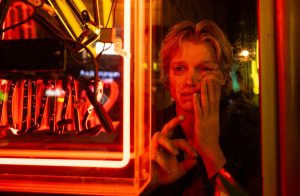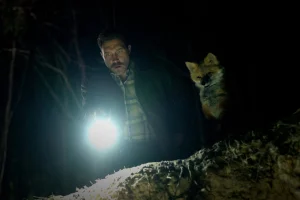
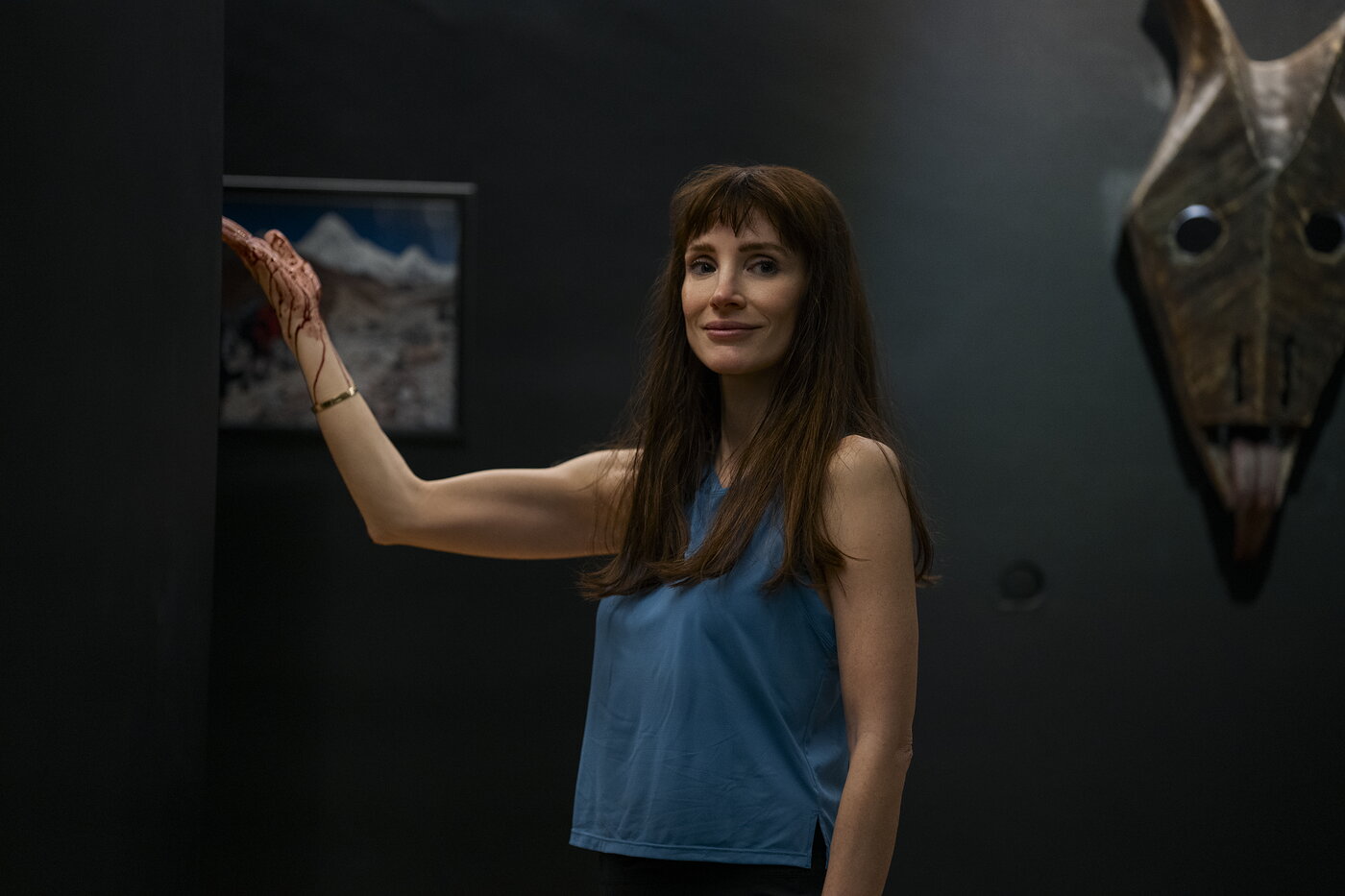

A young girl is terrorized by a supernatural creature that looks exactly like her mother in Other Mommy, the latest horror film from director Rob Savage (Host, The Boogeyman) now playing in Prague cinemas. Jessica Chastain delivers a committed dual performance, and some briefly glimpsed creature effects are genuinely disturbing, but almost everything else in this perplexing supernatural thriller falls spectacularly flat. Characters behave with astonishing stupidity, the monster operates without any discernible rules, and the resulting confusion produces considerably more unintentional comedy than actual scares.
Based on Josh Malerman‘s novel Incidents Around the House, Other Mommy stars Arabella Olivia Clark as Bela, a 7-year-old girl whose imaginary friend isn’t particularly imaginary. The creature she calls Other Mommy looks like a distorted version of her actual mother, Ursula (Chastain), and has apparently been visiting her for some time, attempting to persuade Bela to “let it into her heart.”
Ursula and her husband Russell (Jay Duplass) are experiencing marital difficulties, and their daughter’s increasingly alarming behavior seems like another complication in an already strained household. But Savage quickly subverts one of the most familiar conventions of supernatural horror: Rather than spending an hour dismissing Bela’s claims, Russell actually sees the monster himself.
It’s a terrific opening development, particularly when Other Mommy reveals herself twisted into an impossible shape beneath the family’s kitchen table. Chastain’s grotesquely contorted body provides the movie’s one legitimately effective jump scare, even if the moment has unfortunately already been spoiled by the trailer.
Russell reacts appropriately, too, freaking out and calling the police. Suddenly, Other Mommy seems poised to explore an intriguing question: What happens when ordinary people encounter an undeniable supernatural threat and respond as actual human beings might? The answer, apparently: absolutely nothing.
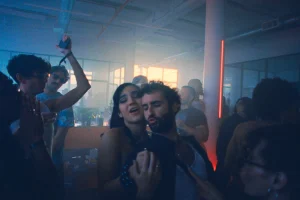
Despite discovering that a terrifying creature has been stalking their daughter, the parents proceed with their lives in almost comically casual fashion. They throw a party, which the monster promptly crashes. They relocate to a friend’s house, where the monster simply follows them. They wander from one location to another, waiting for the next attack without developing anything resembling a plan.
Of course, horror characters have always been prone to questionable decisions. There’s a long tradition of people investigating suspicious noises in dark basements or splitting up when they should obviously stay together. But those familiar lapses generally serve a narrative purpose, allowing characters to confront a threat whose nature we gradually come to understand. In Other Mommy, nobody seems particularly interested in understanding anything.
The creature can apparently appear wherever and whenever it wants, manipulate physical reality, transport people between locations and create elaborate supernatural environments. Sometimes only Bela can see it; sometimes her parents can see it, too. Sometimes it exists in the family’s ordinary surroundings, while at other moments it seems capable of removing everyone else from reality altogether.
None of these abilities comes with recognizable limitations, and the film makes little effort to establish any consistent relationship between the monster and the world it inhabits. This is a fatal problem for a horror movie that depends almost entirely on the threat posed by a single supernatural antagonist.
Consider the difference between Other Mommy and something like A Nightmare on Elm Street, in which Freddy Krueger can do virtually anything within the dream world. The possibilities are limitless, but the central distinction between sleeping and waking provides a framework for the characters’ struggle. We understand what they’re trying to avoid, why they might fail and what they must accomplish to survive.
Here, there’s no equivalent framework. Other Mommy simply does whatever the screenplay requires at any given moment, rendering every confrontation arbitrary.
The characters are just as helpless as the audience. They don’t attempt to investigate the creature’s origins, test its limitations or develop a strategy for protecting Bela. After Russell’s initial call to the police, there’s remarkably little effort to seek practical assistance. No doctors, no priests, no serious paranormal investigators. Only during the climax does a team of dubious ghost hunters finally enter the picture, in an amusing little misdirection that briefly suggests the movie might have developed a sense of humor about its own absurdity.
What exactly are Ursula and Russell trying to accomplish? What would constitute a victory against Other Mommy? What are we hoping Bela will do, beyond somehow surviving until the credits roll? The movie never provides satisfactory answers, and its ending only compounds the frustration by raising further questions about whether anything meaningful has been resolved.
There is potentially interesting thematic material beneath the nonsense. Bela’s troubled relationship with her mother, and her awareness of the tensions between her parents, might have provided a psychological foundation for the monster’s existence. Other Mommy could represent the child’s fear that her mother is becoming someone unfamiliar, or her desperate longing for a more attentive maternal figure.
But these ideas remain frustratingly underdeveloped. The supernatural threat is so arbitrary, and the family’s response so irrational, that any emotional connection between their domestic problems and the horror unfolding around them becomes difficult to sustain.
But Chastain is especially entertaining as the titular creature, contorting her expressions and movements into something genuinely unnatural. Her exaggerated smiles and unsettling physicality suggest a considerably more disturbing movie lurking somewhere beneath the finished product. She’s also convincing as Ursula, whose emotional distance from her daughter gives the story its most recognizable human conflict.
The creature effects are another highlight. Other Mommy’s twisted anatomy and grotesque transformations occasionally produce striking images, though they’re frequently obscured by frantic editing or glimpsed so briefly that their impact is diminished.
Other Mommy is ultimately a movie without rules, without logic and, most damagingly, without any meaningful dramatic objective. Its characters drift helplessly between supernatural encounters, and the audience is left doing the same. The film begins by asking what ordinary people would do if they discovered a monster living in their house. Unfortunately, the filmmakers seem to have no idea, either.