

Two bickering CIA operatives take an unlikely vacation to Easter Island in Wild Horse Nine, the latest dark comedy from writer-director Martin McDonagh (The Banshees of Inisherin, Three Billboards Outside Ebbing, Missouri). Featuring the filmmaker’s trademark dialogue, outrageous humor and an extraordinary lead performance from John Malkovich, it’s another first-rate entry in McDonagh’s filmography, even if the relatively modest story doesn’t quite reach the heights of his previous work.
Set in Chile in 1973, Wild Horse Nine stars Malkovich as Chris Carlisle, a veteran CIA agent who has spent decades participating in some of the agency’s most questionable overseas operations. Now in his 70s, Chris is dying of cancer and beginning to experience memory loss, prompting him to contemplate his legacy while his employers grow increasingly concerned about what he might reveal.
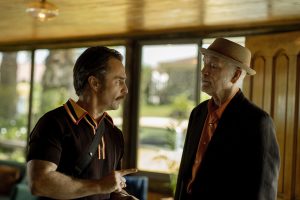
His longtime colleague Lee Chesterfield (Sam Rockwell) accompanies him on a trip to Easter Island, the remote Pacific territory famous for its enormous stone heads. Chris claims he’s always wanted to see the statues before he dies, though neither man’s motivations are necessarily as straightforward as they initially appear.
Back in Santiago, their increasingly suspicious superior, M.J. (Steve Buscemi), worries that Chris might be preparing to expose the agency’s involvement in Chilean politics, where the government of socialist President Salvador Allende is approaching a violent turning point. What follows is a typically McDonagh mixture of profane buddy comedy, political satire and unexpectedly affecting reflections on mortality, friendship and the consequences of a life spent doing terrible things.
Chris is an unapologetically unpleasant man, casually recounting decades of covert operations, assassinations and political interference with the detached amusement of someone discussing an especially dull office job. Yet beneath the cynicism lies a growing awareness that his life is ending, his memory is deteriorating and whatever meaning he might have found in his work has largely evaporated.
Malkovich captures these contradictions beautifully. His character can be hilarious, infuriating and unexpectedly heartbreaking within the same conversation, often without any noticeable change in expression. There’s a wonderfully understated sadness to his increasingly unreliable recollections, particularly as he begins relying on handwritten reminders to keep track of his circumstances and the people around him.
It’s an extraordinary late-career showcase for an actor who has too often been relegated to eccentric supporting roles in lesser productions. An Academy Award nomination would be richly deserved, even if Wild Horse Nine itself seems less likely to repeat the Oscar success of McDonagh’s previous features.
Rockwell is just as good as Lee, whose relationship with Chris provides the film’s emotional foundation. Having already demonstrated his affinity for McDonagh’s dialogue in Seven Psychopaths and Three Billboards Outside Ebbing, Missouri, Rockwell effortlessly handles the distinctive combination of vulgarity, absurdity and sudden emotional vulnerability.
The two actors make a terrific double act, with Malkovich’s increasingly unpredictable behavior continually testing Lee’s patience and loyalty. Their conversations frequently wander into seemingly irrelevant territory, only for an offhand remark or ridiculous anecdote to acquire unexpected significance later.
This is where Wild Horse Nine is at its absolute best. McDonagh remains one of contemporary cinema’s finest dialogue writers, and his ability to make extended conversations simultaneously hilarious, revealing and dramatically compelling is virtually unmatched. There are numerous laugh-out-loud moments, both in the exchanges between the two agents and in the film’s increasingly outrageous situations (that box with the picture drew uproarious laughter at a press screening).
Buscemi contributes another entertaining performance as the increasingly exasperated M.J., while Parker Posey is engagingly abrasive as Lee’s wife Marge, whose telephone conversations with her husband suggest a marriage held together by little more than mutual irritation. Tom Waits has a memorable cameo as Chris’ estranged brother.
Mariana Di Girólamo and Ailín Salas also appear as two young Chilean women visiting the island, whose political convictions bring them into uncomfortable contact with the American agents. Their presence helps establish the broader historical context, particularly the growing tensions surrounding Allende’s government and the role of American intelligence in destabilizing Chilean democracy.
McDonagh doesn’t turn Wild Horse Nine into a conventional political thriller, however. The historical backdrop remains largely peripheral to the central relationship, providing a troubling reminder of the consequences of the men’s careers without overwhelming the film’s more intimate concerns.
It’s an effective approach, even if the screenplay occasionally feels a little too comfortable with its familiar ingredients: morally compromised men, escalating misunderstandings, sudden violence and melancholy reflections on the meaning of friendship.
Wild Horse Nine often resembles a variation on McDonagh’s own In Bruges, with two professional killers finding themselves in an unfamiliar tourist destination while confronting questions of loyalty and mortality. The difference is that Easter Island offers considerably fewer distractions than the Belgian city. The spectacular moai statues and rugged Pacific coastline provide a striking visual backdrop, beautifully photographed by cinematographer Ben Davis, but there’s only so much sightseeing to be done among the giant stone heads.
The film’s visuals are consistently impressive, capturing the island’s dramatic coastline, open landscapes and scattered wild horses with considerable beauty. Carter Burwell’s understated score complements the shifting tone, moving between playful comedy and quiet melancholy without drawing unnecessary attention to itself.
But for all its technical polish and thematic ambition, Wild Horse Nine ultimately feels like a relatively minor McDonagh work. Its revelations and reversals are entertaining, but they don’t fundamentally transform our understanding of the characters or their circumstances. What remains, however, is an enormously enjoyable film built around two terrific actors delivering some of the sharpest dialogue of the year.
Malkovich, in particular, elevates Wild Horse Nine beyond its modest ambitions, finding genuine humanity in a man whose professional life has been defined by the absence of it. McDonagh may not have another masterpiece on his hands, but even a comparatively minor effort from this filmmaker offers more wit and personality than most contemporary comedies.