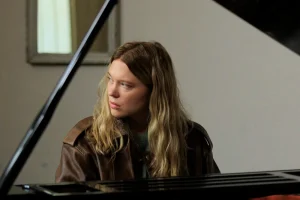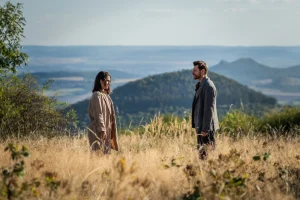
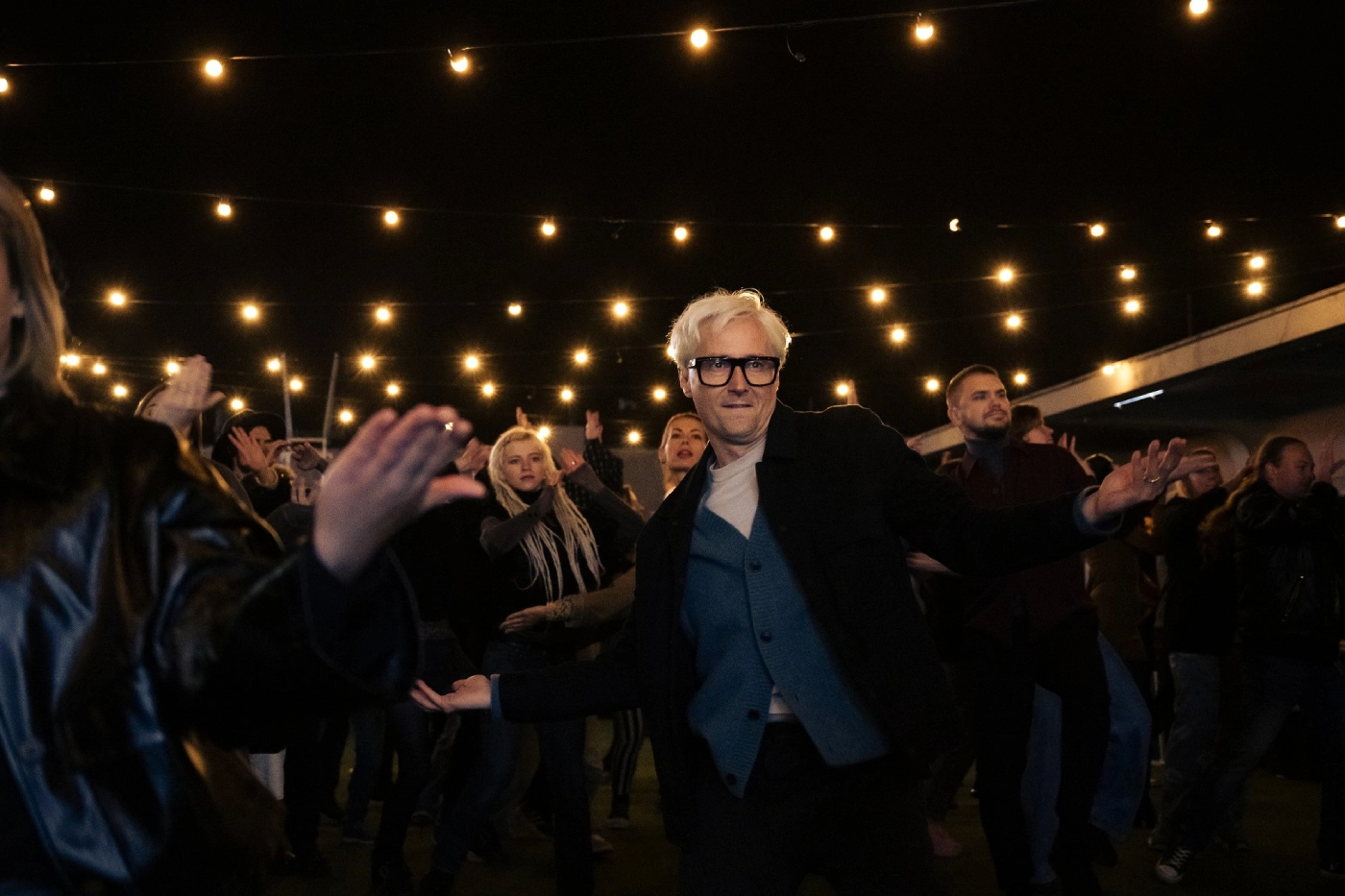
Seven Prague residents navigate love, marriage and the disappointments of adulthood in Changes (Kluci to vidí jinak než holky), the latest film from Czech writer-director David Ondříček, now playing in Prague cinemas (and with English subtitles at Kino Lucerna, Kino Světozor, and elsewhere). A spiritual successor to his 2000 cult classic Loners, this sharply observed ensemble comedy may be the filmmaker’s most accomplished work as director, combining terrific performances, dark humor and gorgeous cinematography to capture a generation that’s grown older without necessarily growing wiser.
The film’s English title in promotional material references David Bowie’s Changes, invoked during one memorable scene, though its onscreen title translates directly from Czech as Guys See It Differently Than Girls. Both are appropriate for a movie about the uncomfortable realization that the people we’ve become bear little resemblance to those we once imagined ourselves becoming.
Ondříček’s Loners (Samotáři) captured a generation of young Czechs navigating relationships and uncertain futures a decade after the Velvet Revolution. Its aimless protagonists seemed to embody a country still figuring out what to do with its newfound freedom, and the film’s offbeat humor and gritty independent sensibility made it a defining portrait of Prague at the turn of the millennium.
A quarter-century later, Changes finds that generation now middle-aged and confronting an equally uncertain future. They’ve established careers, marriages and families, but the sense of aimlessness remains. Thirty-five years after the Velvet Revolution, the Czech Republic itself might be experiencing something resembling a midlife crisis: the excitement of youthful possibility has given way to the compromises and disappointments of adulthood.
The film revolves around seven interconnected characters, including Martin (Jaroslav Plesl), a successful but self-absorbed artist whose marriage to Kamila (Martha Issová) has quietly deteriorated. Martin remains convinced of his own artistic importance while barely recognizing the sacrifices his wife has made to support him, and Kamila is finally beginning to understand that she isn’t obligated to spend the rest of her life serving his needs.
Václav Neužil (who couldn’t be further removed from his portrayal of Olympic champion Emil Zátopek in Ondříček’s Zátopek) is especially good as Karel, a hotshot attorney whose professional success masks a deeply insecure and emotionally stunted personality. Cynical, vulgar and perpetually chasing his next distraction, he’s a swaggering mess of contradictions, projecting confidence while revealing an almost desperate need for affection and validation.
Daniel (Vojtěch Vodochodský of Waves) is a hopeless romantic preparing to marry the considerably more pragmatic Romana (Denisa Barešová), while ambitious journalist Emma (Anna Kameníková) finds herself drawn into Martin’s orbit despite her relationship with Marek (Jan Nedbal of Brothers). Each is searching for something that might give life meaning, whether through love, professional accomplishment or the approval of others. Their problems differ, but the underlying uncertainty is remarkably consistent.
Ondříček, who wrote the screenplay himself, draws these characters with an unusually sharp understanding of their flaws. The men are frequently selfish, immature or simply oblivious, while the women tend to recognize the emotional realities of their relationships considerably sooner. Yet nobody emerges entirely unscathed, and the film’s affection for its characters remains apparent even when their behavior becomes infuriating.
The ensemble is uniformly excellent, and the interconnected relationships develop with an authenticity rarely found in mainstream Czech comedies. There’s something of the independent spirit of Loners here, despite Changes being a considerably more polished and accessible production.
It’s also frequently hilarious, and several scenes are likely to produce audible guffaws from local audiences. Some of the more bleak humor may not translate quite as effectively for international viewers, but the film’s biggest laughs are universal, arriving with a force that caught the audience at a Kino Lucerna screening completely off guard. Even Czech President Petr Pavel, who attended the premiere, offered an enthusiastic one-line review: “I really enjoyed yesterday’s screening. I haven’t laughed that much in a long time.”
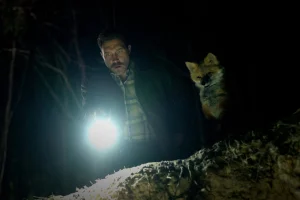
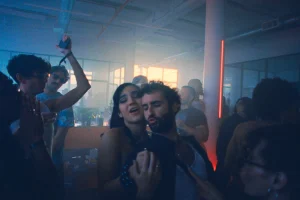
But the movie’s greatest achievement may be its visual presentation. Cinematographer David Hofmann captures contemporary Prague with extraordinary richness, employing deep, inky blacks, striking color contrasts and a grainy, film-like texture that gives the images a tactile quality rarely seen in contemporary Czech cinema.
Shot during autumn, Changes makes magnificent use of the city’s streets, bridges and public spaces, often blanketed in orange and yellow leaves. Střelecký ostrov, the new Masaryčka development, the Vyšehrad railway bridge and the Mánes gallery are among the many recognizable locations, frequently framed against Prague Castle in the distance.
These aren’t merely picturesque backdrops. Prague feels alive throughout the film, its crowded streets and beautiful public spaces contrasting with the loneliness of the people moving through them. The city has changed enormously since Loners, but the emotional distance between its inhabitants remains much the same.
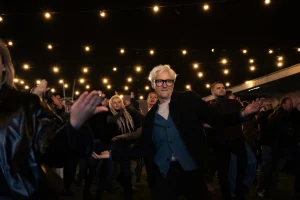
Equally distinctive is the soundtrack by British musician Tom Falle, who performs as Rhumba Club and lends the movie some striking original compositions. Ondříček discovered Falle at a Lucerna Music Bar concert and subsequently invited him to compose the score, an inspired choice that gives Changes an identity unlike most contemporary Czech comedies.
Falle’s retro-electronic compositions, reminiscent of Pet Shop Boys and 1980s synthpop, provide an unexpectedly buoyant accompaniment to the film’s often bleak observations. The music is playful, melancholy and irresistibly catchy, culminating in an onscreen performance by Falle atop Prague’s Radost building.
For all its polish, Changes retains the restless energy of Ondříček’s early work. Its characters make mistakes, hurt one another and occasionally stumble toward moments of genuine understanding, but the film wisely resists offering neat solutions to their problems. Growing older doesn’t necessarily mean figuring everything out; sometimes it simply means becoming more aware of how little you’ve understood.
A quarter-century after Loners, Ondříček has returned to the uncertainty of modern Czech life and discovered that the questions haven’t changed nearly as much as the people asking them. The country has grown up, its capital has transformed, and its citizens have built lives for themselves. But beneath the surface, they’re still searching for somewhere to belong.