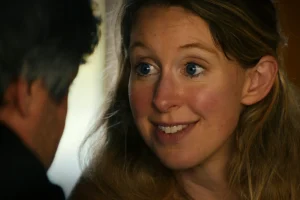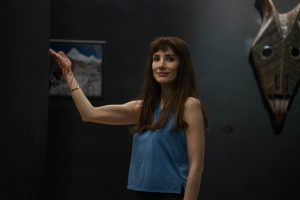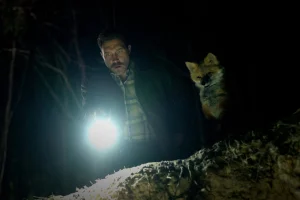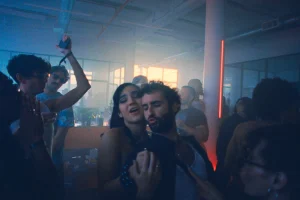

Disgraced Theranos founder Elizabeth Holmes attempts to set the record straight in You Can See Everything, an extraordinary new documentary from Nathan Fielder and Lance Oppenheim that arrives in Prague cinemas this weekend following remarkable word-of-mouth success and box office results stateside. Running nearly three hours, the film begins as a fascinating portrait of one of America’s most notorious fraudsters before transforming into something considerably stranger: an examination of how documentaries themselves construct, distort and occasionally manufacture the truth.
It’s one of the year’s most interesting and very best films, a wildly entertaining and unexpectedly profound experience that leaves you wishing you could spend even more time with its endlessly fascinating subjects.
The filmmakers began shooting in 2023, just weeks before Holmes was due to begin serving an 11-year prison sentence for defrauding investors in Theranos, the Silicon Valley blood-testing company she founded and built into a multibillion-dollar enterprise around technology that never worked as advertised.
Fielder, best known for his brilliantly uncomfortable television series Nathan for You and The Rehearsal, moves into the luxurious California home Holmes shares with her partner Billy Evans and their two young children. There, he attempts to understand how someone convicted of such an elaborate deception continues to insist that she has never lied about anything.
The resulting conversations are mesmerizing. Holmes maintains that the central misunderstanding surrounding Theranos was essentially semantic. When she claimed her company’s machine could perform an extraordinary range of blood tests, she apparently meant that it was capable of doing so… once the necessary technology had been developed.
That the technology didn’t actually exist seems, in her telling, almost beside the point. Fielder tests this peculiar relationship with language by showing Holmes the classic Abbott and Costello comedy routine “Who’s on First?” and asking her to explain the joke. She appears genuinely unable to grasp that the central confusion arises because a player with the unlikely name of “Who” is on first.
It’s an astonishing moment, funny and unsettling in equal measure, suggesting a woman whose understanding of language operates according to rules entirely of her own making. But is Holmes genuinely incapable of recognizing these contradictions, or is she simply extraordinarily skilled at maintaining a carefully constructed fiction, manipulating both the filmmaker and his audience? Fielder never provides an easy answer, and the uncertainty becomes the film’s greatest strength.
Evans, meanwhile, is a much more recognizable character: a wealthy, controlling opportunist whose attempts to manipulate the documentary grow increasingly brazen. He prevents the filmmakers from interviewing Holmes’ parents, demands a share of the movie’s profits and eventually shuts down questioning when Fielder begins probing the scientists developing what appears to be a new version of Theranos’ failed technology.
Unlike Holmes, whose motivations remain frustratingly opaque, Billy wears his intentions almost comically openly. Yet his behavior introduces another fascinating question. Is he manipulating Holmes in the same way he attempts to control the documentary, or is she quietly allowing him to perform the unpleasant work of protecting her interests?
For its first half, You Can See Everything is essentially a conventional documentary elevated by extraordinary access and Fielder’s distinctive interviewing style. His deadpan delivery, willingness to tolerate uncomfortable silences and apparently innocent questions repeatedly expose contradictions that more confrontational methods might have missed.
Then Holmes goes to prison, and the film becomes something else entirely. With its central subject suddenly unavailable, Fielder begins questioning whether he has really understood anything about her. Rather than simply assembling the footage into a conventional portrait, he contacts Amanda Seyfried, who portrayed Holmes in the acclaimed television miniseries The Dropout.
Seyfried joins the project to recreate conversations and moments involving Holmes, allowing Fielder to examine the behavior he witnessed and reconsider his own interpretations. What initially sounds like a gimmick becomes an extraordinary creative development: the documentary begins folding in on itself, with actors reenacting reality, filmmakers interrogating their own motivations and the boundaries between observation and performance growing increasingly difficult to distinguish.
It’s familiar territory for anyone who has watched Fielder’s excellent HBO series The Rehearsal, in which elaborate recreations of real-life situations become tools for exploring human behavior, anxiety and the limits of empathy But You Can See Everything pushes the concept into even more fascinating territory because its subject is someone whose entire public identity has been shaped by deception.
Seyfried’s involvement raises questions that extend far beyond Holmes herself. Can an actress who has studied and portrayed a real person understand that individual more deeply than someone who has actually spent time with her? Does recreating an event reveal hidden truths, or merely reinforce the assumptions of the person staging it?
And what happens when the filmmaker begins recognizing his own biases in the supposedly objective process of documenting another person’s life? These aren’t merely abstract philosophical concerns. Fielder and Oppenheim weave them into the unfolding narrative with remarkable ingenuity, producing moments that are simultaneously hilarious, uncomfortable and genuinely revealing.
Despite its promise of complete transparency, You Can See Everything gradually demonstrates how little we can truly know about another person, particularly when everyone involved has an interest in shaping the story. Holmes wants to rehabilitate her reputation. Evans wants to control the narrative. Fielder wants to understand his subject, but also wants to make a compelling film.
What makes the film so remarkable is that it doesn’t use this uncertainty to excuse Holmes or undermine the established facts of the Theranos scandal. Her criminal conviction remains the foundation of the story. The question is not whether she committed fraud, but how she understands her own actions and why the people around her continue to participate in her version of events.
There’s a broader contemporary relevance here, too, in a world where public figures increasingly construct their own realities and audiences struggle to distinguish genuine conviction from calculated performance. Fielder and Oppenheim have created something that captures this peculiar cultural moment without reducing it to a simplistic warning about misinformation or celebrity manipulation.
At 174 minutes, You Can See Everything should feel unwieldy. Instead, its extraordinary access, fascinating personalities and increasingly inventive storytelling make the running time fly by. The first half alone would have produced a first-rate documentary about Elizabeth Holmes. The second transforms it into something genuinely unique, a film that breaks beyond the boundaries of its genre to examine the very process through which we attempt to understand reality.
It’s funny, unsettling, intellectually stimulating and consistently surprising, with Fielder’s distinctive sensibility finding an ideal subject in a woman who seems to have spent her entire adult life rehearsing a version of herself. We may never see everything about Elizabeth Holmes. But You Can See Everything reveals something even more fascinating: how easily we convince ourselves that we can.