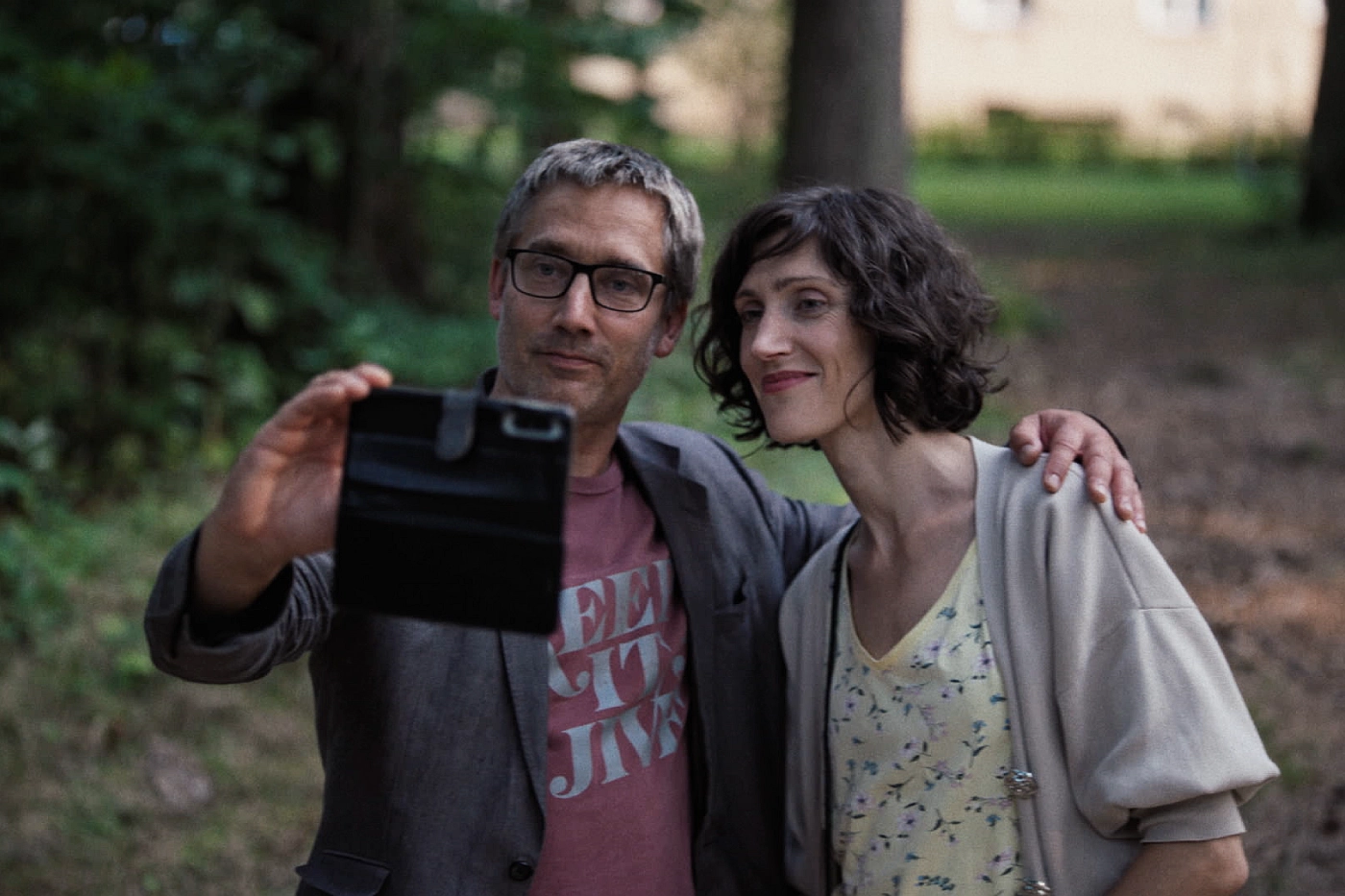
A pregnant woman uncertain about her future shares a deeply personal conversation with her ex-husband in Everything As It Should Be (Mistryně), which premiered in competition at the Karlovy Vary International Film Festival and opens in Prague cinemas this weekend (with English subtitles at Kino Světozor, Kino Aero, Kino Lucerna, and Bio Oko). This tender, melancholy drama dedicates the majority of its screen time to a two-person stroll through the streets of Liberec, and the result is something akin to Richard Linklater’s celebrated Before Trilogy—albeit with a uniquely Czech perspective on love, loss, and relationships that continue to define us long after they have ended.
Written and directed by Bohdan Karásek (Karel, já a ty), Everything As It Should Be stars Marie Švestková as Monika, a doctor who appears to have built the stable life she once wanted. She is five months pregnant and in a loving relationship with Lukáš (Lukáš Bouzek), an outgoing and confident man who seems to complement her more reserved personality. But beneath that surface, Monika is plagued by doubts: about motherhood, about the choices she has made and whether a life that appears happy from the outside is truly the one she wants.
The film begins by establishing Monika’s complicated emotional state, but its central dramatic engine arrives when she meets her former husband Petr (Jiří Havelka). What begins as a cathartic reunion gradually transforms into an extended conversation that takes them through the streets, parks, forests, cafes and public spaces of Liberec.
The structure immediately recalls Linklater’s Before Sunrise, Before Sunset and Before Midnight, each of which follows a single encounter between characters played by Ethan Hawke and Julie Deply. But there is a crucial difference here: unlike Jesse and Céline in those films, we are not waiting for Monika and Petr to rediscover their romance.
Instead, Karásek explores something far more complicated: the tenderness that can remain between two people who have already accepted that their relationship is over. There is no simple romantic fantasy of reconciliation. Their connection is genuine, but so is the sadness surrounding it. Everything As It Should Be finds drama in the uncomfortable space between love and separation, where two people can still deeply matter to one another while knowing they cannot return to what they once had.
That gives the film a distinct emotional quality. There is a quiet melancholy throughout, a recognition that some relationships do not end because people stop caring about each other, but because life simply moves in different directions. The screenplay’s greatest achievement is capturing the lingering echoes of a relationship rather than trying to revive it.
The film almost entirely rests on the performances of Švestková and Havelka, and both actors are excellent. Their relationship is an especially difficult one to portray because the screenplay asks the audience to invest in their shared history without necessarily wanting them to reunite. Švestková brings a convincing mixture of intelligence, uncertainty and emotional restraint to Monika, a woman constantly analyzing her own happiness. Havelka gives Petr a warm, understated vulnerability, capturing someone who still carries affection for Monika while understanding the distance between them.
Karásek’s screenplay also benefits from the way it observes adult relationships rather than idealized romance. Monika’s doubts are not presented as simple dissatisfaction or selfishness, and the film avoids easy answers about whether she should remain with Lukáš or revisit her past with Petr. Instead, it considers the difficult question of whether happiness is something we discover or something we must continually choose.
Cinematographer Tomáš Uhlík makes beautiful use of Liberec throughout Everything As It Should Be, presenting the city as a warm, contemporary place rather than relying on familiar postcard images. The film avoids the city’s most recognizable landmarks, including the iconic Ještěd tower, and instead captures everyday spaces with a quiet sense of affection. The boxy 4:3 compositions reinforce Monika’s feelings of emotional confinement, while also giving the film a distinctive visual identity.
Ondřej Kyas’ gentle score fits naturally with the film’s reflective tone, while the use of Bob Dylan’s Slow Train Coming adds another layer of spiritual depth to the story, and may have also influenced some of the film’s visual motifs.
The biggest challenge with Everything As It Should Be is also central to its design: there is very little conventional momentum. The film is built almost entirely around conversation, observation and emotional nuance. Unlike the Before Trilogy, where the audience is often driven by the possibility of romance between the central characters, Karásek deliberately removes that expectation. The result may feel slow or overly subdued for viewers looking for a more traditional narrative structure.
But for patient viewers willing to settle into its rhythm, Everything As It Should Be offers a rewarding portrait of the complicated ways people remain connected. Karásek has created a thoughtful and unusually mature Czech drama about the paths we take, the lives we leave behind, and the people who continue to shape us even after they are no longer part of our everyday world.