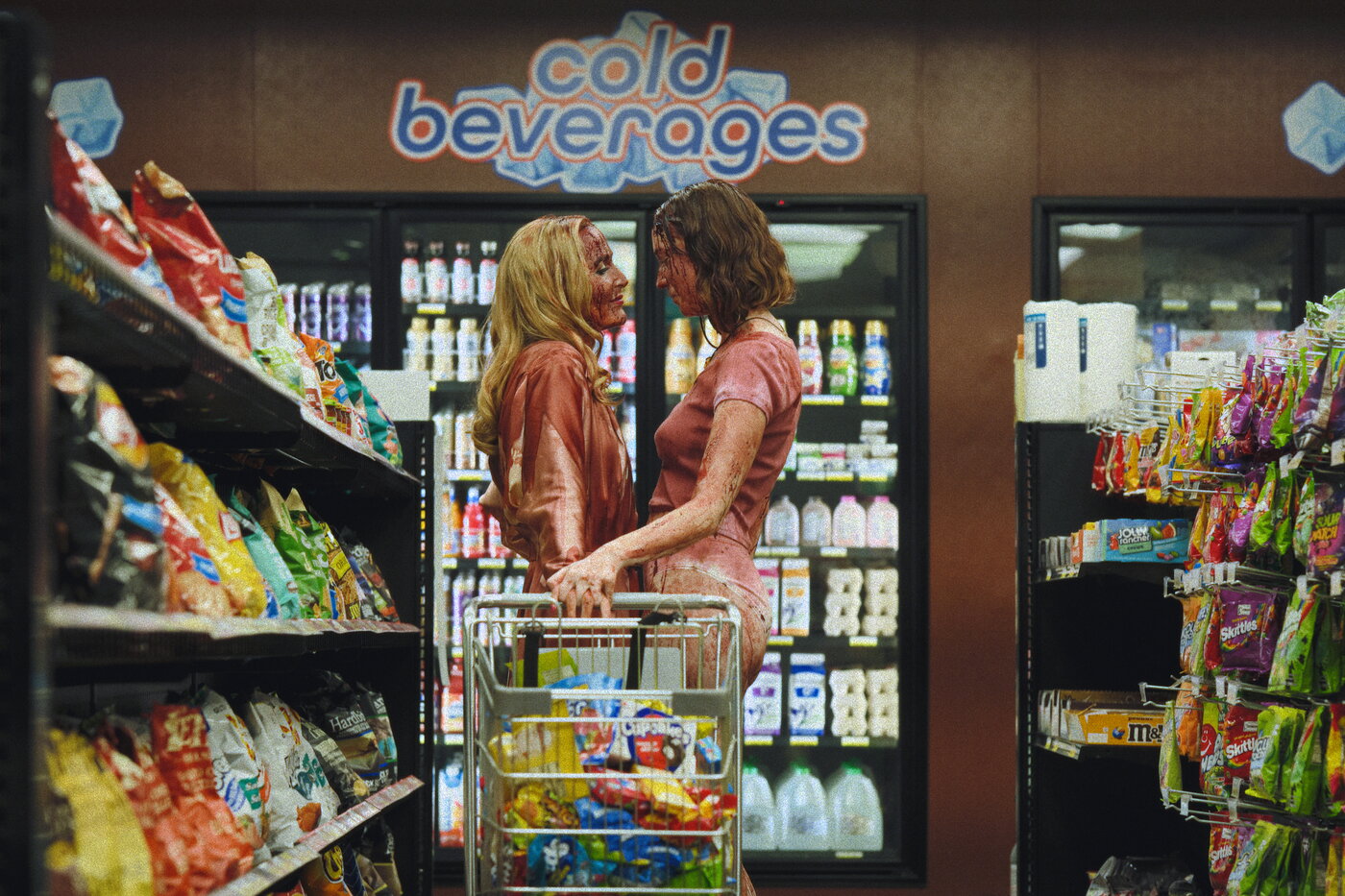
An award-winning young filmmaker attempts to resurrect the slasher franchise that shaped her sexuality in Teenage Sex and Death at Camp Miasma, a surreal new horror-comedy from I Saw the TV Glow director Jane Schoenbrun that premiered at Cannes, played at the Karlovy Vary International Film Festival, and enters Prague cinemas this weekend. Hannah Einbinder and Gillian Anderson are sensational in this wonderfully perverse feature that probes the murky intersection between sex and violence, desire and death, and the strange ways the movies we watch can shape who we become. Only a densely surreal climax, in which the film’s allegory swallows its characters whole, keeps it from ranking among the year’s very best.
Einbinder stars as Kris, a queer Sundance wunderkind whose debut is described as “Psycho from the perspective of the shower curtain.” She’s now been handed the keys to considerably more commercial material: a reboot of Camp Miasma, a beloved 1980s slasher movie that spawned a long-running franchise centered around Little Death, a deadly killer who wears a bizarre mask shaped like an air conditioning vent.
Before introducing Kris, Schoenbrun gives us the entire history of Camp Miasma in a mesmerizing opening-credits montage set to a melancholy cover of R.E.M.’s Nightswimming. VHS tapes, toys, trading cards, newspaper advertisements and other memorabilia chart the franchise’s journey from unexpected hit to increasingly desperate sequels, direct-to-video obscurity and eventual cult rediscovery.
It’s all wonderfully specific, and anyone who grew up obsessing over Halloween, Friday the 13th, Sleepaway Camp and their countless imitators will immediately recognize the trajectory. The fictional Camp Miasma franchise feels so thoroughly realized that Schoenbrun could probably release an entire documentary about movies that don’t actually exist. The clips we see from them, filled with geysers of blood, gratuitous nudity and increasingly ridiculous mythology, only deepen the illusion.
Kris isn’t merely a filmmaker hired to exploit this dormant intellectual property. She’s a lifelong fan who has spent years trying to understand why Camp Miasma means so much to her, particularly one strange psychosexual moment involving Billy Presley (Anderson), the original movie’s final girl. There’s something about the look in Billy’s eyes during a sex scene, and the violent death that follows, that Kris has never been able to shake.
That obsession brings her to Camp Trivoli, the isolated location where the original movie was filmed and where Billy now lives in seclusion. Kris hopes to convince her to return for the reboot, à la Jamie Lee Curtis in the recent Halloween films, but she’s equally interested in interrogating the woman herself about that mysterious moment from decades earlier.
At first, Billy appears to be a Norma Desmond-like relic from Sunset Boulevard, an eccentric former star rattling around the physical remnants of her greatest success. But Schoenbrun gradually reveals something far more interesting. Billy isn’t simply the object of Kris’ obsession; she has spent decades wrestling with the same strange relationship between performance, sexuality and violence that Kris has intellectualized through filmmaking.
Einbinder is perfectly cast as a filmmaker who can eloquently theorize about sexuality but can’t comfortably inhabit her own. Anderson, meanwhile, is having a blast as Billy, initially leaning into the eccentric recluse routine before revealing a vulnerability beneath the theatricality. The two have remarkable chemistry, and what develops between them is tender, funny, uncomfortable and wonderfully perverse.
The sexual relationship that emerges isn’t merely provocation. It gets directly at what Schoenbrun is exploring throughout Teenage Sex and Death at Camp Miasma: why violent imagery can become tangled up with sexual desire, why our fantasies don’t necessarily reflect things we would want in reality, and how difficult it can be to reconcile the private parts of ourselves with the identities we consciously construct.
Slasher movies provide especially fertile territory. The genre has always made an explicit connection between sex and death: teenagers lose their virginity and then lose their lives, knives penetrate bodies, and climactic killings erupt in spurting bodily fluids. Schoenbrun makes the connection literal through Little Death, whose on-the-nose name invokes la petite mort, the euphemism for orgasm. But there’s more going on than a cheeky Freudian reading of Friday the 13th.
Teenage Sex and Death at Camp Miasma is frequently very funny, and the lovingly recreated slasher footage indulges in the kind of outrageous bloodletting that its intellectual discussions might seem designed to critique. Sarah Sherman pops up as Kris’ agent, while Dylan Baker, Jasmin Savoy Brown, Jack Haven, Zach Cherry and Patrick Fischler help populate a world that becomes increasingly detached from conventional reality.
That unreality is reflected in the film’s extraordinary visual design: Schoenbrun and cinematographer Eric Yue frequently place their characters against landscapes that look conspicuously artificial, with forests and skies resembling old-fashioned matte paintings. At times, the deliberately handmade quality recalls the films of Czech fantasy pioneer Karel Zeman, who similarly blended live-action performers with obviously constructed environments rather than attempting to conceal the illusion.
Alex G’s terrific synth-infused original score similarly helps Schoenbrun drift between melancholy introspection, horror and outright fantasy, while the soundtrack is filled with inspired needle drops. Combined with the heightened production design, the result feels less like a straightforward recreation of 1980s slasher aesthetics than a half-remembered version of them.
An increasingly surreal third act allows the fictional Camp Miasma to effectively overtake the narrative until what we’re watching no longer seems to exist within the same reality as the film’s earlier scenes. Instead, it plays like a literal visualization of what is happening inside the characters’ minds: desire, penetration, death and transformation expressed through the language of the slasher movie that brought Kris and Billy together.
That’s an entirely legitimate choice, and perhaps the inevitable destination for a movie so concerned with the ways fiction becomes indistinguishable from identity. But it also diminishes the emotional investment Schoenbrun has worked so carefully to establish. Once Kris and Billy become participants in the metaphor rather than people through whom we interpret it, we begin to lose our connection to them.
It’s a relatively minor reservation given how much Teenage Sex and Death at Camp Miasma gets spectacularly right. Schoenbrun’s previous I Saw the TV Glow explored how pop culture can provide a language for understanding an identity that remains impossible to articulate in ordinary life; this film approaches similar territory from a hornier, bloodier and considerably funnier direction. It understands not merely the appeal of trashy slasher movies, but the intimate relationship we can develop with art whose values we may consciously reject.
Teenage Sex and Death at Camp Miasma might eventually disappear a little too deeply into its own metaphor, but perhaps that’s appropriate for a movie about surrendering yourself to the strange desires that fiction can awaken. Schoenbrun has made a gloriously bloody, funny and deeply personal slasher fantasia that asks why certain images burrow into our brains and stay there, and whether understanding why we want what we want matters nearly as much as finally allowing ourselves to want it.