
Evil spirits possess a family mourning the death of a son and brother at an isolated country estate in Evil Dead Burn, opening in Prague and cinemas worldwide this weekend. This latest Evil Dead entry continues a trend in bucking the playful tone of Sam Raimi‘s original trilogy, and isn’t quite as effective at inducing dread as 2013’s Evil Dead or 2023’s Evil Dead Rise. But this mean-spirited installment works on its own twisted terms, delivering wince-inducing scenes of graphic horror and just enough of a sick sense of humor to keep longtime fans engaged.
Directed by Sébastien Vaniček (Infested), a French filmmaker of Czech heritage, Evil Dead Burn works best as a kind of mashup of the usual series tropes and something like Thomas Vinterberg‘s The Celebration. As deep-rooted trauma and resentment surface over a somber family gathering following a funeral, the Deadites take hold and pit these bickering relatives against one another in especially gruesome fashion. The family drama gives this latest chapter a stronger emotional foundation than its relentless carnage might otherwise suggest.
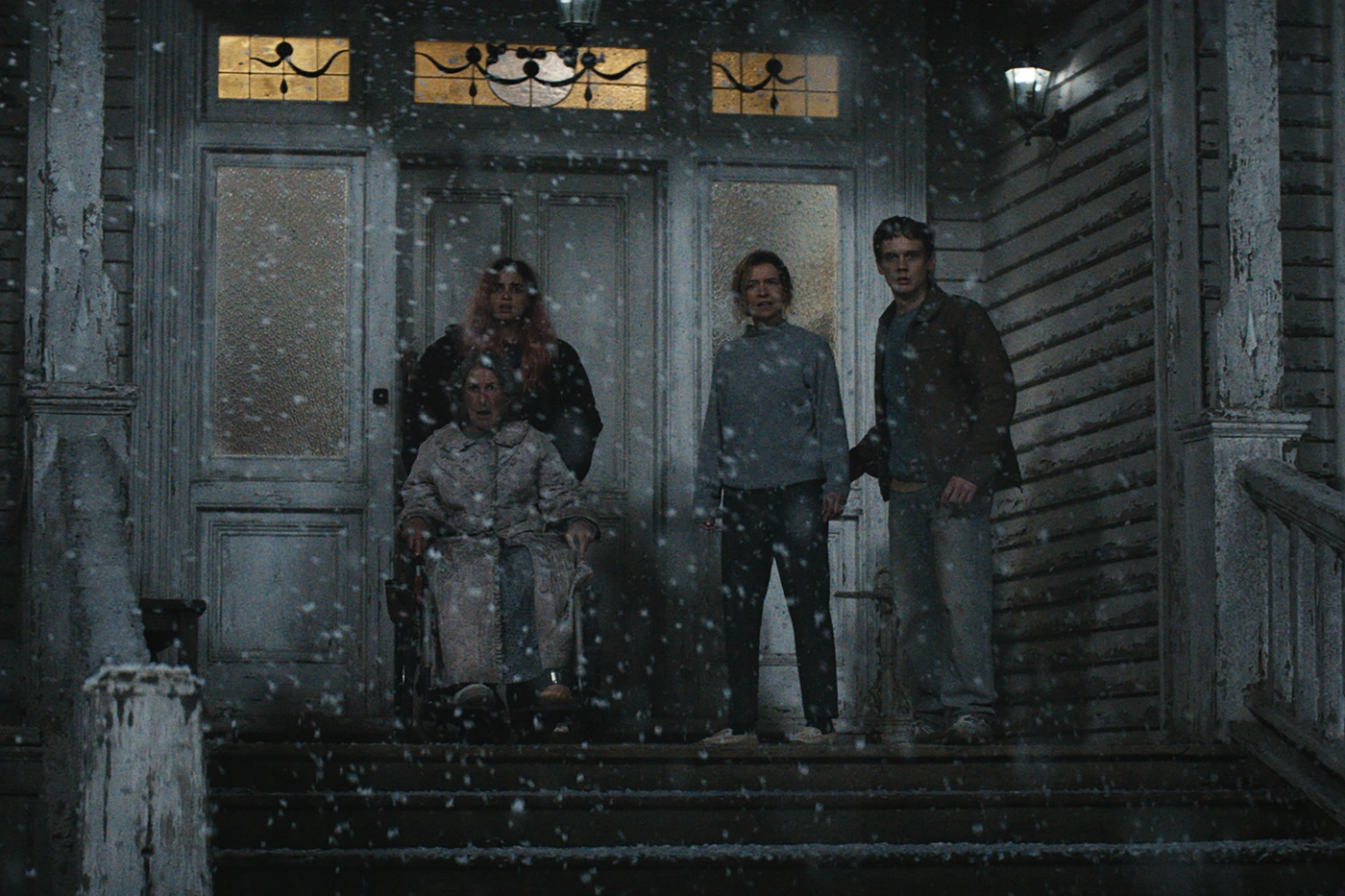
Evil Dead Burn stars Souheila Yacoub as Alice, the widow of the recently deceased Will (George Pullar), who reunites with his estranged family for his funeral at their secluded lakeside estate. There she encounters her hostile in-laws Edgar (Erroll Shand) and Susan (Tandi Wright), gentle brother-in-law Joseph (Hunter Doohan), his girlfriend Thya (Luciane Buchanan), and the family’s elderly matriarch Polly (Maude Davey). When an ancient evil infects the grieving household, old resentments become fertile ground for demonic possession, forcing Alice into a desperate fight for survival against the family that never truly accepted her.
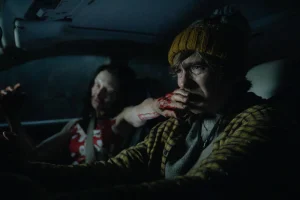
Where Raimi’s original trilogy reveled in manic camera work, slapstick energy, and gleefully excessive gore, and even the more serious recent entries found moments of wicked fun amid the bloodshed, Evil Dead Burn feels determined to wring every ounce of enjoyment from its violence. Its most memorable sequences are also its most unpleasant: one possessed family member calmly shoots themselves in the head multiple times to demonstrate the full extent of their possession, while another sequence involving a character’s face being forced into the hollow cavity where another’s used to be ranks among the grisliest images the franchise has produced.
Even Evil Dead Rise, with its infamous cheese grater sequence, maintained an undercurrent of playful inventiveness beneath the brutality. Vaniček instead embraces a bleakness that recalls the New French Extremity movement of the 2000s, evoking films such as Inside, Frontier(s), and Martyrs far more than Raimi’s original trilogy. That’s not necessarily a criticism. Violence of this severity should feel horrific rather than entertaining. But it does represent a significant tonal shift for a franchise once defined as much by its mischievous sense of fun as its gallons of fake blood. One especially nasty scene involving the family dog also pushes into territory that animal lovers may find difficult to stomach.
The cast grounds the increasingly outrageous mayhem with committed performances. Yacoub makes for a compelling final heroine, never reducing Alice to a conventional scream queen as the character’s complicated history with her abusive late husband gradually comes into focus. Shand and Wright are especially effective as grief-stricken parents whose mourning transforms into something sadistic once the Deadites take hold, their performances finding unsettling echoes of genuine family dysfunction beneath the demonic theatrics.
The screenplay, by Vaniček and Florent Bernard, also does something unexpectedly interesting with Doohan’s Joseph. Horror audiences are conditioned to expect a passive character to eventually redeem themselves through an act of heroism. Instead, Evil Dead Burn deliberately subverts those expectations in a way that feels consistent with its relentlessly pessimistic worldview. This is a film that repeatedly denies its characters the comforting narrative arcs audiences have come to expect.
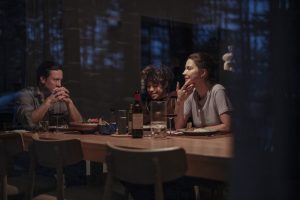
The film’s biggest shortcoming lies in its visual presentation. Every previous Evil Dead film, even the darker recent entries, found striking ways to use bold colors alongside their elaborate practical effects. Evil Dead Burn instead is drenched almost entirely in washed-out grayish blues, to the point that some sequences appear nearly monochromatic. The muted palette drains much of the visual excitement from scenes that are otherwise expertly staged, and even undercuts the performances by leaving characters poorly lit during extended stretches of dialogue.
That’s particularly unfortunate because Vaniček demonstrates considerable visual flair elsewhere. Several kinetic drone shots cleverly update Raimi’s iconic demonic POV camera rushes for a modern audience, while the geography of the decaying lakeside estate creates an effectively oppressive setting for the escalating carnage. With more vibrant cinematography, many of these sequences could have become franchise highlights instead of feeling visually subdued.
Evil Dead Burn ultimately succeeds by refusing to soften either its violence or its worldview. Fans hoping for a return to Raimi’s gleefully anarchic horror-comedy may find themselves disappointed by its relentlessly grim approach, but viewers willing to embrace its harsher sensibilities will find a brutally effective horror film anchored by strong performances and expertly executed practical effects. It may not recapture the mischievous spirit that once made the Evil Dead series unique, but succeeds as a family tragedy transformed into an unrelenting nightmare.