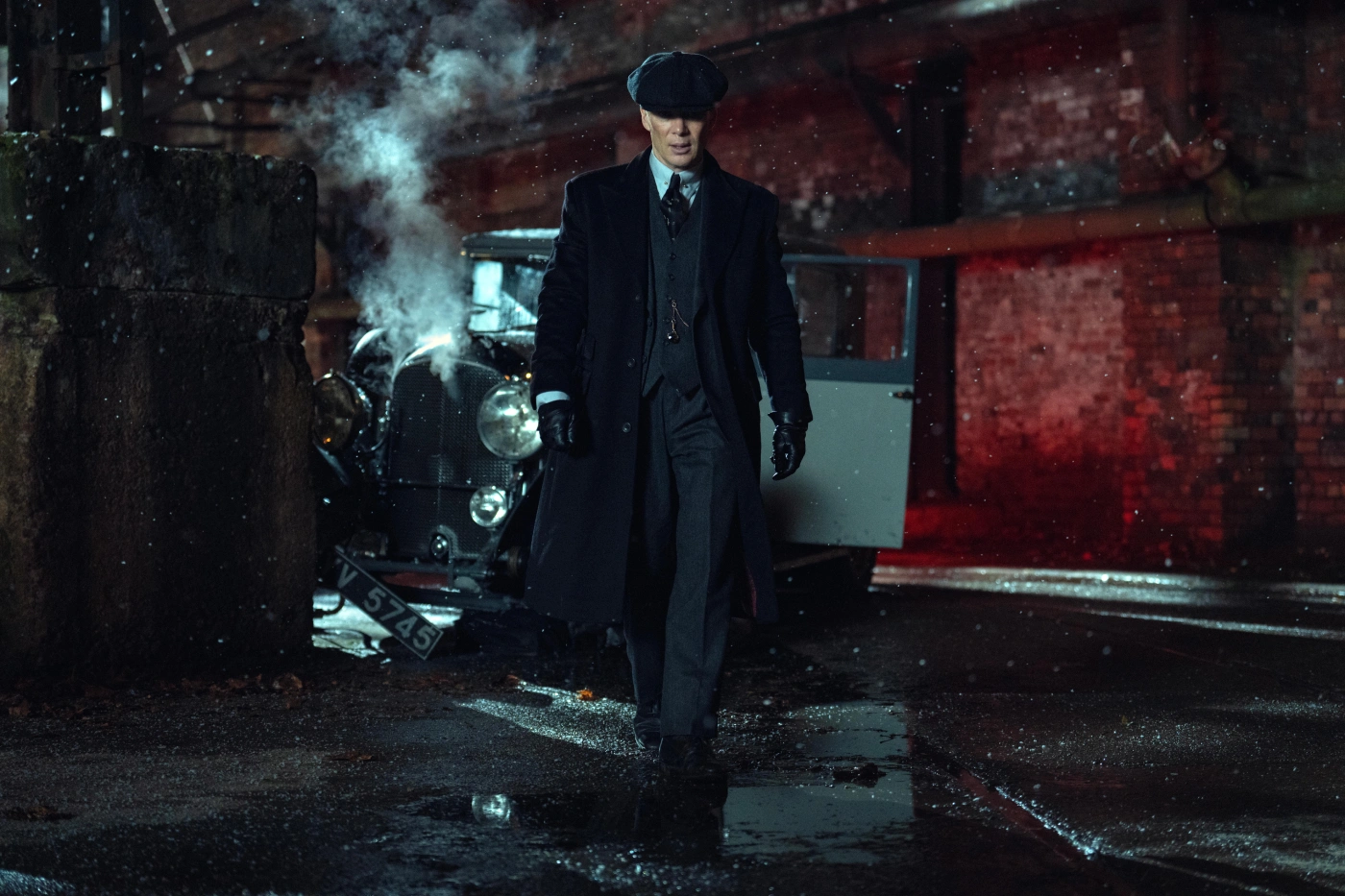

Tommy Shelby returns to Birmingham to stop a Nazi plot to sabotage the British economy in 1940 in Peaky Blinders: The Immortal Man, now streaming on Netflix worldwide after a limited theatrical run in the U.S. and UK earlier this month. Despite a narrative that largely ditches the moral ambiguity that made the BBC series created by Steven Knight so compelling, this return to the world of Peaky Blinders scratches a certain itch, and is likely to be most appreciated by franchise fans.
Set against the Blitz and a Britain under mounting wartime pressure, Peaky Blinders: The Immortal Man finds Tommy (Cillian Murphy) living in self-imposed isolation, hollowed out not only by the events of the series but by more recent losses that have pushed him even further from the world he once controlled.
His sister Ada (Sophie Rundle), now carrying political responsibilities of her own, tries to pull him back into Birmingham as Tommy’s son Duke (now played by Barry Keoghan) becomes entangled in a scheme involving a counterfeit-money scheme led by Nazi agent John Beckett (Tim Roth). But while Ada is unsuccessful, the mysterious Kaulo Chiriklo (Rebecca Ferguson), twin sister of Tommy’s former lover and Duke’s mother Zelda, has more luck.
As in the show, Knight writes in broad, mythic strokes, and the early passages of The Immortal Man have a haunted quality as Tommy drifts through exile, communing more with ghosts than with the living. That first stretch is also the movie’s weakest, as it spends a little too much time waiting for Tommy to re-enter the action, and the drama lacks urgency until he finally returns home.
Once that happens, however, the film clicks into place. As Tommy effortlessly slides back into action, Duke’s uncertain loyalties and Beckett’s escalating threat give the back half a sharper pulse, while the final act delivers the sort of grimly satisfying violence and ritualized family reckoning that fans will have come for.
Still, there is no getting around the fact that the central story is much less interesting than the ones the series used to tell. Casting the antagonists as Nazis feels dramatically lazy, if undeniably efficient. One of Peaky Blinders’ great strengths was its ability to place Tommy and his family in morally compromised conflicts against rivals who were often as charismatic, wounded, or ideologically complex as they were.
Here, there is little ambiguity at all. The film asks viewers to root for Tommy Shelby and company as de facto defenders of England against cartoonishly evil enemies, and that is a much easier, flatter dynamic than the show typically dealt in.
That simplicity also makes the plot feel unusually thin for a feature intended as the culmination of six seasons and 36 episodes. There are relatively few surprises, and Peaky Blinders: The Immortal Man moves in a fairly straight line from Nazi conspiracy to revenge narrative to final reckoning. The scale may be bigger than the original series, but the storytelling is smaller in nuance. What once felt dangerous and unpredictable now feels more conventional, as if the world of Peaky Blinders has been squeezed into the framework of a wartime crime thriller.
What keeps the film compelling is Murphy. He slips back into Tommy Shelby with remarkable ease, but this is not simply a reprise of old habits. His performance here is marked less by icy calculation than by exhaustion, regret, and the dawning recognition that his time is over. Murphy still gives Tommy the familiar smoldering intensity, but now it is tempered by age and weariness.
The film’s best scenes belong to him: a pub confrontation charged with the teetering threat of violence, a bruising mud-soaked fight with his son in a pig pen, and a blistering shootout with Roth’s Beckett. Whatever the shortcomings of the script, the film succeeds as an epilogue for the series largely because Murphy makes Tommy’s final chapter feel earned.
The supporting cast is more unevenly served. Rundle’s Ada is important to the plot but never feels as fully used as she should after being such a major presence in the series. Stephen Graham, Ned Dennehy, and Ian Peck are welcome faces, yet they have almost nothing to do beyond reminding viewers of the world Tommy once commanded. Packy Lee fares a bit better as the loyal Johnny Dogs, while the newcomers to the cast—Keoghan, Ferguson, and especially Roth—gleefully chew up the scenery.
Director Tom Harper, returning to the franchise for the first time since the first season, understands the visual language of Peaky Blinders and, more importantly, how to scale it up without losing its grit. The Immortal Man contains several strikingly staged sequences, from intimate standoffs to full-on gunplay, and its unexpectedly action-heavy climax lands with real force.
George Steel and Ben Wilson’s cinematography is excellent throughout, preserving the series’ mix of industrial grime and operatic grandeur. Costumes and practical sets remain first-rate, though some digital backdrops in the bombed-out Birmingham scenes look less convincing than the show’s usual tactile environments. The music is predictably strong as well, with the franchise’s signature anachronistic use of modern rock still doing much of the mood-setting heavy lifting. When Nick Cave’s Red Right Hand arrives, it still hits just as hard.
As a continuation of Peaky Blinders, The Immortal Man does not fully recover the series’ thornier moral texture or narrative complexity. But as a final ride with Tommy Shelby, it works. It is emotional in ways that sneak up on you, stylish in ways fans will instantly recognize, and anchored by a performance from Murphy that gives the character a proper last bow. This may not be the sharpest cut in the Shelby razorblade cap, but it is a fitting sendoff all the same.