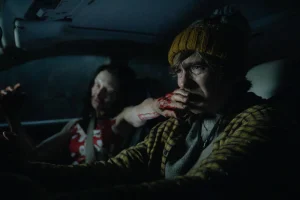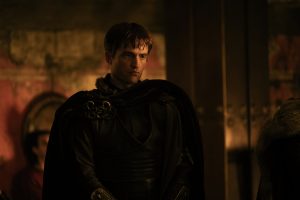


A town full of outlaws is besieged by a posse of bounty hunters looking to score big in Gunslingers, a purported western starring Nicolas Cage and Stephen Dorff now available on VOD. This borderline experimental film from writer-director Brian Skiba recalls the outsider art of Danzig (Death Rider in the House of Vampires) and Insane Clown Posse (Big Money Rustlas) more than anything its respectable cast would indicate. You have been warned.
Gunslingers opens in New York City, 1903, with a sepia-tinted establishing shot that you might accuse of being AI-generated, if you didn’t secretly know that AI would have done a better job. But never mind all that: we immediately cut to a gunfight already in progress, as Thomas Keller (Dorff) shoots some guys, they shoot back, and his brother Robert (Jeremy Kent Jackson) ends up in the fireplace with a bullet in his chest. In a motif that will become a recurring theme, we have no idea who these people are or why they are killing each other.
But we do hear the name ‘Rockefeller’ bandied about, and after a slightly more coherent shootout with a gang led by a character played by Yellowstone‘s Forrie J. Smith, we infer that Keller is a criminal with an especially high bounty on his head. Thomas makes his way to a rural Kentucky town inhabited by the likes of Ben (Nicolas Cage), Jericho (Costas Mandylor), Lin (Tzi Ma), Levi (Cooper Barnes), and Doc (Randall Batinkoff), and is promptly hanged for his misdeeds, at (seemingly) his own request.
Or… is he? When Val (Heather Graham) comes into town with her daughter in tow and asking questions, it’s revealed that this is no ordinary town, but one exclusively inhabited by wanted criminals. Thomas only faked his own death to join their ranks. But bad news for this outlaw town: Val is pursued by a posse of at least 100 men, led by Thomas’ brother, who is now out for revenge for being left for dead.
The stage is set for Gunslingers‘ epic showdown. You check the running time. We are 15 minutes into the movie.
What follows can only be described as experimental filmmaking. In one shot, a character pops out from behind a corner and fires a gun. In another shot, a different character writhes in pain and tumbles to the ground as a digital squib effect fills the screen. In Gunslingers, these two shots are completely unrelated, but through the cinematic technique of editing, our brains fill in the gaps: one character has shot and killed the other. Not since Luis Buñuel’s Un Chien Andalou has the audience been challenged to explain what is happening on the screen in such direct fashion.
This sequence will repeat itself no fewer than 100 times throughout the remainder of Gunslingers, with brief pauses for dialogue interrupted by 10-minute-long gunfights that follow the same formula: a gun is fired, and a person is shot. Repeat. Every shot is the same hip-level close-up, so we have no idea where these characters are in relation to each other. Often, we don’t even know who is doing the shooting, or who is getting shot.
The screenplay matches the avant-garde filmmaking. We don’t understand why Robert wants to kill his brother, let alone why his posse of 100 nameless men sacrifice themselves to the barrage of gunfire from the town of outlaws. We learn next to nothing about any of these characters, including our alleged protagonist. No one in the movie has any objective, other than to shoot, and not get shot.
After about an hour, we become numb to the mindless barrage of gunfire, and Gunslingers turns into another kind of experiment. What are we watching? Why are we watching it? Is it cinema? Like Michael Snow’s Wavelength, nothing happening onscreen manages to hold our attention, and we turn the focus inward. What life choices have led us to watching Gunslingers?
A saving grace here is Nicolas Cage, decked out in a bowler hat and sunglasses tinted in the shape of a cross, doing his best Tom Waits impression as he wheezes dialogue about a “promise to God.” He constantly rocks back and forth and shakes his hand as if he has Parkinson’s; that’s particularly concerning given that he’s also the town’s photographer. He has one of those old-timey accordion cameras that needs a flashbulb and a dark cloth, but he has neither of those things, and instead takes walk-by snapshots as if he were Vivian Maier.
Cage is in many scenes throughout the movie but has almost nothing to do; one would be tempted to say he’s wasted here, but by that standard every actor in the cast is wasted. Still, he’s the reason many may be tempted to tune in. Avoid that temptation. The actor has made many bad movies, but none as bad as this since at least 2020’s Jiu Jitsu.
Gunslingers is not the worst movie of the year, or even the worst movie released this weekend (that honor goes to Prime Video’s G20), but if you’re expecting even a mildly competent Cage western on the level of The Old Way or Butcher’s Crossing you’ll be left bitterly disappointed by what’s on display here.