
Queer desire is reframed as a demonic affliction in Leviticus, the feature debut of Australian writer-director Adrian Chiarella now playing in Prague cinemas after debuting earlier this year at Sundance. Like many recent genre films exploring the intersection of intimacy and danger, it is structurally familiar—drawing clear lineage from It Follows—but distinguishes itself through its specific focus on homosexuality as both lived experience and socially constructed curse. The result is a film that is transparent from the outset, but compelling in how consistently and confidently it presents its central theme.
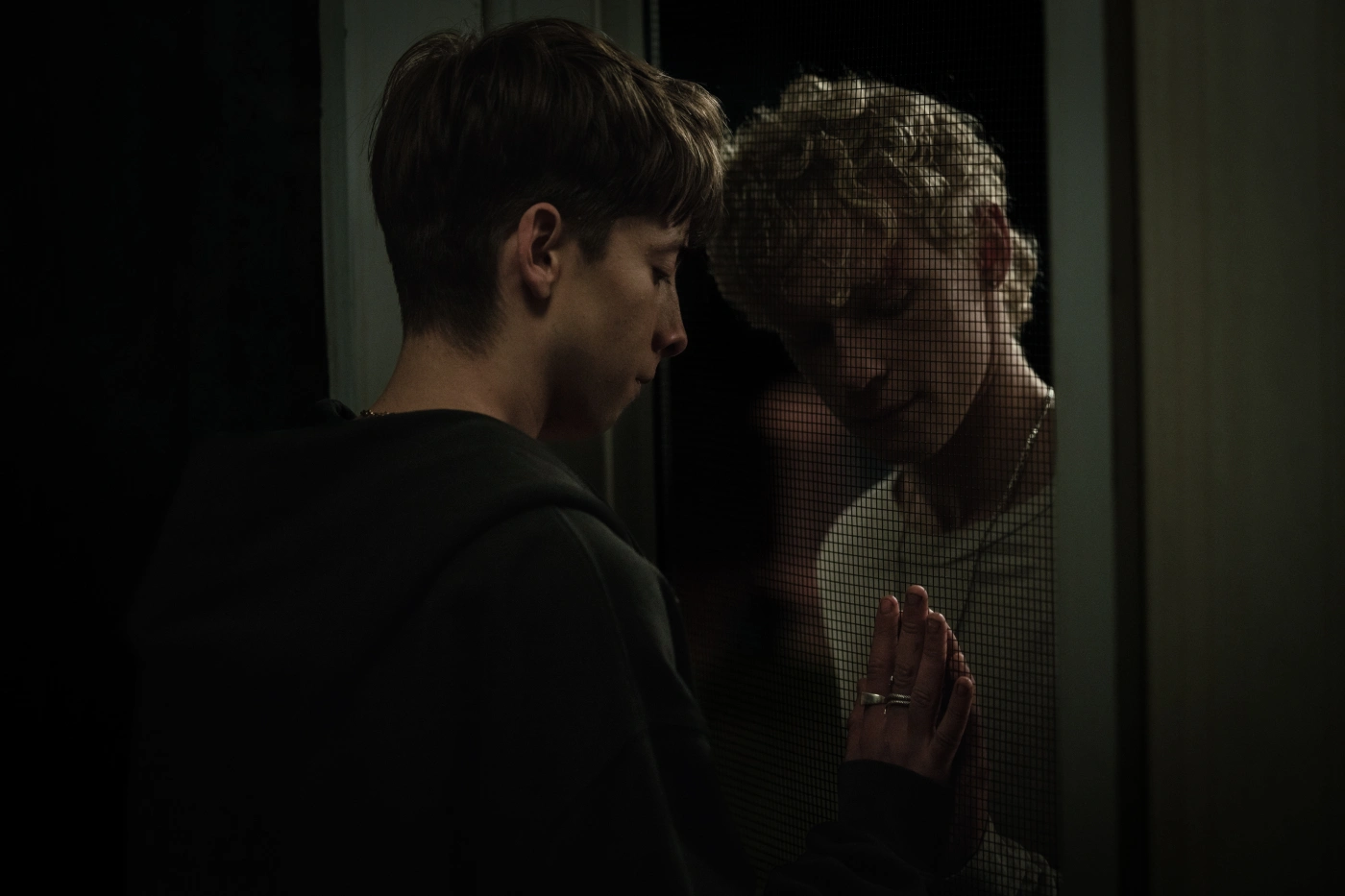
Leviticus is built on a simple but effective conceit: a young gay man becomes haunted by a demonic doppelganger of the person he is attracted to, invisible to everyone else and violently intent on punishment. The metaphor is hardly subtle. Conversion therapy, religious condemnation, and the internalized violence of shame are all immediately legible in the film’s premise, and Chiarella does not significantly complicate that reading as the narrative progresses.
The film centers on Naim (Joe Bird) and Ryan (Stacy Clausen), two teenage boys navigating a fragile, clandestine attraction in a remote Australian industrial town. Mia Wasikowska is Naim’s emotionally distant mother, whose inability—or unwillingness—to recognize what her son is going through becomes a quiet but persistent source of anguish.
Bird and Clausen deliver impressively assured performances for such young actors, grounding the film’s heightened allegory in something recognizably human; their hesitancy, coded glances, and wary physical closeness carry far more weight than the film’s overt supernatural mechanics. Wasikowska plays Naim’s mother with a stern detachment that reads less as outright villainy than as a painfully plausible form of parental blindness.
What prevents Leviticus from feeling reductive is the clarity and control with which it is executed. Chiarella demonstrates an unusually assured visual sensibility for a debut feature, grounding the supernatural horror in the stark, industrial textures of remote Australian (filming took place on the outskirts of Melbourne).
Cinematographer Tyson Perkins captures this landscape with a bleak precision: smoke-stained skies, decaying infrastructure, and vast, isolating spaces that reinforce the film’s preoccupation with emotional and social alienation. The environment does not simply host the story; it actively mirrors the internal containment of its characters, who appear trapped long before anything literal begins to manifest.
That sense of containment extends to the film’s emotional architecture. The central relationship between the young leads is defined less by overt romance than by cautious proximity, as if intimacy itself carries an anticipated consequence. When the supernatural presence begins to take shape as a doppelganger of desire, the horror is not simply externalized violence but the impossibility of safely acting on attraction.
Chiarella repeatedly frames moments of physical closeness as structurally dangerous events, where affection and annihilation become indistinguishable. The comparison to It Follows is unavoidable, but Leviticus narrows that allegorical mechanism into something more explicitly identity-specific, replacing generalized sexual anxiety with a targeted cultural and religious condemnation of homosexuality.
There’s a notable emotional restraint in how the characters respond to their predicament. Rather than actively resisting the curse or attempting to reinterpret its rules—there does appear to be a way to confront it, left somewhat unexplored—they often appear resigned, moving through the narrative with a subdued acceptance that reinforces the film’s sense of inevitability. This passivity can be read as thematic coherence, but it also limits the escalation of tension in conventional horror terms.
This is particularly evident in the portrayal of Wasikowska’s mother, a figure who embodies a kind of emotional blindness that feels both frustrating and deliberate. She is not written as a caricature of religious hostility so much as a recognizable form of parental denial, unable or unwilling to perceive the reality of her son’s experience. The film uses her presence to sharpen its critique of well-meaning repression, suggesting that harm is often administered not only through overt hatred but through avoidance.
Where Leviticus succeeds most consistently is in its atmosphere and tonal control. Even when its thematic direction feels overly legible, Chiarella maintains a firm grasp on mood, pacing, and visual coherence. The industrial landscapes, a quiet ever-present dread, and sudden intrusions of violence are all handled with a steady hand that suggests a filmmaker more interested in sustained unease than shock value (though there is one real-deal jump scare). The horror itself is less about surprise than inevitability.
Chiarella’s film may not transcend the boundaries of its concept, but it articulates it with enough precision and aesthetic conviction to leave a lasting impression. In a crowded field of allegorical horror, Leviticus stands out both for what it says and how assuredly it says it.