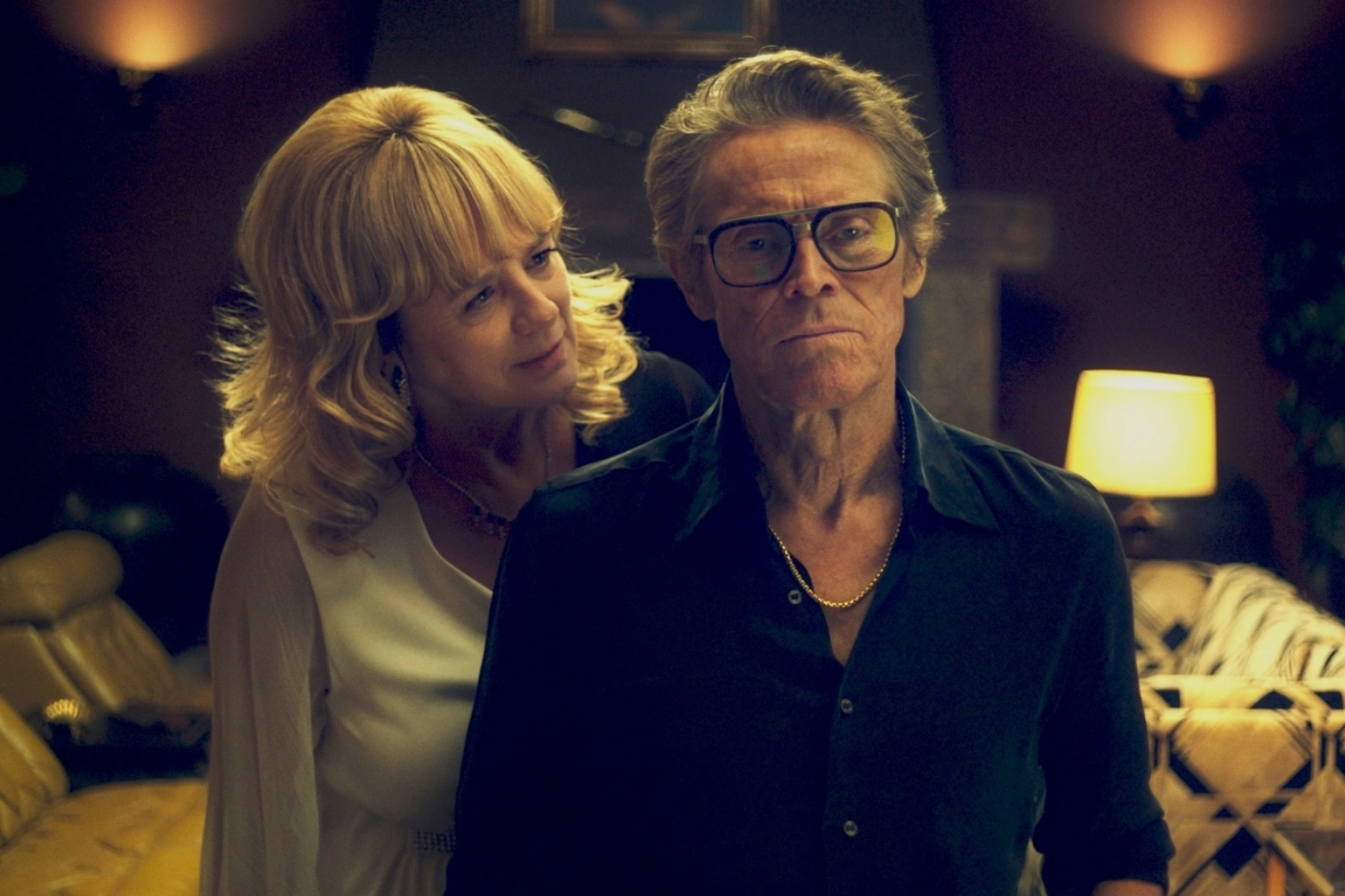
A wealthy Greek shipping magnate hosts a lavish celebration for his daughter on his private island while secretly plotting to control her future and his own legacy in The Birthday Party, opening in Prague cinemas this weekend after premiering at last year’s Locarno Film Festival. This striking psychological drama from writer-director Miguel Ángel Jiménez, adapted from Panos Karnezis‘ acclaimed novel, boasts an arresting central performance by Willem Dafoe and gorgeous Mediterranean scenery, but its intimacy is undercut by a central flaw: we don’t really care about any of these people.
The Birthday Party opens in flashback, as Marcos Timoleon (Dafoe) learns of the death of his 18-year-old son in a plane crash at sea. By 1975, Marcos has transformed his grief into an all-consuming obsession with his family, his fortune and, above all, his legacy. He brings together an assortment of wealthy friends, political associates and hangers-on for the 25th birthday of his daughter Sofia (Vic Carmen Sonne), whose relationship with young English writer Ian Forster (Joe Cole) threatens to disrupt the future Marcos has carefully envisioned for her.
There’s a deliciously sinister setup here, somewhere between an Agatha Christie mystery and a Greek tragedy, as Marcos quietly manipulates the people around him while everyone else tries to figure out exactly what he is up to. Dafoe is perfectly cast as the Onassis-like patriarch, a man whose enormous wealth has given him the power to make everyone around him feel like a subordinate simply by raising an eyebrow. The actor’s performance is commanding without being showy; even his softest lines carry the implicit threat of someone who has never had to hear the word “no.”
The problem is that the film’s psychological drama doesn’t give us enough reason to care about the characters. Karnezis’ novel tells the story of Timoleon’s entire life, closely mirroring the biography of Aristotle Onassis, and gives us the context necessary to understand how this man became the person we see at the party. Jiménez and co-writers Giorgos Karnavas and Nicos Panagiotopoulos strip away almost all of that history to concentrate on the titular celebration. It’s an understandable choice, but it leaves Marcos frustratingly opaque.
We learn about him almost entirely through conversations with the other characters, or through what those characters say about him. The central conflict of a wealthy patriarch confronting his own mortality and attempting to ensure that his legacy survives through his daughter and her future children is potentially fascinating, but the film gives us precious little access to the man experiencing it.
Instead, much of the immediate drama centers on Sofia, particularly her relationship with Forster, who has been working on a biography of her father. This makes her seem like the protagonist for long stretches, even though Marcos’ machinations are ultimately driving the story. Once his intentions become clear, much of the mystery disappears, leaving the film with relatively little narrative momentum.
Yet The Birthday Party remains compelling almost entirely because of its cast. Dafoe is terrific, effortlessly establishing Marcos’ authority over everyone around him. Watching him negotiate with the colorful collection of people he has assembled on his island is often more interesting than the plot itself: He can dismiss someone with a glance, or completely change the temperature of a conversation with a seemingly innocuous remark.
Emma Suárez is also excellent as Marcos’ soon-to-be-ex-wife Olivia, who maintains an unexpectedly close relationship with him despite their impending separation. Christos Stergioglou (Dogtooth) brings weight to Marcos’ longtime friend and doctor Patrikios, while Sonne and Cole give the younger generation a necessary sense of volatility. The ensemble is first-rate, even when the script doesn’t seem to give them much to do.
What the screenplay lacks in narrative weight, however, Jiménez makes up for with an extraordinarily polished visual presentation. Cinematographer Gris Jordana makes the most of the film’s locations in Corfu, standing in for Marcos’ private island, with additional studio work in Athens. The widescreen compositions are immaculate, moving from sun-drenched Mediterranean exteriors to sultry nighttime parties and elegant interiors.
There’s also a wonderful tactile quality to the production design and the use of color. Jiménez understands that this world of extreme wealth should look almost unreal, and the film’s images frequently resemble photographs from a particularly decadent dream. Even during the later stretches, when all of Marcos’ cards are on the table and the mystery has largely evaporated, the visual design remains enough to keep us watching.
The same is true of the music. The score by Alexandros Livitsanos and Prins Obi blends Greek-influenced sounds with propulsive 1970s party rhythms. It gives the movie a unique identity and provides a momentum that the screenplay sometimes lacks.
There’s a wonderful sense of ancient tragedy lurking underneath all of this modern wealth and decadence. Marcos has spent his life acquiring everything he could possibly want, only to discover that money cannot protect him from mortality. His attempts to control his daughter’s future are ultimately an extension of that same impulse: If he can control what happens after his death, perhaps he can somehow defeat death itself.
But the film never quite transforms that idea into the emotional punch it seems to be reaching for. The Birthday Party is much more successful as a portrait of a fascinatingly powerful man than as a drama about the people surrounding him. When the film asks us to care about the consequences of Marcos’ decisions, we are too often left at an emotional distance.
Still, there’s enough here to recommend, particularly for arthouse audiences. Jiménez has created a strikingly composed psychological drama with a superb central performance, beautiful photography and an excellent score, and the final rendition of Don’t Let Me Be Misunderstood by Dafoe, backed by the Czech Studio Orchestra, recording from Prague, is an appropriately flamboyant cherry on top. The Birthday Party may not give us enough of Marcos Timoleon’s life to fully understand him, but watching Dafoe rule this little kingdom is a party worth attending.