
Forty years ago this month, My Sweet Little Village (Vesničko má středisková) entered Czech cinemas and became one of the most enduring popular films of 1980s Czechoslovak cinema. Directed by Jiří Menzel from a screenplay by Zdeněk Svěrák, the 1985 tragicomedy had already attracted attention at film festivals before its domestic theatrical release.
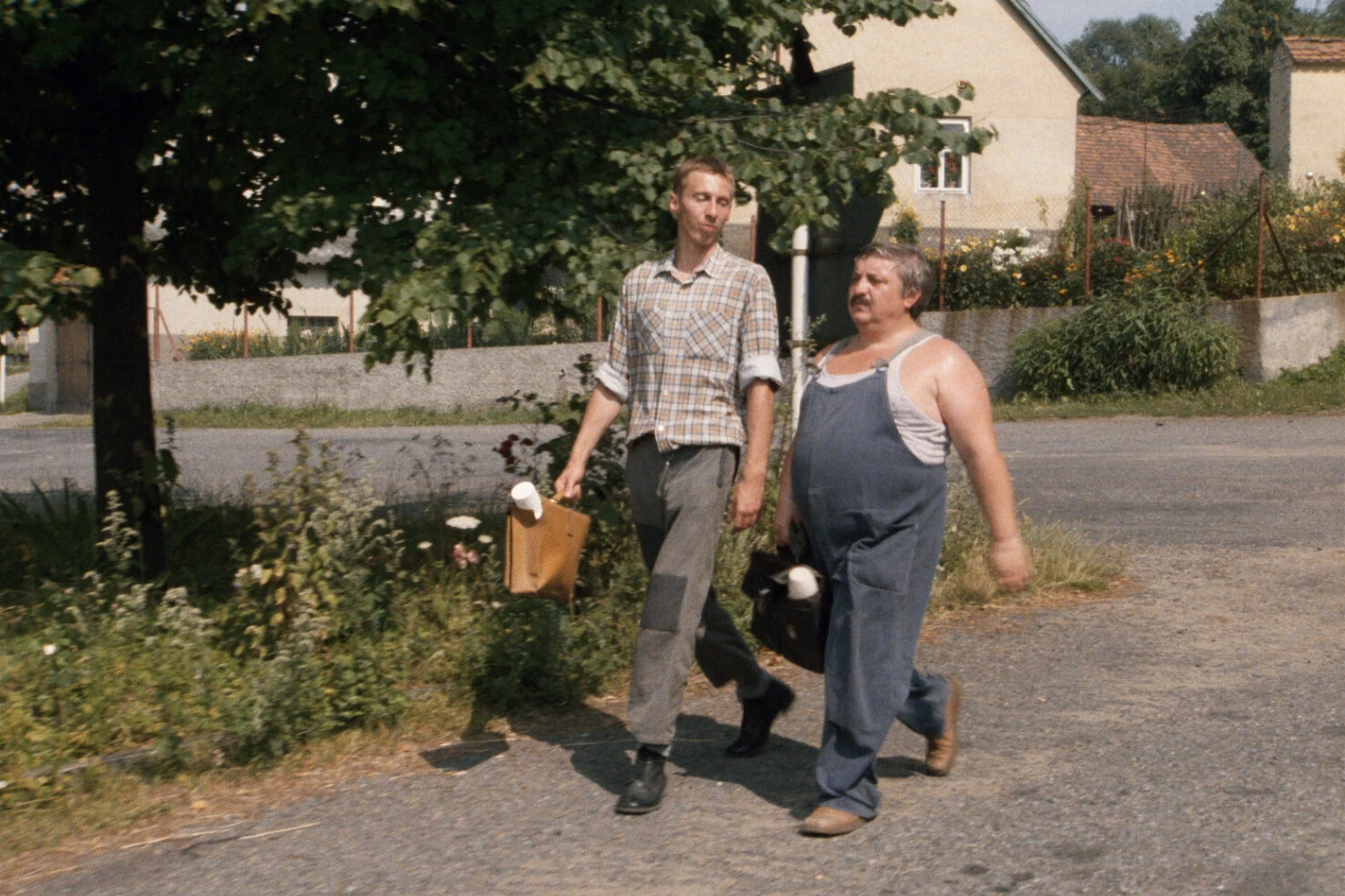
Set in the fictionalized Central Bohemian village of Křečovice, the film follows truck driver Karel Pávek and his accident-prone assistant Otík Rákosník, a young man with an intellectual disability who is deeply attached to his home and community. Around them, Menzel and Svěrák construct an episodic portrait of village life populated by eccentric doctors, jealous husbands, unhappy wives, cooperative employees and local officials.
The film’s gentle humor and unhurried observation helped it connect with audiences at home and abroad. Within two months of its Czech release, the film had attracted its first million domestic viewers, while a festival run that began before the theatrical premiere helped establish it as an international success. It went on to receive an Academy Award nomination for Best Foreign Language Film and was distributed theatrically in numerous countries.
From rural Czechoslovakia to international festivals
The film was produced in 1985 and first reached audiences through festival screenings before its Czech theatrical premiere. At the 1986 Karlovy Vary International Film Festival, where it screened out of competition, My Sweet Little Village was already generating substantial interest. Contemporary festival reports noted strong audience and critical attention, and the film would later be selected for the Montreal World Film Festival, where it received a Special Jury Prize.
A presentation at the Toronto International Film Festival was also important in introducing the film to the North American market. By the end of September 1986, the film had been sold to 12 countries. Further festival appearances followed in Valladolid, Festroia, London, Vienna, Paris and São Paulo, among others.
The international response was notable partly because the film’s appeal was rooted in details of everyday Czechoslovak life. Foreign critics variously compared Menzel’s comic approach to the work of Luis García Berlanga, Jacques Tati, Buster Keaton and Laurel and Hardy. The comparisons differed, but many focused on the same qualities: the director’s affection for imperfect characters, his use of understated visual gags and the way individual stories overlap without turning the village into a conventional plot-driven setting.
The film also offered a subtle portrait of life under late socialism. The central conflict arises when a Prague bureaucrat attempts to remove Otík from his village so that his picturesque cottage can be acquired as a country retreat. What initially appears to be a small dispute over housing ultimately becomes a confrontation between the village community and an impersonal bureaucracy.
American critic Roger Ebert, reviewing the film for the Chicago Sun-Times when it entered U.S. distribution in January 1987, praised Menzel’s ability to connect the individual stories. He wrote that Menzel “weaves their stories together almost without seeming to,” while also identifying everyday life as a vehicle for a “subtle attack on bureaucracy.”
A Czech classic with a lasting legacy
The film’s international reception was not uniformly positive. Some critics found its episodic structure and deliberately modest dramatic stakes too slight, while others objected to its slow pace or simple comic situations. In the United States, reviews from Ebert and The New York Times‘ Vincent Canby represented sharply different assessments of Menzel’s approach.
For some critics, My Sweet Little Village worked precisely because it avoided conventional dramatic escalation. Its story is less about a single conflict than about the relationships among the residents of Křečovice and the routines that bind them together.
The performances were central to that approach. Slovak actor Marián Labuda plays Pávek as an outwardly irritable but fundamentally caring man, while Hungarian actor János Bán plays Otík with a largely physical and expressive performance. Rudolf Hrušínský‘s absent-minded Dr. Skružný became another of the film’s defining characters, while Petr Čepek and Libuše Šafránková anchor a subplot involving the volatile Turek and his unhappy marriage.
The film’s success also extended the international reputation of Menzel, one of the key directors associated with the Czechoslovak New Wave. He had won the Academy Award for Best Foreign Language Film for Closely Watched Trains in 1968, but My Sweet Little Village demonstrated that his understated comic style could continue to attract audiences outside Czechoslovakia nearly two decades later.
In February 1987, My Sweet Little Village received an Academy Award nomination for Best Foreign Language Film, further increasing its visibility in international markets. It ultimately lost to the Dutch film The Assault, but the nomination became an important milestone for Czechoslovak cinema during the normalization period, when relatively few domestic productions were achieving broad Western distribution.
Four decades later, the film remains closely associated with Menzel’s humane approach to comedy and with a particular vision of Czech rural life. Its village is hardly idealized: arguments, infidelity, bureaucracy and petty frustrations are everywhere. Yet the community ultimately protects one of its most vulnerable members, reinforcing the film’s central idea that ordinary human relationships can prove more durable than official institutions.
My Sweet Little Village was newly digitized in 2023 through a collaboration involving the National Film Archive, the Czech State Cinematography Fund and the Karlovy Vary International Film Festival, with restoration work carried out at Prague’s Universal Production Partners and Soundsquare. The restoration has helped ensure that one of Menzel’s most internationally recognized films remains accessible to new audiences as it reaches its 40th anniversary. In Czechia, the new restoration can be currently be streamed with English subtitles on Netflix and KVIFF.tv.