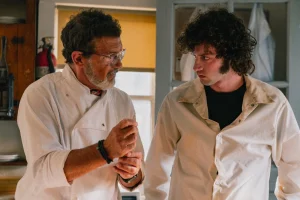


A political prisoner and his flamboyant cellmate bond over the retelling of a kitschy Hollywood musical while serving time during Brazil’s military dictatorship in Kiss of the Spider Woman, opening in Prague cinemas this weekend after premiering at the Sundance Film Festival and debuting stateside in October. Directed by Bill Condon, this adaptation of Terrence McNally‘s 1993 musical—based on Manuel Puig‘s 1976 novel that inspired the Oscar-winning 1985 film—is visually sumptuous and anchored by three standout performances, though its attempt to reconcile campy spectacle with serious historical drama does not always succeed.
Kiss of the Spider Woman opens toward the end of Brazil’s Dirty War, as political dissident Valentin Arregui Paz (Diego Luna) receives a new cellmate in the gregarious Luis Molina (Tonatiuh), a gay window dresser imprisoned for indecency. Unbeknownst to Valentin, Molina has been recruited by the prison’s warden (Bruno Bichir) to spy on him in exchange for early parole and the chance to see his ailing mother.
Initially irritated by Molina’s chatter and flamboyance, Valentin gradually warms to him as Molina recounts his favorite Hollywood musical, Kiss of the Spider Woman, with the sequences re-enacted piece by piece. Jennifer Lopez stars in dual roles as Aurora and the titular Spider Woman, with Luna and Tonatiuh portraying her cinematic love interest Armando and friend Kendall Nesbitt, respectively.
Condon’s adaptation occupies an unusual space between Puig’s original novel, the 1985 film starring Raul Julia and William Hurt, and McNally’s musical. Unlike the stage version, where the musical numbers are wholly integrated with the prison sequences, here the songs are largely confined to Molina’s retelling of the Hollywood film. This structural choice produces a visually striking juxtaposition but introduces unevenness in tone. The staging, choreography, and cinematography are all excellent, but the underlying narrative sometimes feels overshadowed by the musical grandeur.
The Hollywood musical being recreated is itself somewhat conventional—more of a sentimental romance than the darker, politically charged propaganda film of the original movie. The story within a story is charming but rarely compelling on its own, and the tonal oscillation between the stark realities of imprisonment and the escapist musical fantasy can be jarring.
Kiss of the Spider Woman’s production design is consistently impressive. The musical sequences are lavishly staged, with shimmering costumes, sweeping sets, and choreography that clearly nods to classic Hollywood. Condon employs long, fluid takes to emphasize both the physicality of the dancers and the scale of the sequences, evoking Busby Berkeley-style musical grandeur.
In stark contrast, the prison sequences are austere and meticulously framed, with harsh lighting and confined spaces that underscore the characters’ oppression. The visual juxtaposition between the two worlds—prison and musical—is perhaps the film’s most effective storytelling device, even if the tonal shifts are occasionally abrupt. Where You Are, one of the only prison-set song-and-dance numbers kept from the musical, is a clear highlight, and enough to suggest that the filmmakers perhaps should have staged a more faithful adaptation.
Luna and Tonatiuh deliver strong, heartfelt performances, and the growing bond between Valentin and Molina is poignantly rendered. Their developing intimacy is the narrative and emotional anchor of Kiss of the Spider Woman, providing genuine warmth and stakes amid the spectacle.
But Lopez consistently dominates the musical sequences, turning them into the film’s most memorable moments. She radiates charisma, elegance, and a convincing Hollywood Golden Age glamour throughout the movie, and keeps us in rapt attention through commanding vocals and consistently impressive dance moves; like Luna’s Valentin, by the film’s climax we’re waiting for her next appearance to distract us from the story at hand.
This adaptation remains faithful to the core themes of the source material: love, loyalty, and resilience under authoritarian oppression. Molina’s moral integrity and emotional intelligence consistently clash with Valentin’s rigid idealism, and the poignancy of their parting—set against the backdrop of political turmoil and personal sacrifice—provides the film’s emotional payoff, even if the musical detours occasionally undercut the drama.
Kiss of the Spider Woman is a visually sumptuous experience, anchored by Lopez’s radiant performance and a touching depiction of the evolving relationship between Luna and Tonatiuh’s characters. Its lavish choreography, striking production design, and faithful adaptation of the source material make it a memorable cinematic experience. Yet the tonal shifts between spectacle and political drama, combined with dated gender representations and a somewhat inert story-within-a-story, prevent the film from fully coalescing. Still, fans of musicals will find a lot to like here, and Hollywood blockbusters like Wicked: For Good could learn a thing or two from Condon’s staging of the material.