
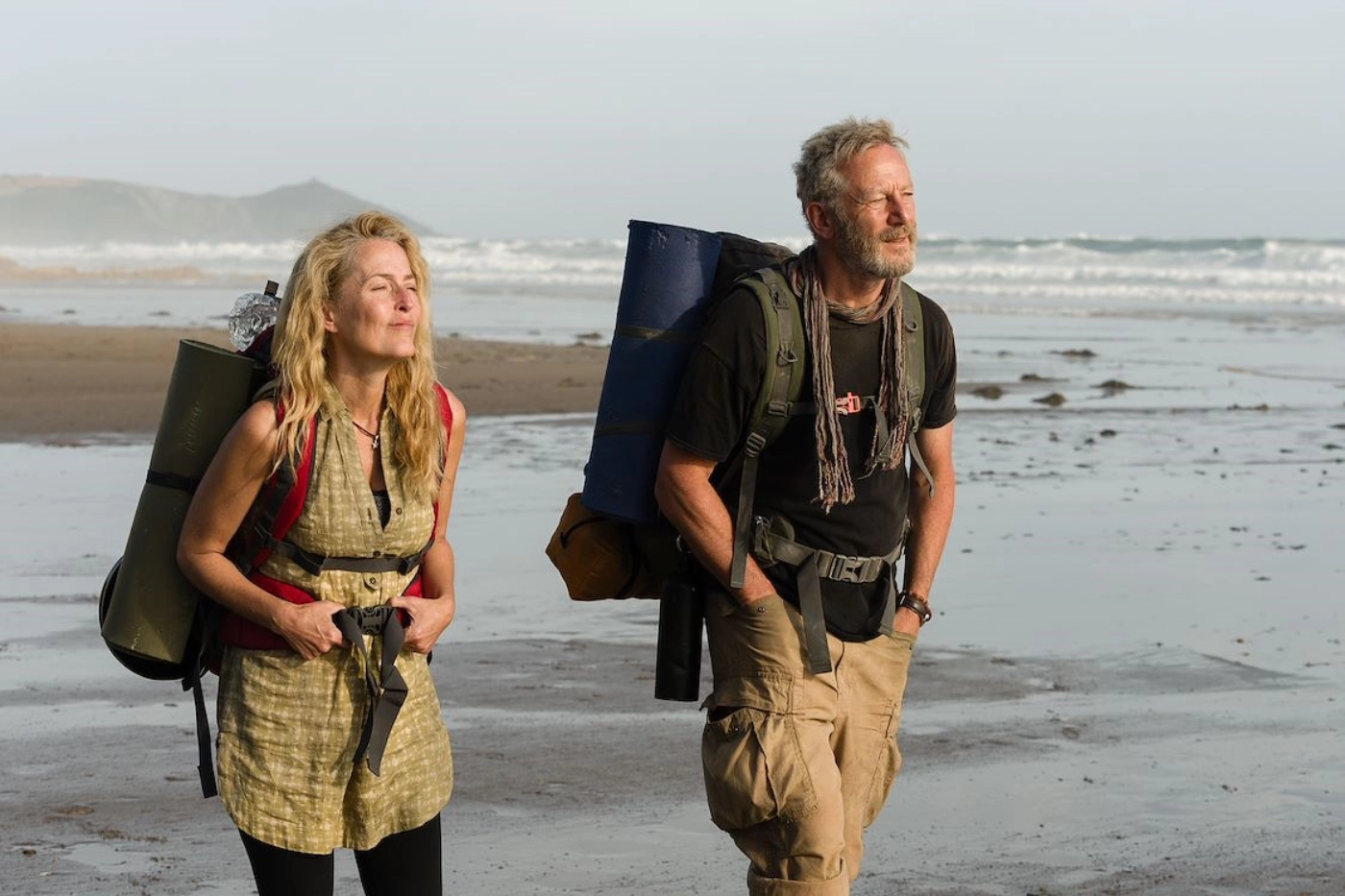

A middle-aged couple left homeless and penniless embarks on a trek through England’s South West Coast Path as a means of existential survival in The Salt Path, opening in Prague cinemas this weekend after bowing in the UK earlier this year. This unusually downbeat story features some gorgeous cinematography on the coast of Southwest England and two endearing performances from Gillian Anderson and Jason Isaacs, but it doesn’t always ring as true as it should and takes its time getting to the final destination.
Adapted from Raynor Winn‘s bestselling autobiographical novel, The Salt Path stars Anderson and Isaacs as the author and her husband Moth, who embark on a months-long journey through the 630-mile (1,014-kilometer) National Trail along England’s coast. Through flashbacks, we learn that Moth has been diagnosed with a rare degenerative condition, and the couple have recently been evicted from their farm—their only residence and lone source of income.
Their titular journey, in other words, isn’t one of self-discovery or adventure—it’s one of necessity, and the tent they carry on their backs will become their only shelter for the foreseeable future. “We’re homeless,” the initially optimistic Moth explains to some inquisitive tourists, slowly coming to terms with the reality of their situation.
The Salt Path follows a familiar story of characters taking to nature as a journey of self-discovery, and shares a kinship with Wild, which followed Reese Witherspoon‘s Cheryl Strayed through the Pacific Crest Trail, and Into the Wild, which showcased Chris McCandless’ tragic foray into the Alaskan wilderness.
What sets The Salt Path apart from those films, however, is the harsh reality of the situation faced by its characters. Rebecca Lenkiewicz‘s screenplay is at its best when focusing on the minimalist means that the Winns have at their disposal, painted in almost neorealist terms by director Marianne Elliott. The couple must survive on just £40 a month; meals are rare, and bags of tea must be shared between two cups.
Crucially, Raynor and Moth cannot expect any kindness from strangers, and must fend for themselves at every stop along the way, berated by dog walkers for pitching their tent where they shouldn’t, locked out of public restrooms, and Falling Down-style, denied pastries after . Raynor attempts to find work at a passing cafe, but she’s quickly rejected, presumably because of her age. Even Polly (Hermione Norris), who allows the couple to stay in her shed over the winter in exchange for renovating it… well, she’s just rude, barging in on them without ever knocking.
Unlike other films of this type, Raynor and Moth never find solace in others. In one of the film’s most touching scenes, Grant (James Lance) offers to pay for their popsicles when he sees Raynor struggling to come up with his change. He even invites them to his place for a cold beer and a shower, but The Salt Path pulls the rug on this act of kindness—he only offered assistance because he mistook Moth for a famous author. Even when an injured Raynor is taken in and cared for by a group of campers, she doesn’t seem to find much kinship with them.
“You’re salted,” a passerby tells the couple towards the end of their journey, recognizing the effect it has had on them, which the film intends as some kind of at-peace-with-nature form of self-realization. From our perspective, however, these characters seem salted in different terms: bitter, exhausted, and done with humanity.
But is this really the reality of the Winns’ situation, or just their discolored perspective on things? It seems unusual that this middle-class couple with college-aged children would be suddenly and unexpectedly left not only homeless and penniless, but entirely without any resources at their disposal. Even without family and friends to rely on, there must be some kind of safety net in the United Kingdom that could spare them from this fate.
In other words, it feels a little disingenuous of The Salt Path to present its titular journey as the only option for its protagonists rather than a self-imposed choice. Even without state assistance, both of these characters are able to work, and some kind of temporary housing solution should be possible. A recent article in The Observer exposed Winn’s story as one “spun from lies, deceit and desperation”—but beyond that, this film just doesn’t ring true, as if the audience is not being told the full story.
In that regard, the movie recalls another true-life tale of someone taking to nature as a means of self-discovery or re-invention: They Called Him Mostly Harmless, a documentary that followed a group of interested parties searching for the identity of a benevolent deceased hiker… only for them to discover that he wasn’t so harmless, after all.
Despite the uneven storytelling, The Salt Path remains deeply affecting thanks to Anderson and Isaacs, who bring warmth and emotional precision to their characters. Their lived-in chemistry conveys both the fragility and resilience of two people stripped of comfort but clinging to each other’s presence. Complementing their performances is the luminous widescreen cinematography by Hélène Louvart (Never Rarely Sometimes Always), whose sweeping coastal vistas lend a grandeur that contrasts poignantly with the couple’s hardship—and captures both the beauty and indifference of nature, a complexity missing from the film’s central story.










One Response
Keep up with the program! It’s a scandal and the story has been debunked by the Observer newspaper in the UK – loads of questionable stuff and misinformation. The movie is rubbish IMHO!