
A son’s surprising revelation leads to a journey of self-discovery for his mother in Chica Checa, which played in competition at this year’s Karlovy Vary International Film Festival and opens in Prague cinemas this weekend (and with English subtitles at Kino Světozor, Kino Lucerna, Bio Oko, Kino Aero, Kino Přítomnost and Edison Filmhub). This endearing new comedy-drama is light on both comedy and drama, but makes up for it through a tender, affectionate presentation that avoids the usual stereotypes, along with two endearing performances by Pavla Tomicová and Jan Cina that nicely capture the film’s central relationship.
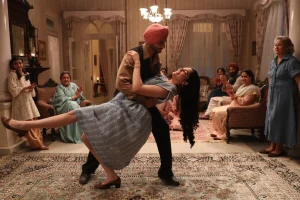
Written and directed by Šimon Holý, Chica Checa follows Zdena (Tomicová), a widowed postal worker living alone in a small Czech town while caring for her dying mother. Her only son, Lukáš (Cina), has been living in France, where Zdena believes he works in finance. Lukáš returns home with his grandmother on her deathbed, and when she expresses a final wish to see Czech pop icon Helena Vondráčková, he devises an unusual solution: he will dress up as the singer and perform for her himself.
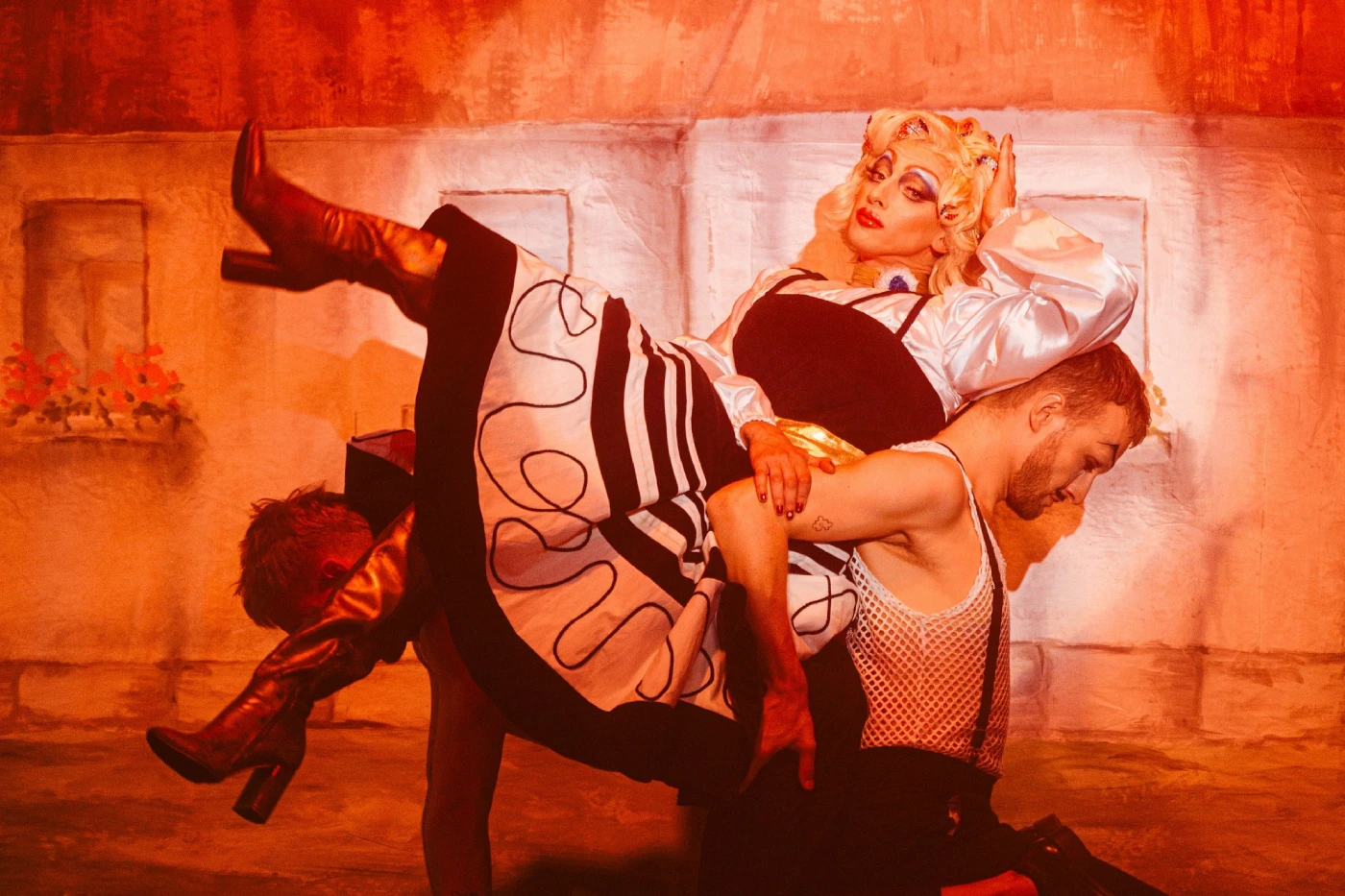
But before he can channel Helena (in one of the film’s most touching sequences), first a revelation for mom. Lukáš is gay, and he doesn’t work at a bank: he earns a living in Paris as a successful drag queen under the stage name Chica Checa (Czech girl). For Zdena, the discovery becomes less a crisis over her son’s sexuality than an unexpected opportunity to reconsider how little she actually knows about him, and how much she has assumed about the life he should be living.
That distinction is what makes Chica Checa more interesting than its basic premise might suggest. Typical films about coming out fall into familiar patterns of intolerance and family rejection. Holý largely avoids all of that. Lukáš does not return to a community that immediately turns against him, and Zdena does not respond with a melodramatic outburst before eventually coming around. Instead, she is curious, confused and quietly introspective. Her first instinct is to understand her son rather than condemn him.
There is a lovely scene when a prospective buyer of Zdena’s house compliments her for being so open-minded. Zdena responds that she would do anything for her son, and the moment carries a subtle ambiguity: perhaps she really is open-minded, but perhaps she has simply never had to question her assumptions before. Chica Checa is ostensibly about a drag queen coming out to his mother, but its real subject is a mother learning just as much about herself as she does about her son.
Tomicová is the film’s true lead, even if Cina gets the more showy role. Her Zdena begins as a somewhat broad character, defined by her absent-mindedness, loneliness, and everyday routines. There are moments early on when Tomicová’s performance seems almost too mannered, but the actress gradually strips away those exterior characteristics as Zdena begins processing her son’s life.
By the time she travels to Paris for the finale, her performance has become remarkably quiet and observant. When she meets his boyfriend and watches Lukáš perform onstage, very little needs to be said. Cina is performing for the audience, but the real thematic weight of Chica Checa is going on through Tomicová’s tender performance.
Cina is equally good in a role that requires him to balance two distinct personas. Two extended drag scenes as Vondráčková and the titular character give him a chance to strut his stuff, but he also gives as Lukáš an understated warmth that makes his relationship with his mother convincing. The chemistry between Cina and Tomicová is the film’s foundation; without their believable affection for one another, the story would have little to sustain it.
The downside to taking such a gentle approach is that there is very little dramatic momentum. Zdena’s response is almost immediately compassionate, and conflicts tend to resolve themselves through conversation and mutual understanding. That’s preferable to manufacturing an artificial family crisis simply because the screenplay requires one (which almost occurs at one point), but it also leaves Chica Checa feeling decidedly small.
Thematically, the film’s refusal to turn its central revelation into a battle is refreshing. The story is less about tolerance than about the process of learning to see another person clearly. Zdena does not need to be transformed from a bigot into an ally; she needs to understand that being a mother does not mean having a predetermined idea of who her child should be. Her journey is more personal than political, and Holý is interested in the small shifts that occur when long-held assumptions are challenged.
There is also something quietly radical about the film’s depiction of contemporary Czech rural life. The countryside is not presented as an inherently backward place populated by people waiting to sneer at anything unfamiliar. The film occasionally brushes against stereotypes about provincial life, but they are not treated as the defining characteristic of the community. Zdena is nervous about Lukáš revealing to others what he has shared with her, but they respond with a similar curiosity and compassion.
Holý’s direction reinforces that modesty. The film is visually polished without calling attention to itself, and the location work in smaller towns across the Ústí nad Labem and Pilsen regions gives the story a convincing sense of place. Cinematographer Jana Hojdová (whose documentary Robert Richardson: The White Devil also premiered at this year’s KVIFF) makes particularly good use of these locations, capturing the mundane details of contemporary small-town Czechia while also giving the film a warm, intimate visual texture.
Ultimately, Chica Checa is a gentle film about acceptance that does not need to shout its message. Its lack of conventional conflict makes it less dramatically compelling than it could have been, and its comedy is generally mild, but Holý compensates with genuine warmth, strong visual craftsmanship and two terrific central performances. There is something appealing about a Czech film finds its most meaningful transformation not in the flamboyant drag queen onstage, but in the mother quietly watching from the audience.