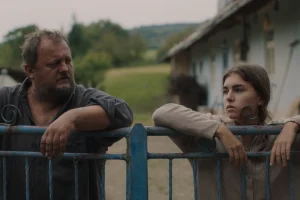


A majestic ginkgo biloba tree in the heart of a German university garden silently observes a trio of stories about human connection across more than a century in Silent Friend, which premiered at last year’s Venice International Film Festival, screened at this year’s Karlovy Vary International Film Festival, and is now playing in Prague cinemas (with English subtitles at Kino Světozor, Kino Aero, and Bio Oko).
The latest feature from writer-director Ildikó Enyedi (My 20th Century, On Body and Soul) pairs an unorthodox narrative with affectionate observations about our relationship with nature, and with each other, all beautifully captured through the filmmaker’s assured direction and cinematographer Gergely Pálos’ lush, painterly widescreen imagery. Audiences willing to surrender to the film’s meditative rhythms will find themselves richly rewarded, though a leisurely 145-minute runtime will inevitably test some viewers’ patience.
Rather than following a single protagonist, Silent Friend unfolds across three distinct eras linked by the same towering ginkgo tree at Germany’s University of Marburg. In 1908, Grete (Luna Wedler) becomes the institution’s first female botany student, confronting entrenched sexism while discovering new ways of seeing the natural world through photography. In the early 1970s, shy student Hannes (Enzo Brumm) reluctantly inherits a friend’s botanical experiment, gradually developing an unexpected connection with the plants under his care. Finally, during the COVID-19 lockdown, visiting Hong Kong neuroscientist Tony Wong (Tony Leung) finds himself stranded on an empty campus, where his research unexpectedly shifts from the human brain to the hidden language of trees.
All three stories have their own quiet appeal, but the contemporary storyline is easily the film’s most compelling. Leung brings remarkable warmth and restraint to a man isolated not only by the pandemic, but by language and culture as well. His thoughtful conversations over video calls with French botanist Alice Sauvage (Léa Seydoux), who proposes that plants may communicate in ways science has yet to fully understand, form the philosophical backbone of the film without ever becoming heavy-handed.
Just as memorable is Tony’s uneasy coexistence with the university’s gruff caretaker, played with understated irritation by Sylvester Groth. Unable to properly communicate, the pair circle each other through deserted corridors and empty gardens in a quietly amusing portrait of lockdown isolation that feels strikingly authentic only a few years removed from those strange months. Rather than exploiting the pandemic for easy drama, Enyedi captures its peculiar mixture of loneliness, uncertainty, and unexpected introspection with remarkable precision.
The 1970s storyline initially feels slighter, centering on Hannes’ infatuation with fellow student Gundula (Marlene Burow), whose experiments seek to measure how plants respond to human presence. But what begins as an understated coming-of-age story eventually blossoms into one of the film’s most magical sequences, as Hannes continues Gundula’s research alone and slowly becomes convinced that nature is responding to him in return. Without abandoning realism, Enyedi stages these moments with quiet wonder that beautifully captures the mystery at the heart of the film.
The earliest storyline, following Grete’s struggle to establish herself in an academic world dominated by men, is also engaging thanks largely to Wedler’s determined performance. Yet it feels somewhat compressed compared to the other narratives, attempting to cover a much broader stretch of time while omitting developments that seem essential to the character’s journey. It also stands slightly apart from the film’s central conceit, venturing beyond the university grounds into scenes that the ginkgo tree, the film’s silent observer and spiritual protagonist, would not have witnessed.
Pálos’ cinematography is exceptional throughout, giving each period its own distinct visual identity while maintaining a unified aesthetic across the film. The monochrome photography of Grete’s era evokes early cinema without feeling like imitation, while the hazy, grain-rich texture of the 1970s carries the warmth of faded memories. The contemporary storyline embraces crisp digital imagery that complements its themes of scientific observation and emotional distance. Throughout all three stories, the university’s botanical garden remains a place of quiet beauty, grounding the film in a location that feels simultaneously timeless and constantly evolving.
Equally impressive is the score by Gábor Keresztes and Kristóf Kelemen, which subtly adapts its musical language for each era while maintaining a shared emotional thread. Combined with richly layered sound design, the music gently nudges the audience toward the possibility that the natural world may indeed be communicating all around us, if only we slow down enough to listen.
That willingness to slow down is ultimately what Silent Friend demands from its audience. Enyedi rarely explains connections outright, allowing themes to emerge gradually through visual echoes and emotional parallels rather than conventional plotting. At times the film threatens to drift into abstraction, and its measured pacing occasionally stretches individual scenes beyond their dramatic necessity. Yet its cumulative effect proves surprisingly powerful, building toward an evocative finale that quietly transforms the way we have been looking at the world all along.
Like the centuries-old tree at its center, Silent Friend asks us to observe on a different scale than we normally do at the cinema. It is a thoughtful, visually exquisite meditation on curiosity, solitude, and humanity’s place within the natural world that values contemplation over narrative momentum. It won’t resonate with every viewer, but those willing to embrace its patient rhythms will discover something unique and quietly beautiful.