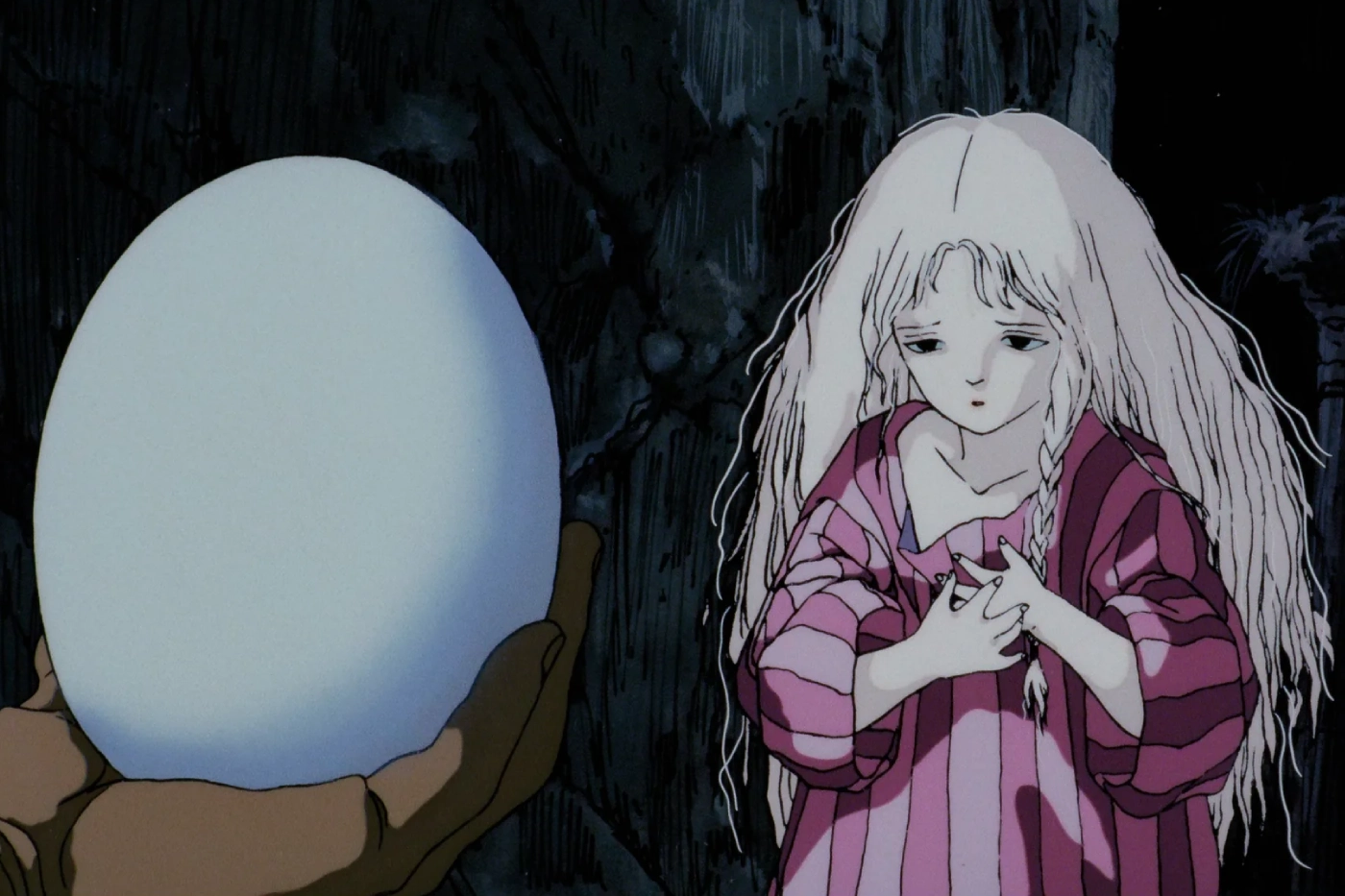

A young girl transports a mysterious egg through a dystopian wasteland in Angel’s Egg, which released to muted appreciation (by Western audiences, at least) in 1985 before gaining a cult reputation and critical reappraisal over the ensuing decades. A gorgeous new 4K restoration of the film approved by director Mamoru Oshii premiered at last year’s Cannes Film Festival and opens in Prague cinemas this weekend (and with English subtitles at Edison Filmhub).
The narrative of Angel’s Egg is deceptively simple, though its meaning is anything but. In a desolate, flooded city filled with towering Gothic ruins and strange mechanical relics, the young girl (voiced by Mako Hyodo) wanders alone while carefully protecting a large egg she believes contains an angel. Her solitary existence changes when a mysterious boy (Jinpachi Nezu) arrives in the city riding atop a military tank, carrying a weapon shaped like a cross. Their encounter forms the fragile narrative thread that carries the film forward.
Viewers quickly realize that conventional storytelling is not the point. Oshii provides almost no exposition about where we are, when the events take place, or even who these characters might be. Dialogue is extremely sparse and the world itself is largely unexplained. Instead, the film unfolds through a series of striking visual tableaux as the girl guards her egg, the boy questions her belief in it, and the pair wander through abandoned streets, cavernous buildings, and flooded plazas populated only by ghostly fishermen chasing shadows of fish along the walls.
Watching Angel’s Egg becomes less about following a plot than absorbing its atmosphere. The story washes over the viewer through Yoshitaka Amano’s extraordinary art design and the film’s slow, hypnotic pacing. The girl protects the egg with childlike determination, while the boy—skeptical and analytical—probes its meaning. His warped retelling of the story of Noah’s Ark becomes one of the film’s key symbolic elements.
Oshii has largely refused to provide a definitive explanation, but certain ideas emerge through the symbolism. The girl embodies innocence and faith, while the egg represents hope—something that may or may not exist, but which she believes in absolutely. Their journey through the ruined city evokes a world haunted by the remnants of the past, themes connected to postwar Japan and the search for meaning after national catastrophe.
At the same time, the film’s imagery is deeply influenced by Western culture. The Biblical allegory of Noah’s Ark sits alongside architecture that feels unmistakably European, with narrow cobbled streets, towering Gothic buildings, and vast stone plazas that evoke old-world cities. In its winding alleys and looming structures, the setting even carries a faint resemblance to the austere atmosphere of communist-era Prague.
The boy’s role complicates the film’s symbolism further. Emerging from a convoy of tanks and wielding a cross-shaped weapon, he represents a fusion of religion, ideology, and technology: American cultural imperialism relentlessly dictating the future of a community while never fully understanding it.
The film presents his destructive climactic act not as simple cruelty, but as the logical conclusion of his relentless drive to question, analyze, and progress, ultimately preserving only a facade. In the film’s haunting climax, a cascade of new eggs rises through the water, suggesting that hope, once destroyed, may still reappear in new forms for future generations.
If the narrative remains deliberately elusive, the film’s artistry is unmistakable. Angel’s Egg is often described as resembling a moving painting, and the comparison feels apt. Amano’s character designs are elegant and unforgettable, while the environments—created with richly detailed backgrounds—transform the ruined city into a world of eerie beauty. Oshii frequently frames his characters as tiny figures dwarfed by massive architectural landscapes, using extreme wide shots that are rare in animation and recalling the visual scale of epics like Lawrence of Arabia.
The film’s pacing is equally distinctive. Instead of the rapid editing typical of commercial animation, Angel’s Egg unfolds through long, meditative takes, allowing viewers to absorb the imagery and atmosphere at their own rhythm. Yoshihiro Kanno’s ethereal score deepens this dreamlike quality, blending haunting melodies with long stretches of silence. The result is an experience that feels closer to a surreal meditation than a conventional narrative film.
Mamoru Oshii would go on to achieve international fame with later works such as Ghost in the Shell and Avalon, films that explored similar themes of identity, technology, and existential uncertainty. Yet Angel’s Egg remains one of his most personal and uncompromising works. Its blend of philosophical ambiguity and visual experimentation places it closer to the tradition of art cinema than mainstream anime, and it may be the director’s true masterpiece.
The new restoration highlights the Angel’s Egg’s remarkable craftsmanship. Produced from the original 35mm elements and supervised by Oshii himself, the 4K remaster reveals the intricate textures of Amano’s artwork with unprecedented clarity. The muted color palette now appears richer and more detailed, while the expanded sound mix reconstructs the original mono audio into immersive surround formats that enhance the film’s haunting atmosphere.
Four decades after its initial release, Angel’s Egg remains a singular experience in animation. Its abstract storytelling and deliberate pacing may frustrate viewers expecting a clear narrative, but those willing to surrender to its imagery and symbolism will find a film of rare beauty and depth. At just over 70 minutes, it is a brief journey into a strange and unforgettable dream, and one that continues to invite new interpretations every time it is revisited.