

A middle-aged family man whose life has slipped into a tedious day-to-day routine finds himself pulled into more excitement than he bargained for in Nobody, opening in Prague cinemas June 21 after releasing stateside in March. This action thriller is cut from the same cloth as John Wick—not surprising given it was penned by that film’s screenwriter Derek Kolstad—but benefits enormously from unlikely action star Bob Odenkirk’s committed turn in the lead.
Directed by Ilya Naishuller, Nobody delivers one of the most gratifyingly staged action sequences audiences are likely to see this year—an unrelenting, bone-crunching set piece that shifts the film into high gear and cements its credentials as a crowd-pleasing genre entry. The film builds patiently toward this gloriously over-the-top payoff, though it leans perhaps too heavily on Wick-style fantasy to fully stand apart.
Nobody stars Odenkirk as Hutch Mansell, a suburban father stuck in a monotonous daily routine. He commutes to work, shares an increasingly distant marriage with his wife Becca (Connie Nielsen), and endures quiet disappointment from his teenage son (Gage Munroe). Hutch is the definition of a man overlooked, tolerated, and dismissed—by his family, by neighbors, and by himself.
His passivity becomes glaring one night when a pair of burglars break into the Mansell home. Hutch surprises them in the kitchen, golf club in hand, but freezes. Rather than risk violence, he lets the intruders escape with only minor spoils. The fallout is humiliating: his son calls him weak, the police shrug off his restraint, and even his neighbors see him as spineless.
For much of the first act, the film appears to be a study of emasculation in the mold of Straw Dogs. Hutch shuffles through his days, visibly seething under the surface. It’s not until a chance bus ride turns violent that he reveals what he has been suppressing: not a hidden spark of bravery, but a deeply buried history of professional violence.
The bus sequence is the film’s undeniable high point. After a group of young thugs threaten passengers, Hutch finally explodes. What follows is a bruising, prolonged fight scene that is both brutally physical and meticulously choreographed. Odenkirk doesn’t glide through the violence like an invulnerable superhero; he takes a beating, gets knocked down, and struggles to catch his breath. Yet his determination—and unlikely skill—slowly turns the tide.
The brilliance of this set piece lies not only in its physicality but in its buildup. The film carefully primes the audience for Hutch’s eruption, making his violent outburst cathartic rather than gratuitous. It’s an action scene that resonates on a character level, not just as spectacle, and it stands as Nobody‘s action highlight above the mayhem that follows.
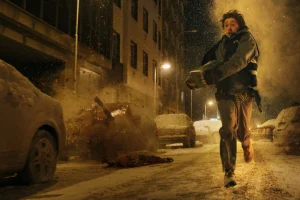
Naishuller, who previously directed the frenetic first-person experiment Hardcore Henry, reins in his stylistic excess here and delivers something more polished. Working with cinematographer Pawel Pogorzelski (Midsommar, Hereditary), he crafts a noir-inflected world of neon lights, slick night streets, and shadowy interiors. The film often looks like a graphic novel come to life, drenched in color and mood.
Technically, the later action scenes are executed with flair, but none recapture the emotional intensity of that initial outburst. The climax, set in a generic warehouse, indulges in elaborate gunplay and over-the-top improvisational weapons, but by then Hutch has been revealed as a virtually unstoppable John Wick-style assassin. The sense of vulnerability that made the earlier fight so gripping is lost, and with it some of the tension.
The biggest surprise—and strength—of Nobody is Odenkirk himself. Known for his sly, slippery performance as Saul Goodman in Better Call Saul and Breaking Bad, he seems like the least likely candidate for a late-career pivot into action stardom. But that’s exactly what makes him so effective. Odenkirk plays Hutch as a weary, frustrated man who can barely summon the energy to go through the motions of family life. When he finally lashes out, the rage feels raw and real.
Unlike Keanu Reeves’ almost supernatural John Wick, Odenkirk embodies a more relatable figure: a vulnerable everyman who can take as much punishment as he dishes out. Unfortunately, the film undermines this strength by giving Hutch a Wick-style backstory as a retired government assassin. While this conceit explains his skill set, it feels like an unnecessary leap into pulp fantasy; a more grounded background—as a soldier or police officer—would have preserved the everyman believability that Odenkirk conveys so well.
Nobody is, in many ways, a genre exercise: a revenge fantasy that sticks closely to the conventions of its predecessors. Russian mobsters, explosive gunfights, and colorful supporting allies (including Christopher Lloyd as Hutch’s trigger-happy father and RZA as his adoptive brother) all feature prominently. The story doesn’t aim for realism, and at times its excesses border on parody.
Still, Naishuller’s slick direction, Pogorzelski’s striking visuals, and especially Odenkirk’s full-throttle commitment elevate the film above standard genre fare. For all its contrivances, Nobody remains a brisk, entertaining 90 minutes that proves its star can carry an action film with both grit and heart. It may not escape the shadow of John Wick, but in its best moments, it offers something just as satisfying: the sight of a downtrodden “nobody” standing up tall and, at least for a while, becoming somebody worth watching.