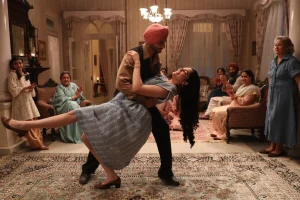

Lithuania has selected How to Divorce During the War, a Czech-supported international co-production directed by Andrius Blaževičius, as its submission for the 2027 Academy Awards in the International Feature Film category.
The selection gives the Czech film industry another connection to the international Oscar race through a project that has already received significant recognition abroad. The film, a co-production between Lithuania, Luxembourg, Ireland and the Czech Republic, won the World Cinema Dramatic Directing Award at the 2026 Sundance Film Festival earlier this year. Czech producers Jakub Košťál and Vratislav Šlajer of Prague-based Bionaut are among its co-producers, while the project also received support from the Czech Audiovisual Fund.
The Lithuanian selection continues a recent pattern in which Czech co-productions have entered the Academy Awards race under the banner of other countries. Last year, Denmark submitted the Czech-Danish documentary Mr. Nobody Against Putin, Slovakia selected the Czech-Slovak-Polish drama Father, and Poland submitted Agnieszka Holland’s Czech-Polish-German co-production Franz for the 2026 Oscars.
A Lithuanian-led production with Czech backing
How to Divorce During the War is Blaževičius’ third feature and is led by Lithuanian production company M-Films, with Red Lion from Luxembourg, Feline Films from Ireland and Bionaut from the Czech Republic serving as co-production partners. The Czech Film Center lists the film as a Lithuania, Luxembourg, Ireland and Czech Republic production, with Czech involvement extending beyond financing.
The film is set in Vilnius in 2022. Marija, a high-flying media executive, decides to divorce her husband Vytas just one day before Russia launches its full-scale invasion of Ukraine. As the war transforms the atmosphere in Lithuania, the couple attempts to navigate their separation while confronting a wider refugee and social crisis.
The personal and political strands are deliberately intertwined. Vytas, a struggling filmmaker, is forced to move in with his Russian-speaking parents, whose views increasingly conflict with his own. Meanwhile, Marija deals with the impact of the war on her professional and personal life. The story uses the breakdown of a marriage as a lens through which to examine a society living in the shadow of a conflict taking place just across its border.
Czech participation includes editor Anna Johnson Ryndová, composer Jakub Rataj, makeup designer Adéla Anděly Bursová and costume designer Aneta Grňáková. The production also includes Czech co-producers Košťál and Šlajer, whose Bionaut has worked on a number of international projects.
The film’s international profile was established before its Oscar submission. It premiered in the World Cinema Dramatic Competition at Sundance in January and Blaževičius received the category’s Directing Award. The Sundance jury praised his handling of a darkly comic story set against wartime circumstances.
The film has continued to travel on the festival circuit since Sundance, including a Silver Lady Harimaguada award at the Las Palmas de Gran Canaria International Film Festival. A North American theatrical release was also secured by Zeitgeist Films in association with Kino Lorber following its Sundance success.
Another Oscar route for Czech co-productions
Lithuania’s selection is notable within the Czech industry because the Czech Republic is not the country submitting the film, despite its production and creative involvement. Oscar rules allow an international feature to be submitted by a country that meets the Academy’s eligibility requirements, meaning European co-productions can sometimes enter the race through a partner country rather than through Czechia.
That situation has become increasingly visible for Czech-backed productions. For the 2026 Academy Awards, Mr. Nobody Against Putin was selected by Denmark. The documentary was produced by Danish and Czech partners, received Czech Audiovisual Fund support and underwent post-production work in Prague. It ultimately went beyond the international-feature submission process, earning an Oscar nomination for Best Documentary Feature and later winning the category.
Slovakia meanwhile submitted Father, directed by Tereza Nvotová, for the same awards cycle. The drama was produced as a Slovakia-Czech Republic-Poland co-production and premiered in the Orizzonti section at the Venice International Film Festival before becoming Slovakia’s Oscar candidate.
Poland’s selection of Franz provided another prominent example. Holland’s portrait of Franz Kafka was produced as a Czech-Polish-German co-production, with substantial Czech participation including Barrandov Studio and Czech Television, and was shot primarily in Prague. Poland selected the film as its official international-feature submission after its world premiere at the Toronto International Film Festival.
For How to Divorce During the War, the Lithuanian submission gives Czech producers and creative personnel another opportunity to reach the Academy Awards without the film being entered by the Czech Republic itself. Its Sundance directing prize and existing international distribution provide an established awards profile, although the Lithuanian selection is only the first stage of the Oscar process and does not guarantee a shortlist or nomination.
The 98th Academy Awards cycle demonstrated how far Czech co-productions can travel within the awards system, including the eventual Best Documentary Oscar win for Mr. Nobody Against Putin. The latest selection from Lithuania underscores the increasingly international nature of Czech film production, where Czech companies and creatives can contribute substantially to projects that ultimately represent other countries on the global awards stage.