
A textile factory worker in Myanmar becomes infatuated with a new co-worker whose feelings don’t entirely mirror her own in Fruit Gathering, a Czech-French-Myanmar co-production that won the Crystal Globe at this year’s Karlovy Vary International Film Festival and is now playing in Prague cinemas (with English-subtitled screenings at Kino Atlas).
Writer-director Aung Phyoe takes an understated, observational approach that asks audiences to infer much of what other films would state outright, making for a leisurely experience that may test some viewers’ patience. But beneath its quiet surface lies an authentic, deeply felt portrait of longing, anchored by an exceptional lead performance and a visually rich depiction of contemporary Myanmar.
Fruit Gathering stars Nandar Myat Aung as San Kyi, a shy garment factory worker living in Yangon with her mother and grandmother while dreaming of a simpler life back in her rural hometown. Her routine changes when new employee Theint Theint Oo (Nandar Myint Lwin) arrives at the factory and offers San Kyi a small act of kindness. What begins as an ordinary workplace friendship gradually develops into something much deeper for San Kyi, whose growing emotional attachment is never fully reciprocated by her new companion.
Phyoe wisely avoids framing San Kyi as either a tragic victim, romantic heroine, or into uncomfortable stalker territory. Instead, Myat Aung gives San Kyi a quiet vulnerability that makes her yearning immediately recognizable. What she seems to desire above all is simple companionship, a meaningful connection in a life defined by routine, obligation and emotional isolation, and the actress makes us empathize with that longing even when her actions become difficult to defend.
Myint Lwin is equally impressive as the more outgoing and charismatic Theint. While San Kyi gradually falls in love, Theint appears to value the relationship on very different terms. She borrows money, disappears without explanation and reappears only when she needs help again, suggesting someone who is perfectly happy to accept San Kyi’s affection without ever returning it in kind. Yet the film never paints her as a villain, instead leaving viewers to wrestle with the ambiguity of a relationship built on unequal emotional investment.
That ambiguity defines much of Fruit Gathering. Phyoe avoids exposition, allowing glances, gestures, and long silences to communicate what his characters cannot openly express. In Myanmar, where same-sex relationships remain heavily stigmatized, that restraint feels less like an artistic affectation than a reflection of the characters’ reality. The unspoken emotions between the two women become more powerful precisely because they remain largely unarticulated.
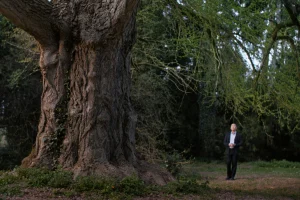
Cinematographer Thaid Dhi gives the film a quietly immersive visual identity. The bustling textile factory, cramped city apartments and crowded streets of Yangon feel convincingly lived-in, while excursions to San Kyi’s rural hometown provide a striking contrast of lush greenery, mango orchards and open landscapes. Rather than romanticizing either environment, the film captures both urban and rural Myanmar with a naturalism that grounds even its more dreamlike passages.
If Fruit Gathering unfolds with remarkable patience, often requiring audiences to piece together character motivations and narrative developments that more conventional dramas would make explicit. That subtlety can be rewarding, but it also makes the 97-minute running time feel considerably longer. Some supporting storylines, including labor organizing within the factory, are largely underdeveloped, adding to the sense of a film more interested in atmosphere than dramatic momentum.
When the narrative finally reaches its emotional breaking point, however, Aung reveals an unexpectedly bold stylistic flourish. The restrained naturalism gives way to a climax accompanied by an eerie, almost horror-inspired musical score that transforms familiar emotional conflict into something more unsettling. It’s an audacious tonal shift that catches us off guard, recontextualizing everything that has come before and providing the film with a dramatic intensity its understated first two acts deliberately withhold.
For a debut feature, Fruit Gathering displays impressive confidence, particularly in its refusal to force easy emotional resolution; its greatest strengths lie not in plot but in performance, atmosphere and the delicate observation of unspoken desire. Patient viewers willing to meet the film on its own quiet terms will find a thoughtful and affecting drama, and an impressive introduction to a promising new voice.