
Robert Redford, the Oscar-winning actor, director, and champion of independent cinema whose career defined decades of American film, died Tuesday at his home in Utah. He was 89. His death, confirmed by publicist Cindi Berger, came peacefully in his sleep at his mountainside residence outside Provo.
A charismatic screen presence and thoughtful filmmaker, Redford bridged mainstream stardom and socially conscious storytelling. He was one of Hollywood’s most bankable leading men of the 1970s, celebrated for roles in Butch Cassidy and the Sundance Kid, The Sting, All the President’s Men, and The Natural (pictured at top), while later earning acclaim as a director with the Oscar-winning Ordinary People. Beyond the screen, he reshaped the independent film landscape as founder of the Sundance Institute and Sundance Film Festival, which helped launch the careers of filmmakers such as Quentin Tarantino and Steven Soderbergh.
Redford was also known for his environmental advocacy, independent spirit, and ability to infuse serious cultural issues into popular entertainment. His career spanned more than six decades, during which he consistently resisted Hollywood’s commercial pressures in favor of projects that carried personal and political meaning.
A career of enduring influence
Born Charles Robert Redford Jr. in Santa Monica, California, on Aug. 18, 1936, Redford rose from a troubled youth to Broadway stages before becoming one of Hollywood’s most recognizable faces. His breakout came with Barefoot in the Park (1967) and Butch Cassidy and the Sundance Kid (1969), pairing him with Paul Newman in an iconic buddy western. Their on-screen chemistry continued with The Sting (1973), earning Redford his sole Academy Award nomination for acting.
Other notable performances included All the President’s Men (1976), which dramatized the Watergate investigation, and Three Days of the Condor (1975), a tense Cold War thriller. As a director, he won an Academy Award for Ordinary People (1980), a family drama praised for its emotional precision, and later helmed A River Runs Through It (1992) and Quiz Show (1994), both celebrated for their visual elegance and moral complexity.
Redford’s cultural impact extended beyond filmmaking. In 1981, he founded the Sundance Institute, nurturing emerging filmmakers and transforming a small Utah gathering into a global showcase for independent cinema. Over the next four decades, the Sundance Film Festival would become one of the most prestigious worldwide, and a vital showcase for independent cinema.
Throughout his life, Redford remained an outspoken environmentalist and advocate for social causes. He fought to preserve Utah’s landscapes, campaigned against coal plants and highways, and inspired future generations of activist artists. Though he resisted the label of “activist,” his actions defined a model of celebrity engagement that influenced figures from Leonardo DiCaprio to Mark Ruffalo.
Honored in Czechia and drawn to its culture
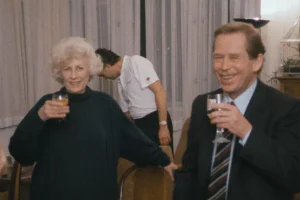
Redford’s connection to Czechia came into focus in 2005, when he visited the Karlovy Vary International Film Festival at the invitation of former U.S. Secretary of State Madeleine Albright. During the visit, he met former Czech president and playwright Václav Havel, a meeting he described in an interview with Radio Prague as profoundly meaningful.
“For a long time I’ve been aware of Havel,” Redford told Radio Prague. “His role as an artist and as the kind of activist that stood up for human rights was very interesting to me. And that he could become the president was especially interesting to me. We’ve had very intense conversations, we’ll have more. I have great admiration for him, the way he sees the world and his sophistication and his depth as a humanitarian I have great appreciation for. I think the world could use many leaders like him.”
Redford explained that his trip to Prague fulfilled a long-held wish. As a young man traveling through Europe in the 1950s, he had missed visiting the city despite taking part in relief efforts during the 1956 Hungarian revolution. “Prague for me was a city that I was not able to see and I had always wanted to see,” he said. “I wanted to see how the people survived centuries of occupation by other cultures. So when I came here the other day it was something I had waited for for many, many years. I was not disappointed.”
His ties to Czech culture stretched back decades. He recounted friendships with Czech artists such as Jiří “George” Voskovec, whom he acted with in a 1963 New York play, and filmmakers Miloš Forman and Jan Kádar. Frank Daniel, the first artistic director of the Sundance Institute, was also from Prague. Redford even professed his fondness for Czech beer.
“I love Czech beer,” he said. “I’ve had Czech beer for so many years. I drink it at home in California, Pilsner Urquell. Last night I was having dinner with President Havel, I said, you tell me what you think is the best beer and they brought these beers… I love Czech beer, and I’m not saying that because I’m here—I love it.”
Robert Redford is survived by his wife, German artist Sibylle Szaggars, his daughters Shauna and Amy, and seven grandchildren. His legacy endures in the films he made, the artists he mentored, and the movements he helped inspire — from the mountains of Utah to the festival halls of Karlovy Vary.
One Response
Robert Redford isn’t just a legendary actor, he’s also a visionary director and a strong voice for independent cinema. His contribution through Sundance has shaped generations of filmmakers. Truly an icon who blends art with purpose.