
An ambitious Czech surgeon becomes disenfranchised by the state-mandated sterilization of Roma women in communist Czechoslovakia in Only Beautiful Things to Look At (Pramen), which debuted in competition at the Karlovy Vary International Film Festival and is now playing in Prague cinemas (and with English subtitles at Kino Světozor, Kino Aero, and Kino Lucerna). This striking new feature from Slovak filmmaker Ivan Ostrochovský spotlights a troubling chapter in Czech history that continues to linger to this day, but its focus on intimate character drama results in a languid pace that may leave some viewers feeling the important central topic is insufficiently explored.
But despite its measured approach, Only Beautiful Things to Look At succeeds through quiet moral weight rather than overt outrage. Ostrochovský and co-writer Marek Leščák avoid easy villains or melodramatic confrontations, instead depicting how an inhumane system perpetuates itself through ordinary people performing ordinary jobs. While the film occasionally keeps its central subject at an emotional distance, it remains a thoughtful and deeply unsettling examination of institutional racism and personal complicity.
Anna Geislerová stars as Ingrid, a respected gynecologist hoping to become head of her hospital in the mid-1980s, only to find her own professional ambitions constrained by the male-dominated Communist establishment. Alongside routine deliveries, Ingrid is responsible for carrying out the government’s sterilization program targeting Roma women, many of whom are persuaded into the irreversible procedure with promises of financial compensation worth as much as CZK 20,000, a life-changing sum for struggling families at the time.
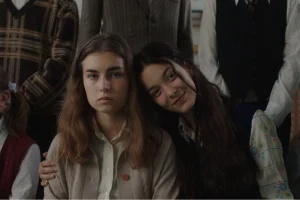
When she befriends a young hospital orderly, Agáta (Simona Boledovičová), whose own past reveals an even darker side of the program, Ingrid is forced to confront both her role within the system and the devastating human consequences of policies she had long accepted without question.
One of the film’s strongest achievements is illustrating the chillingly transactional nature of the sterilization campaign. An early meeting between hospital administrators matter-of-factly discusses quotas and strategies for increasing participation, with Ingrid suggesting larger financial incentives almost as casually as if discussing hospital budgets.
The sequence is quietly horrifying precisely because nobody questions the morality of what they are doing. The women are not physically forced into surgery in these cases, but poverty and systemic discrimination leave them with little meaningful choice. By establishing Ingrid as an active participant in this machinery rather than an immediate dissenter, the screenplay lays the groundwork for a more nuanced moral awakening.
That awakening arrives through Agáta, whose story ultimately proves the film’s emotional center. Boledovičová gives a beautifully understated performance as a young woman caught between identities, gradually reconnecting with her Roma heritage while carrying trauma she has scarcely acknowledged herself. When Ingrid discovers that Agáta herself was sterilized as a child during what she believed was a routine hernia operation, the revelation becomes the catalyst for her growing crisis of conscience.
It’s perhaps the screenplay’s one notable weakness that Ingrid’s transformation comes through discovering another doctor’s misdeeds rather than fully recognizing her own complicity, externalizing the character’s central conflict. Even so, Geislerová brings remarkable restraint to the role, allowing guilt, confusion and dawning awareness to emerge almost entirely through subtle expression rather than dialogue.
Both actresses deliver exceptional work, though their characters follow somewhat separate emotional trajectories. There are moments when it feels as though the film is torn between Ingrid’s gradual reckoning and Agáta’s far more immediate experience as a victim of the policy. One cannot help but wonder whether an even more powerful film might have emerged had it committed entirely to either perspective rather than balancing the two.
Visually, Only Beautiful Things to Look At is consistently striking. Juraj Chlpík’s widescreen cinematography makes inspired use of macro-lens close-ups, repeatedly drawing attention to overlooked details in a manner that echoes the film’s central theme of exposing truths long ignored. Faces, hands, objects, and quiet gestures take on enormous significance, while a warm amber palette lends the drama an almost dreamlike quality.
Still, the production makes only limited effort to immerse viewers in the specific look of 1980s Czechoslovakia. Sets, costumes and interiors often feel surprisingly contemporary despite the period setting. Whether intentional or not, the effect subtly reinforces the film’s larger point: that the story does not belong safely in the past. Forced sterilization of Roma women continued into the 2000s in both the Czech Republic and Slovakia, with state compensation for victims only arriving in recent years. The relative absence of overt period nostalgia prevents audiences from comfortably distancing themselves from the events unfolding on screen.
Rather than delivering a sweeping historical account, Only Beautiful Things to Look At chooses a more intimate, contemplative path through one of the darkest chapters of modern Czech history. While that restraint occasionally blunts the urgency of its subject matter, Ostrochovský’s compassionate direction, two excellent central performances, and a quietly devastating examination of systemic injustice ensure the film leaves a lasting impression.