

If Czech filmmakers Věra Chytilová or Jan Švankmajer ever adapted the work of the Brontë sisters it might look something like 2026’s Wuthering Heights, opening in Prague and cinemas worldwide this weekend. Emerald Fennell‘s relentlessly grotesque, gleefully perverted new feature, drenched in various bodily fluids, will disgust those expecting a faithful adaptation of Emily Brontë‘s landmark 1847 novel, but there’s a lot to wallow in for the sickos in the back row.
Fennell’s Wuthering Heights does for the Gothic romance what films like Greaser’s Palace and McCabe and Mrs. Miller did for the American western: by heightening the reality of the world the film is set in, it deconstructs our romantic notions of the genre. This is a late 18th-century romance inhabited by characters who bathe once a month (maybe), wallow in filth, and are motivated by greed, envy, and uninhibited lust. And the more the movie strips away their appeal, the more fascinating they become.
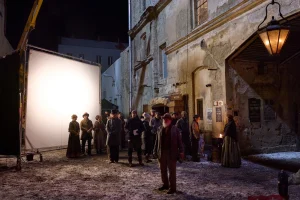
What better way to open your Valentine’s Day film than with a public hanging in a muddy town square? “Look, he’s got a stiffy!” remarks a group of giggling schoolboys of the hooded prisoner gasping for breath. “Shh!” a nun scolds them, as she herself seems to orgasm at the sight of a man in the throes of death. The entire crowd seems to erupt in orgiastic celebration as the writhing stops.
The bestial celebrants include a young Catherine Earnshaw (played in early scenes by Charlotte Mellington), who later sobs over the reality of what she has witnessed. This juxtaposition serves as a nice allegory for the themes explored later in the film: the deep-seated regret and moral destruction earned by giving in to one’s animalistic impulses.
Catherine is surprised to find a young vagrant (Owen Cooper) under her bed, who—for reasons of fetishistic table-setting—cups his grubby hands over her mouth as he pulls her into his grasp. Cathy’s father Mr. Earnshaw (a scene-stealing Martin Clunes), a brutish drunk and gambler, has whisked the child off the filthy streets only to raise him in the more morally degrading environment of Wuthering Heights, his country estate. He presents him as a “toy” for Cathy to play with, and she names him Heathcliff, after her dead brother.
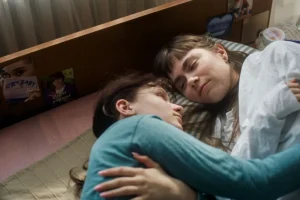
Years later, Cathy is played by Margot Robbie, and Heathcliff is Jacob Elordi, and he still cups his filthy mitts over her mouth as they spy on the servants having dirty sex in the stables. Heathcliff, too, is a lowly servant, and even though the sexual tension between the two is so thick it fogs up the screen, Cathy openly pines to be married off into proper company.
Whether you’ve read the novel or not, you know where this is headed: Cathy marries wealthy neighbor Edgar Linton (Shazad Latif), and Heathcliff runs off and returns with a mysterious fortune, marrying Edgar’s sister Isabella (Alison Oliver). But the volcanic passion between the two finally erupts and destroys everything and everyone in its path.
And what about all those other characters from the timeless classic? Jettisoned from Fennell’s warped vision, which turns a laser-like focus to the central relationship and the underlying messiness of it all. And as Cathy and Heathcliff lust after each other, pig carcasses are sliced open with blood drenching the walkways, characters spy on each other masturbating and play perverse sexual games, and they fondle raw egg yolks with a prurient curiosity and stick their fingers into aspic-covered fish heads. You want to throw up… but why are you so turned on?
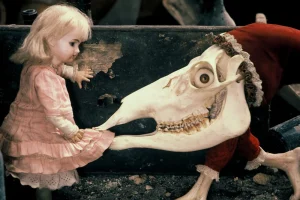
The characters wallow in all the filth, and so do we. There’s a surreal, countercultural feel to Fennell’s Wuthering Heights that recalls Chytilová’s Daisies and Dušan Makavejev’s Sweet Movie and other subversive classics from the late 60s and early 70s, and attaching it all to (what some may consider) a stuffy literary classic is the perfect touch.
There’s only one problem here: this version of Wuthering Heights wants to have its cake and eat it too, or in other words, also work on the traditional romantic level. And as the Charli xcx ballad swells on the soundtrack and Heathcliff and Cathy begin to wallow in a more traditional lovesick melancholy, in addition to all the filth, the movie starts to lose its transgressive appeal.
Robbie and Elordi are both excellent here—Elordi, perhaps appropriately, is more imposing and frightening here than he was as the monster in Frankenstein—but we don’t buy into their brand of pure love amidst all the other perversion the film is drenched in. While their union becomes the central focus, the other relationships are far more interesting as presented here: the fetishistic dominant-submissive marriage between Heathcliff and Isabella, and the chilly bond between Cathy and emotionally manipulative servant Nelly (Hong Chau), who comes out of this version of the story as its villain.
Like all the excess grotesquerie on display, this take on Wuthering Heights isn’t flawless, but it is so packed with provocation and craft that it demands to be seen. Linus Sandgren’s cinematography finds stark beauty in the mud and decay of rural Yorkshire locations, while Anthony Willis’ sweeping score lends the film an ironic romantic grandeur. The magnificent costumes and set design—that flesh-colored wall is a stunner—give the film a tactile, almost nauseating physicality and all but guarantee attention during next year’s awards season.
Fennell’s Wuthering Heights may repel as many viewers as it enthralls, but that juxtaposition feels entirely intentional. By dragging Emily Brontë’s story through filth, flesh, and desire, the film strips away centuries of romantic varnish to reveal something far more unsettling underneath. It doesn’t replace the novel so much as interrogate it—and while its reach occasionally exceeds its grasp, this is a bold, abrasive, and often mesmerizing act of desecration perfect for Valentine’s Day, 2026.