
Franz Kafka has long been frozen in the public imagination as a somber, austere figure—thin, pale, and dressed in black. His image, drawn from a small handful of photographs, has become almost as iconic as his writings. But a new Czech-German-Polish co-production, Franz, directed by Agnieszka Holland, aims to challenge that vision when it reaches Czech cinemas on Sept. 25 after premiering at the Toronto International Film Festival this week.
At the center of this reinterpretation is costume designer Michaela Horáčková Hořejší, whose approach to Kafka’s wardrobe challenges more than a century of assumptions. Rather than black, she chose deep midnight blue to define Kafka’s presence on screen, a decision she describes as both historically grounded and artistically symbolic. Her designs, numbering more than 4,500 costumes across the production, play a crucial role in reshaping how audiences might see the writer.
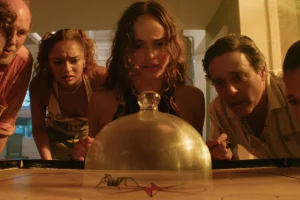
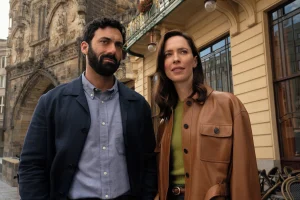
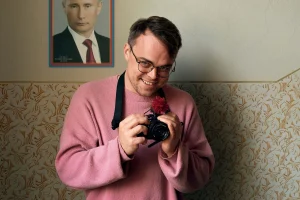
The film, starring Idan Weiss as Kafka alongside Jenovéfa Boková, Ivan Trojan, Josef Trojan, and Emma Smetana, tells a kaleidoscopic story inspired by Kafka’s life, writings, and imagination. From his childhood in Prague to his final days in Austria after World War I, Franz seeks to blend biography with dreamlike elements, mirroring the paradoxes of a man who struggled to reconcile private self-perception with public identity.
Reimagining Kafka through costume
For Hořejší, whose background in scenography and historical costume collecting informed her work, Kafka’s clothing was more than fabric and cut. “Franz’s style is quite specific. Everyone thinks they know what he looked like, that he was dressed in black. We worked with that archetype, but we deepened it with subtlety, elegance, and nuance,” she explained in an interview.

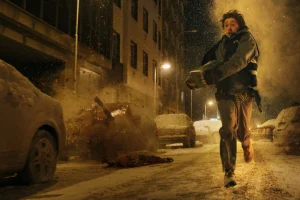
Around 150 custom-made pieces were created for Weiss, closely modeled on garments Kafka is known to have worn. These designs emphasized both Kafka’s fragility and his distinctive silhouette, while the dark blue tones served as a visual thread throughout much of the film. Black was reserved only for a pivotal late scene, in which Kafka symbolically confronts his own mythologized image.
The production also blended meticulously tailored reproductions with genuine period clothing. Hořejší, who has collected vintage garments for more than a decade, incorporated original pieces dating back 120 years. This mix lent authenticity to the film, while also evoking a sense of continuity between Kafka’s time and today.
Among the more striking costumes are a Japanese kimono worn by Milena Jesenská, Kafka’s swimwear, and a fur-trimmed scarf referencing his sisters. A hat by designer Vivienne Westwood also makes an appearance, underscoring Hořejší’s belief that fashion reflects enduring human passions rather than transient trends.
A European co-production with international scope
Franz is not only a Czech production but also an international collaboration. Alongside Prague-based Marlene Film Production, the film was co-produced with Germany’s X Filme Creative Pool and Poland’s Metro Films. Support came from major institutions including Barrandov Studio, Telewizja Polska, Czech Television, the Polish Film Institute, Canal+, and the Czech Audiovisual Fund, as well as Eurimages and regional film funds. Distribution in Czechia will be handled by Bioscop, while Films Boutique manages worldwide sales.
The project also attracted an ensemble cast of Czech and European actors, including Peter Kurth, Katharina Stark, Sandra Korzeniak, and Carol Schuler. Behind the camera, Holland collaborated with cinematographer Tomasz Naumiuk, editor Pavel Hrdlička, and composers Mary Komasa and Antoni Komasa Łazarkiewicz, whose score aims to reflect the tension between Kafka’s inner and outer worlds.
By combining fragments of Kafka’s life with dreams, letters, and stories, Holland’s film constructs what producers describe as a “sensory portrait” of a man who never stopped searching for himself. It is a portrait shaped not only through narrative but through texture, color, and the quiet power of costume. In Hořejší’s words, the clothes are not simply accessories, but a lens through which Kafka’s humanity—and his myth—are reexamined for a new century.