
An aging Hollywood star reevaluates his life choices during a trip to Europe to attend a tribute in Jay Kelly, which is now streaming on Netflix worldwide after receiving a limited theatrical release in the States last month. This Noah Baumbach dramedy feels a little more detached from its characters than the industry insider film it perhaps should have been, and misses the opportunity for the bitterly sharp, self-knowing satire of some of his best films (Marriage Story, Greenberg, The Squid and the Whale), but two powerhouse performances from George Clooney and Adam Sandler and a generally first-rate technical presentation sell the narrative regardless.
Clooney is Jay Kelly, the titular movie star of the variety they just don’t make any more—Gary Cooper, Clark Gable, he references at one point in the movie. He’s a genuinely nice guy, and one who has avoided the kind of controversies that plague’s today’s stars, but his commitment to making movies and becoming Hollywood’s biggest star has cost him relationships with friends and family.
Oh, boo hoo, you might be thinking right from the outset. It’s a sacrifice that many of us would gladly make—heck, many toil away at the cost of our personal relationships just to survive. There are far more interesting struggles experienced by the Hollywood elite, from scandal to addiction to outspoken political beliefs: the kind of real-world conflict experienced by today’s stars, and probably those of the Golden Age, too—they just had more effective PR in a pre-digital age.
As Jay Kelly opens, our star has just wrapped his latest movie, and has a rare two-week reprieve before his next one. He hopes to use the time to bond with daughter Daisy (Grace Edwards) after 18 years of missed time, but she has other ideas that include a trip across Europe with her friends. Jay’s older daughter Jessica (Riley Keough) is already somewhat estranged from her father, who was away making movies for most of her childhood too.
Jay doesn’t have many friends, either, and one of them has just passed away: Peter (Jim Broadbent), the director who gave a young Jay (played by Charlie Rowe in flashbacks) his first big break. A chance encounter with old acting school pal Timothy (Billy Crudup)—perhaps his last genuine friend, who has despised him since he landed that part in Peter’s film—has Jay reflecting on his life and career.
Under the guise of attending a tribute at a film festival in Tuscany, Jay plans an impromptu trip to Europe to see if he can tag along with his daughter. But he comes to realize that after abandoning everyone around him—on an emotional level, at least—over the course of his career, he has no one to celebrate his life’s accomplishments with. Well, except for devoted manager Ron (Sandler), who sacrifices his own personal life to look after Jay.
Jay Kelly has an embarrassment of acting talent on display, and also includes Laura Dern as Jay’s publicist; co-writer Emily Mortimer as his hairstylist; Stacy Keach as his father; Patrick Wilson as Ben Alcock, another of Ron’s clients who is also being feted in Tuscany; Isla Fisher as Ben’s wife, Greta Gerwig as Ron’s wife; Lenny Henry as Jay’s old acting coach; Eve Hewson as Daphne Spender, one of Jay’s old co-stars; Alba Rohrwacher as Jay’s film festival guide; and others.
Baumbach gives each of these characters their own little moment of quiet reflection—filtered through Jay’s perspective—and they all get a small chance to shine. Henry is especially memorable as the coach who tells the young Jay how hard it is to play oneself—one of the film’s key themes—as is Broadbent across two sequences: giving young Jay his big break, only to be politely rejected by him later in life, after his own star has fallen.
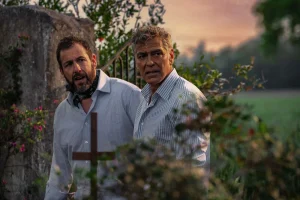
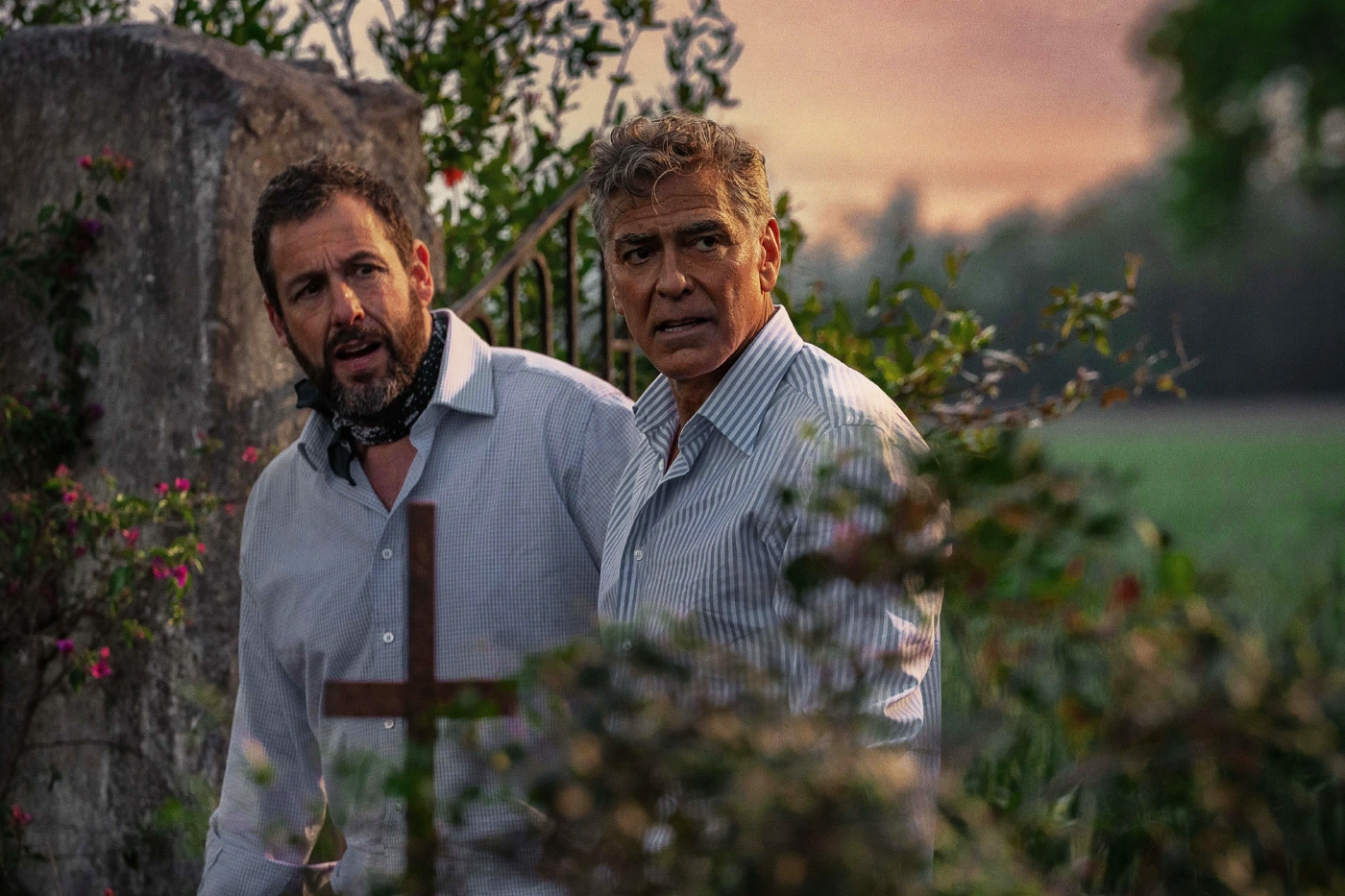
But Jay Kelly belongs to Clooney, and his effortless charisma keeps us entirely invested in what might otherwise be a bland and uninteresting characterization. He’s matched by Sandler as his put-upon manager, and climactic scenes between the two, in which Jay finally bares his teeth and reveals the kind of arrogance that has resulted in his condition, are the closest the film gets to any real bite—and, subsequently, heart.
Jessica calls Jay an “empty vessel” at one point, and we tend to agree: but perhaps not in the way Baumbach has intended. He is the image of the classic Hollywood star—a hero in real life and on the screen, beloved by the public and without controversy. But this character doesn’t exist in reality—it’s the public image, the glossy facade, of a real person rather than anything of substance.
We get some sense that the character is in some way a stand-in for Clooney himself, but even what little we know of Clooney’s personal life is more interesting than anything going on with Jay Kelly. In attempting to ascribe the struggles of a common man to this megastar, the film settles on an emotional arc that never really resonates; Sandler’s beleaguered agent becomes a much more compelling character by the end of the movie, which nevertheless serves tribute to the empty vessel as it leans on him for emotional support.
Despite an uneven emotional core, Jay Kelly remains a polished and engaging outing from Baumbach thanks to terrific performances across the board and lush cinematography from Linus Sandgren across a variety of European destinations. Clooney and Sandler anchor the story with engaging performances that bring real texture to the world around them, and while he film may not reach the heights of the director’s strongest work, it delivers a reflective portrait of fame that’s consistently enjoyable to watch.