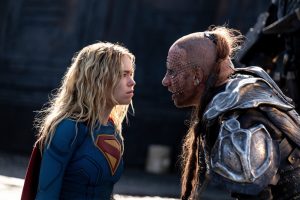


A group of orphans on the run from authorities in a dystopian future ravaged by a viral outbreak finds themselves at the doorstep of a mysterious woman in Please Don’t Feed the Children, which premiered at the Sitges Film Festival last year, debuted on Tubi in the States in June, and opens in Prague cinemas this Halloween weekend. Destry Allyn Spielberg—daughter of Steven Spielberg—displays a strong command of visual storytelling in her feature debut, but the narrative (from a script by Paul Bertino) starts off on shaky ground and takes its time going nowhere.
Please Don’t Feed the Children stars Zoe Colletti as teenager Mary, who runs down the basics in some sparse opening narrative: a cannibal virus has decimated the world’s adult population, while kids have displayed 99 percent immunity. You’d think the surviving adults would want to work with the future inheritors of the Earth on a path forward, but instead—in the southwestern U.S., at least—they round up all the orphans and place them in brutal internment camps.
How brutal are the camps? In a gruesome flashback that evokes Holocaust imagery that the film never earns, Mary’s pre-teen sister is shot in the head for daring to attempt escape. How and why this particular dystopian landscape evolved demands more explanation, but Please Don’t Feed the Children asks us to just accept what we’re told and move on.
Mary has managed to escape, and in the film’s opening scene, she’s attempting to board a bus to purported freedom in Mexico. While she remains hidden from gun-toting authorities, Jeffy (Dean Scott Vazquez), another random teen wandering around the area for reasons unexplained, happens to stumble upon her and blow her cover.
Jeffy leads Mary back to the local community center, where a small group of surviving orphans has created a makeshift home: his older siblings Ben (Andrew Liner) and Vicky (Regan Aliyah), and young couple Crystal (Emma Meisel) and Seth (Joshuah Melnick). Even if the background is not satisfyingly explored, the prospect of watching these teenagers attempt to make a life for themselves in a desert wasteland is promising.
The movie we get, however, is something completely different. After running out of gas following a botched gas station robbery, the group finds themselves stranded without resources in the New Mexico desert. “Look!” Jeffy says, pointing at the sprawling country home right in front of them that no one else has noticed. Salvation. Kindly matron Clara (Michelle Dockery) patches up Ben’s gunshot wound and bakes them all some fresh cookies.
Of course, the teens soon wake up imprisoned in Clara’s attic, while Mary finds herself dressed up in Clara’s dead daughter’s clothes. By the end of the first act, Please Don’t Feed the Children has completely abandoned its dystopian future premise: these teens might as well have been driving home from a Bad Bunny concert in Albuquerque as they stumble into the usual Texas Chainsaw Massacre/The Hills Have Eyes/Wrong Turn scenario.
Dockery (Downton Abbey) steals the film with her off-kilter performance, but she’s hardly Leatherface; these kids have so many opportunities to overtake her by strength or surprise, but never act (the script appears to have been written with younger protagonists in mind, while many of these actors are well into their 20s). Giancarlo Esposito has the thankless role of the local sheriff who comes to check on Clara after the kids’ vehicle is found by her property.
Spielberg displays a strong command of the visuals, with deliberate shot composition and careful framing that emphasizes both the isolation of the orphans and the vast, unforgiving landscapes of rural New Mexico. Shane Sigler’s cinematography nicely captures the desert locations, though much of the movie is confined to the central setting.
Despite these strengths, Spielberg struggles to generate sustained tension or horror, and the story loses momentum in the second half. Ultimately, Please Don’t Feed the Children is a film with striking images and moments of promise that never fully cohere into a satisfying whole, and meandering pacing and underdeveloped stakes make it hard to stay invested. It’s a visually sharp debut that bites off more than it can chew—and never really sinks its teeth in.